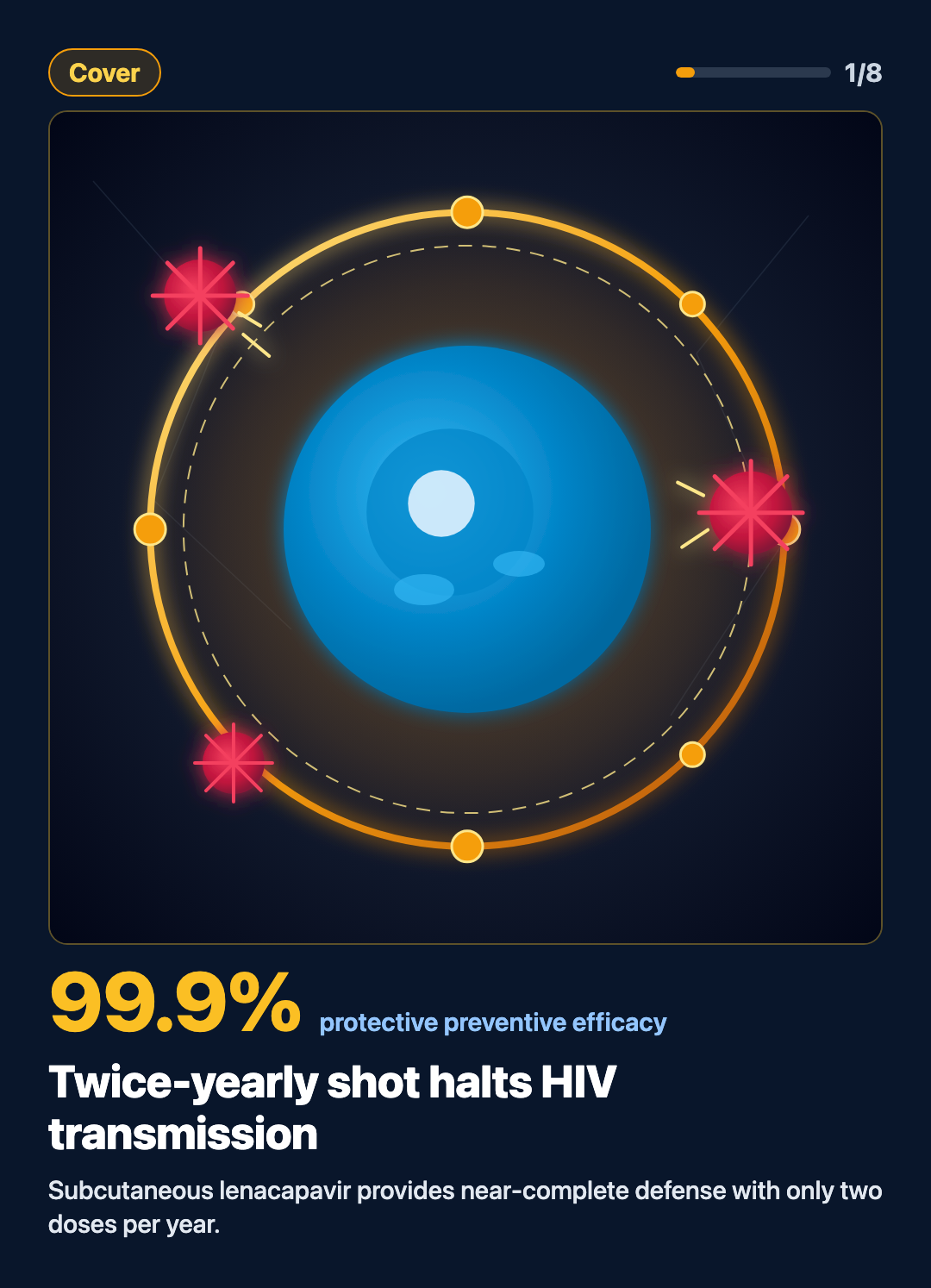
Twice-yearly injection paves the way to halting HIV transmission
1h
0 0Imagine carrying a vital security key with you every single day of the year, knowing that if you forget it on your kitchen counter just once, an intruder could break into your home. For decades, the global battle against HIV has been fought under that exact strain. Millions of people at risk must remember to swallow an antiviral prevention pill every single morning without fail. However, a major medical milestone was just achieved when an international clinical trial team from the PURPOSE 2 study published their findings in The New England Journal of Medicine on November 27, 2026. The researchers demonstrated that an innovative medicine administered as a subcutaneous injection just twice a year provides near-total protection against HIV transmission. HOW PREVENTIVE MEDICINE SHIELDS THE BODY To understand why this discovery sent shockwaves through the medical world, we need to look at how pre-exposure prevention currently operates. The gold standard today is pre-exposure prophylaxis. Individuals at high risk take daily antiretroviral pills to maintain a steady defensive concentration of medicine in their bloodstream. When HIV enters the body, these chemical guards intercept and prevent the pathogen from multiplying. Note – Pre-exposure prophylaxis: A preventive strategy of taking antiviral medicine before potential exposure to stop a pathogen from establishing an infection, much like wearing a bulletproof vest before stepping into danger rather than looking for bandages after being shot. The fundamental issue is that humans are not flawless machines. Swallowing a pill at the exact same hour every day for years on end poses a massive psychological burden. Many individuals miss doses due to busy work schedules, or feel ashamed to carry medicine bottles because of social stigma. When drug concentrations dip in the bloodstream, the defensive shield develops holes, allowing the virus to slip inside host cells. HOW A TWICE-YEARLY SHOT TRANSFORMS THE BATTLE A breakthrough drug called lenacapavir has fundamentally overturned the conventional paradigm. Rather than requiring users to swallow hundreds of pills every year, this new therapeutic requires only two subcutaneous injections, spaced six months apart. This approach turns HIV prevention into something as manageable as visiting the dentist twice a year for a routine cleaning. Note – Long-acting therapeutics: Formulations engineered to release active drug molecules very slowly into the bloodstream over several months, much like a large tea infuser steadily diffusing flavor into a giant pitcher all day long without fading. Crucially, this medication strikes a vulnerable structural feature of the virus that previous generations of drugs could not target. That target is the cone-shaped protein fortress encasing the genetic blueprints of the virus, known as the capsid. Note – HIV capsid: The rigid protein shell that shelters the genetic material of the virus, acting like the hard shell of an egg protecting the yolk inside while traveling through the air. RIGOROUS EVIDENCE CONFIRMS THE MOLECULAR PADLOCK Scientists discovered that lenacapavir functions like an exquisitely precise molecular padlock. The drug wedges itself into the seams between protein units of the viral capsid, locking the entire cone structure tight. Because the shell cannot dismantle itself, the virus cannot inject its infectious genetic payload into the human cell nucleus. Simultaneously, newly assembled virus particles fail to form complete protective shells, turning into harmless duds that the body quickly clears away. Note – Capsid inhibitor: A chemical compound that binds tightly to the outer protein shell of a virus and jams its machinery, much like jamming pebbles into a keyhole so the lock can never turn. To evaluate real-world efficacy, the international research consortium conducted a large-scale randomized, double-blind active-controlled trial. The study enrolled 3,265 participants across multiple countries globally, including cisgender men who have sex with men, transgender women, transgender men, and gender-diverse individuals facing elevated transmission risks. Note – Randomized double-blind trial: A gold-standard medical testing method where neither the participants nor the treating physicians know who receives the new drug versus the comparator, eliminating subjective bias entirely. The findings exceeded expectations across the scientific community. Among the 2,183 participants receiving twice-yearly lenacapavir, investigators observed merely 2 incident HIV infections throughout the follow-up period, translating to an extraordinarily low incidence of 0.10 infections per one hundred person-years. This marks a 96% reduction in infection risk compared to the background HIV incidence in the screened community. When benchmarked directly against participants taking daily oral Truvada, the twice-yearly injection demonstrated an 89% superiority in preventing infections. In terms of safety, the treatment was well tolerated, with side effects mainly limited to mild, transient injection-site bumps or redness. Note – Background HIV incidence: The baseline rate at which new infections naturally occur in a specific population without the intervention, serving as the benchmark to prove whether a treatment truly works. GLOBAL SIGNIFICANCE AND THE ROAD AHEAD This breakthrough provides a historic window of opportunity for global public health. For the first time in the four decades since the HIV epidemic began, humanity possesses a preventive tool offering 99.9% efficacy without demanding daily pill adherence. This molecular armor relieves millions from chronic anxiety and social prejudice. Vulnerable populations can now protect their well-being discreetly, with their dignity and privacy intact. Nevertheless, bridging the gap between clinical trial victory and widespread availability in community clinics will require several crucial steps. While these phase three results have earned peer-reviewed confirmation, regulatory agencies worldwide must still formally grant approval for preventive indications. Researchers must also continue tracking long-term safety metrics and monitoring for potential resistant viral strains as the drug scales up. The most critical challenge remains affordability and equitable global distribution. If the market price remains prohibitively high, lower-income communities in sub-Saharan Africa and Southeast Asia that bear the brunt of the epidemic will be excluded. The immediate next priority for international health organizations and policymakers is securing voluntary licensing agreements for generic production. Only by making this medicine affordable can a laboratory triumph become the tool that finally ends the HIV pandemic worldwide. SOURCES The New England Journal of Medicine – Twice-Yearly Lenacapavir for HIV Prevention in Men and Gender-Diverse Persons – https://doi.org/10.1056/NEJMoa2611858 Science – Breakthrough of the Year: The great work continues – https://doi.org/10.1126/science.adv1489 World Health Organization – Long-acting lenacapavir for HIV pre-exposure prophylaxis – https://www.who.int/news/item/lenacapavir-prep
0 комментариев
Ads
Похожие публикации

Zelensky offers halting refinery strikes for US Patriot missiles November 2026

Iran allegedly used Starlink against US forces as tanker hits mine November 2026

Taiwan ruling party rebounds, Netanyahu offers rotating premiership November 2026

The Blood-Brain Barrier Acts as a Smart Delivery Hub for the Brain

Taiwan votes under pressure, Riyadh intercepts Houthi cruise missile November 2026

Water-based batteries double storage capacity through a four-electron molecular carrier

Wall Street seals best week in a year as Bitcoin slips below 60000

US disables Iran blockade-runner, Germany locks in Ukraine aid November 2026

AI Designs Single Peptide Drugs That Unlock Two Disease Targets

Weekly Horoscope Nov 30–Dec 6, 2026: Restoring Order and Emotional Depth

China activates state funds as global equities and gold stage strong rally

Zelenskyy rebukes Trump on Putin, New Zealand election deadlocked November 2026

China industrial profits surge 20% lifting Asian equities in broad rebound

Ancient poisoned spears reveal unexpected prehistoric human ingenuity

Two Italians killed in Kuwait strike, EU picks ECB chief November 2026

Scientists Move a Cancer Drug Recipe From Yew Trees to Tobacco

Monthly Horoscope December 2026: Major Breakthroughs and Grounded Priorities

Vietnam stocks drop 58 points on US tariff proposal as European shares rebound

South Korea hikes rate to 3.25% as Asian equities rebound

South Korea hikes rates as tanker blast hits near Dubai November 2026
Ads