Ads
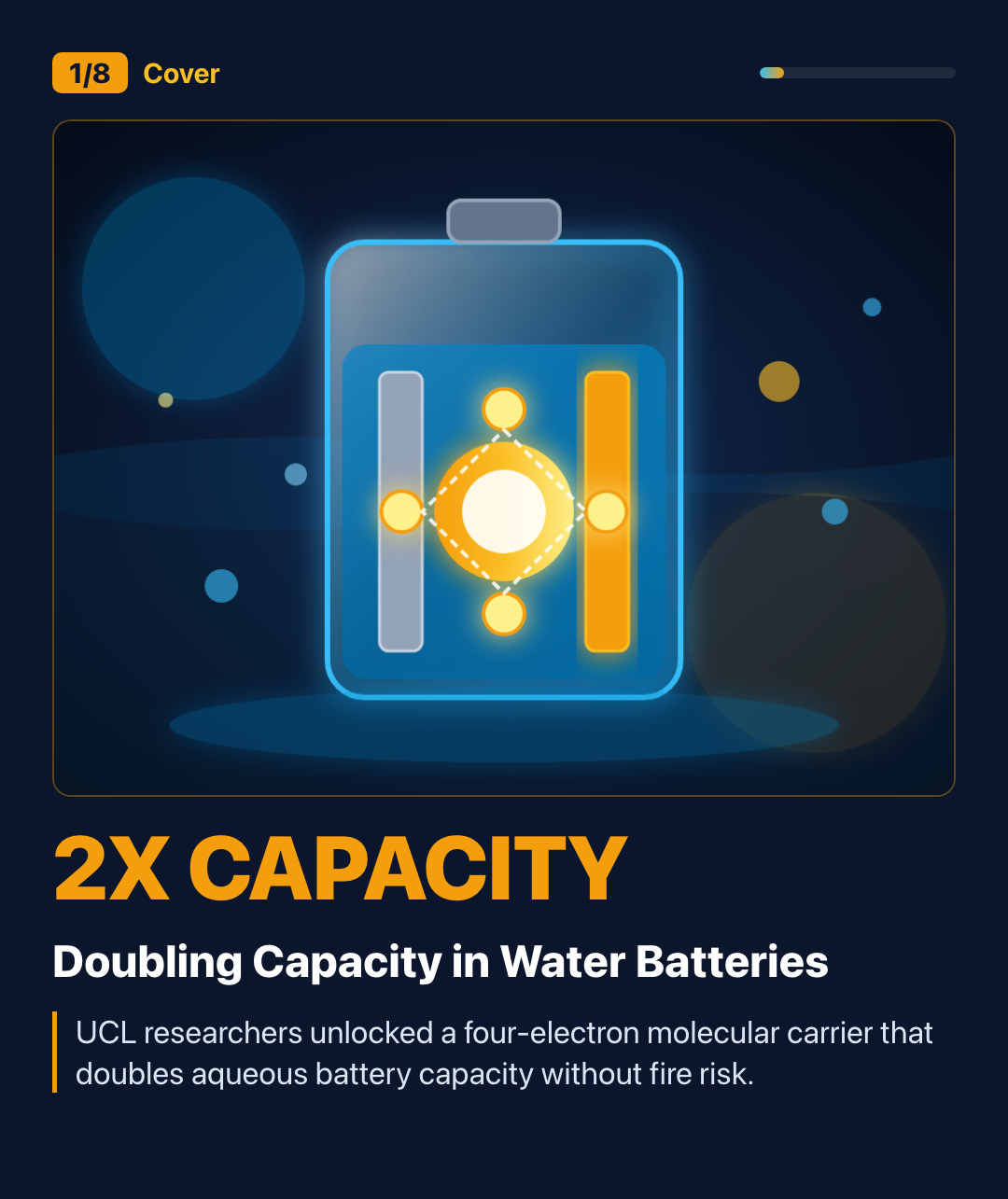
Water-based batteries double storage capacity through a four-electron molecular carrier
22 phút trước
00Imagine carrying a smartphone or driving an electric car without ever dreading that the battery pack under your feet could violently ignite. For decades, the dream of a safe, water-based rechargeable battery that is non-flammable and environmentally benign has stood as a holy grail of clean technology. On November 11, 2026, a research team led by Dr. Ruwei Chen and Professor Guanjie He at University College London published a milestone study in the journal Nature: they successfully unlocked a reversible four-electron redox reaction for iodine in water, effectively doubling the charge storage capacity of aqueous batteries without relying on dangerous corrosive chemicals.
BACKGROUND: WHY ARE WATER BATTERIES SO SAFE YET DISAPPOINTINGLY WEAK?
To appreciate why this advance matters, consider how conventional batteries work. Today's ubiquitous lithium-ion cells rely on volatile organic liquid electrolytes, functioning essentially like tiny, sealed fuel canisters that can catch fire if punctured, overheated, or short-circuited. By contrast, aqueous batteries use water-based solutions as electrolytes. Operating like a pool of calm water, they eliminate fire hazards at the source and remain completely non-flammable under all operating conditions.
Note – Aqueous battery: A rechargeable battery system that uses water-based solutions rather than flammable organic solvents as its liquid electrolyte. It operates like a safe reservoir where charged particles swim back and forth without fire risk, though its operating voltage has historically been limited by water decomposition.
Note – Electrolyte: The liquid or gel medium positioned between the two electrodes of a battery, acting like a highway river that allows charged ions to flow freely during charge and discharge cycles.
Yet aqueous batteries have long suffered from an Achilles heel: very low energy storage density. In conventional designs, energy-storing elements like iodine only exchange two electrons per cycle. It is as if a strong worker is only allowed to carry two light boxes per trip, leaving the overall energy capacity of the battery far lower than that of its flammable lithium-ion competitors.
NEW FINDING: A FOUR-ELECTRON CONVERSION DOUBLES CAPACITY
From fundamental chemistry, if each iodine particle could be induced to yield two additional electrons—transforming from iodide into a hypervalent iodine cation—the system would undergo a full four-electron conversion. This double-charge exchange would immediately double the theoretical storage capacity of the active material.
Note – Four-electron reaction: A chemical process where an atom or molecule exchanges four electrons simultaneously rather than the standard two. This functions like a delivery vehicle doubling its cargo payload in a single trip, drastically increasing energy density.
Note – Hypervalent iodine cation: A positively charged state of iodine that has shed multiple electrons. Highly reactive and fragile, these cations degrade rapidly upon contact with surrounding water molecules unless shielded by a specialized protective structure.
Historically, capturing this four-electron reaction in water was deemed nearly impossible. Once formed, hypervalent iodine cations react aggressively with surrounding water, destroying the battery's chemistry in seconds. Prior lab attempts required highly concentrated halogen-based solutions with intense acidity and corrosive salts, which damaged battery hardware and canceled out the environmental appeal of water batteries. The UCL team overcame this dilemma by engineering a non-halogen aqueous electrolyte framework that cradles and stabilizes hypervalent iodine in mild water.
EVIDENCE: MOLECULAR BODYGUARDS AND MULTI-LAYER CELL ENDURANCE
How did the London researchers achieve this molecular feat? They assembled a three-part team consisting of kosmotropic anions, polar anions, and nucleophilic molecules that function together like molecular bodyguards shielding the reactive iodine.
Note – Halogen bonding: A directional non-covalent attractive force between an electron-deficient region of a halogen atom and an electron-rich neighbor. It acts like a precision magnetic clamp, securing the iodine cation without altering its core chemical identity.
Note – Kosmotropic anion: A negatively charged ion capable of organizing neighboring water molecules into structured, tightly bound hydrogen-bonding networks, restricting water's ability to trigger unwanted side reactions.
Note – Polar anion: An asymmetrical negatively charged ion that gathers near the electrode surface to push free water molecules away, creating a water-deficient buffer zone that shields sensitive chemical intermediates.
During operation, polar anions gather at the electrode surface to create a localized water-deficient zone, functioning like an invisible umbrella that repels water droplets. Simultaneously, kosmotropic anions lock surrounding water molecules into rigid structures, freeing up nucleophilic molecules to form protective halogen bonds around the positive iodine cations. Cradled within this protective molecular carrier, iodine releases four electrons smoothly without being destroyed by water.
To validate performance under real-world conditions, the researchers demonstrated the framework in both zinc-iodine and aluminum-iodine battery formats. Moving beyond tiny coin cells, the team constructed multi-layer pouch cells comparable in structure to consumer device batteries. During rigorous endurance testing, the cells retained 96 percent of their initial capacity after 1,000 cycles and maintained 94 percent capacity across 2,000 consecutive charge-discharge cycles, providing peer-reviewed experimental proof of long-term durability.
MEANING FOR HUMANITY: A STEPPING STONE TOWARD SAFER CLEAN POWER GRIDS
This breakthrough arrives at a crucial moment for the global transition toward renewable energy. Solar and wind power are inherently intermittent: the sun sets each evening and wind gusts fluctuate unpredictably. To supply steady electricity around the clock, civilization requires massive stationary energy storage installations.
Using lithium-ion batteries for multi-megawatt grid storage facilities creates severe thermal runaway risks that necessitate isolated locations and expensive fire suppression infrastructure. Safe aqueous batteries with doubled storage capacity offer an ideal alternative, making it feasible to install multi-megawatt storage banks directly inside urban basements, substations, hospitals, and industrial centers without fire hazard.
Nevertheless, the road from university benches to commercial battery gigafactories will require several years of development. The present technology remains at the laboratory trial stage, demonstrated in prototype pouch cells. Scientists still need to identify lower-cost synthetic additives to lower manufacturing expenses and verify cycle endurance under freezing winter and sweltering summer temperatures. The authors are now collaborating with industrial engineering partners to scale up pouch cells toward commercial dimensions and assess full life-cycle economics on operational power grids.
SOURCES
Nature – Non-halogen aqueous electrolytes for four-electron iodine conversion – https://doi.org/10.1038/s41586-026-11282-0
University College London – Chemistry researchers unlock four-electron storage in water-based batteries – https://www.ucl.ac.uk/news/2026/nov/chemistry-four-electron-aqueous-batteries
ChemEurope – Breakthrough in aqueous battery electrolytes doubles capacity – https://www.chemeurope.com/en/news/1184920/aqueous-iodine-four-electron.html
0 comments
Ads
Related Posts
Ads