Ads
Scientists Move a Cancer Drug Recipe From Yew Trees to Tobacco
25 phút trước
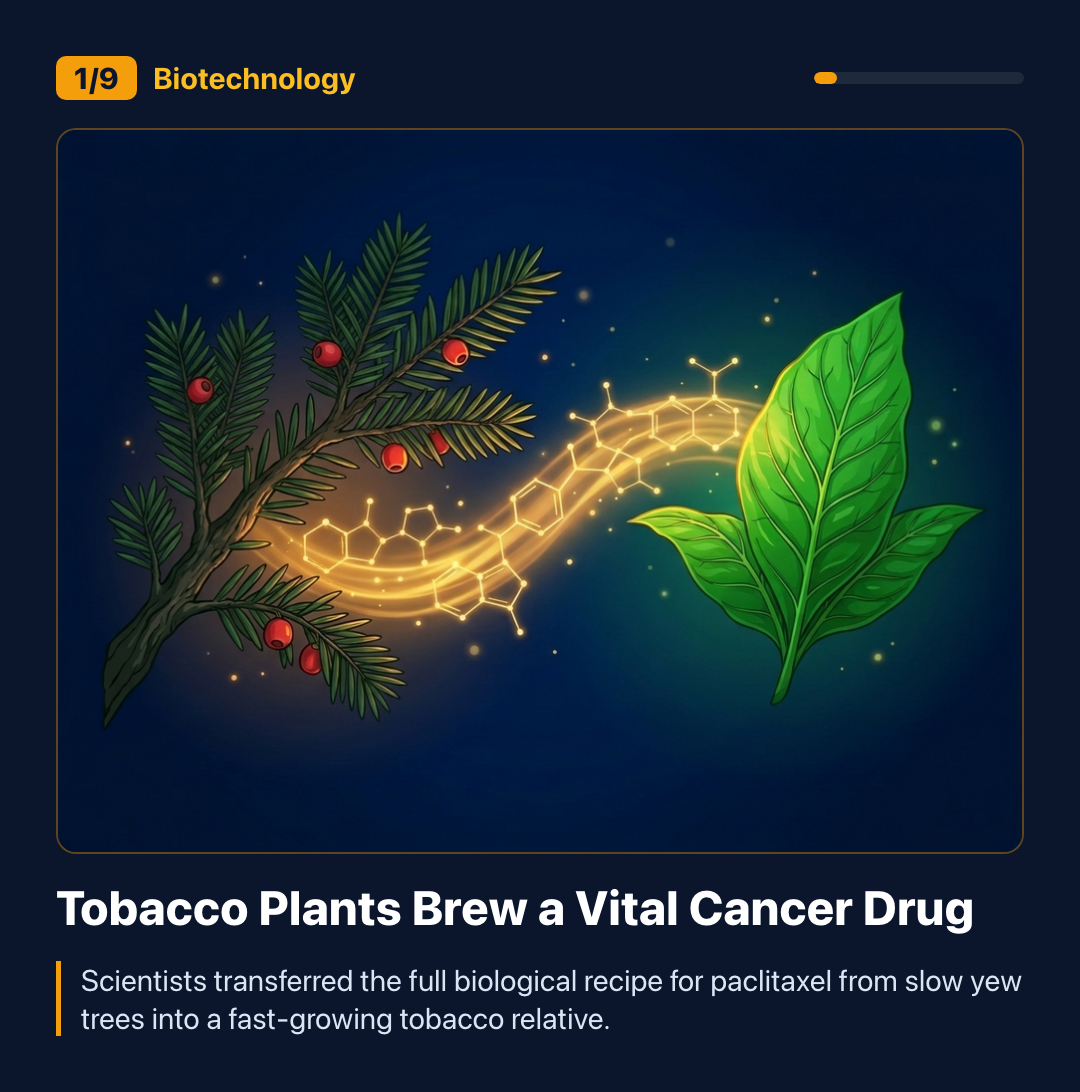
00Imagine a life-saving medicine locked inside the bark of a rare tree that takes decades to grow. Right next to it stands a leafy cousin of the tobacco plant that reaches full size in just a few weeks inside a greenhouse. What if scientists could copy the entire biological recipe from the slow tree and run it inside the fast-growing leaf.
That is the milestone achieved by researchers led by Professor Sotirios Kampranis, alongside co-authors Feiyan Liang and Zhen Fan at the University of Copenhagen, working with collaborators at the National and Kapodistrian University of Athens and international partners. In a peer-reviewed paper published in Nature Chemical Biology on November 23, 2026, the team reconstructed the complete natural production pathway of the cancer drug paclitaxel inside a fast-growing tobacco relative.
Note – Paclitaxel (Taxol): One of the world's cornerstone chemotherapy drugs, widely prescribed for breast, ovarian, cervical, and certain lung cancers. It works by freezing the internal scaffolding of tumor cells so they can no longer divide.
WHY WAS THIS DRUG SO HARD TO MAKE
Paclitaxel was originally discovered in the bark of the Pacific yew tree. The trouble is that Pacific yews grow painfully slowly and store only trace amounts of the compound in their bark, making wild harvesting unsustainable and costly. Meanwhile, the paclitaxel molecule is built like an intricate multi-tiered wedding cake, so synthesizing it purely from scratch with lab chemicals is commercially impractical.
Today, pharmaceutical factories still depend on yew cell cultures or chemical semi-synthesis from plant-derived starting materials. That long, delicate chain keeps paclitaxel among the costliest active medicines, limiting affordable access for patients in many lower-income countries.
Note – Chemical semi-synthesis: A hybrid manufacturing method that blends nature with chemistry, much like buying a plain sponge cake from a bakery and adding complex frosting at home. Manufacturers extract a related precursor molecule from plants and run multiple chemical reactions to turn it into the finished drug.
WHAT CHANGED WITH THIS DISCOVERY
For decades, scientists held only scattered pages of the yew tree's instruction manual. They understood parts of the beginning and end of the process, but lingering uncertainty surrounded which enzymes performed the middle steps and in what exact sequence.
The Copenhagen-led team filled in the missing pages. They introduced more than 20 yew genes into Nicotiana benthamiana, a fast-growing relative of the tobacco plant. Because it is also a plant, its cells offer a familiar kitchen environment capable of running the entire yew recipe in weeks rather than decades.
Note – Enzymes: Microscopic biological workers inside living cells, each specialized to handle a single chemical cut or join. If drug production were a car factory, each enzyme would act like a robotic arm tightening one exact bolt.
Note – Nicotiana benthamiana: A fast-growing relative of tobacco that scientists can easily program with new genes. Biologists often treat it as a living green test bench for prototyping plant-derived molecules.
HOW SCIENTISTS PROVED EVERY STEP WORKED
To prove the assembly line ran cleanly from start to finish, the researchers tested candidate enzymes directly inside plant leaves, isolated key intermediate compounds along the way, and verified their 3D atomic structures using nuclear magnetic resonance (NMR). That step-by-step chemical fingerprinting resolved long-standing disputes about the true catalytic order.
Note – Nuclear magnetic resonance (NMR): A molecular scanning technique that works much like an MRI machine for chemicals. Using strong magnets and radio waves, it maps how atoms are connected inside an invisible molecule.
While tracing the pathway, the team uncovered a crucial logistical surprise: the assembly line does not sit on a single workbench. Instead, critical reactions are split across four distinct cellular compartments — plastids, the endoplasmic reticulum, the cytosol, and peroxisomes — meaning intermediate ingredients must be shuttled in the right direction between rooms to keep production moving.
Note – Cellular organelles: Specialized, membrane-wrapped rooms inside a cell, much like a kitchen, pantry, and packing station inside one house. Each compartment maintains its own chemical conditions for specific jobs.
Guided by this cellular traffic map, the researchers re-engineered enzyme targeting and pathway coordination. In living plant experiments, those targeted adjustments boosted paclitaxel accumulation by more than 500-fold, jumping from an initial 0.104 micrograms to 61.05 micrograms per gram of dried plant material. Sixty-one micrograms per gram equals roughly 61 parts per million — like 61 tiny droplets in a million drops of water — yet it matches the natural concentration reported in yew tree bark.
WHAT THIS MEANS FOR HUMANITY AND THE ROAD AHEAD
Holding the complete genetic recipe opens a cleaner, potentially far more affordable route to manufacturing an essential cancer medicine. Instead of relying on slow-growing trees or heavy chemical conversions, researchers can now build on this blueprint to produce paclitaxel in greenhouse plants or transfer the pathway into fermented yeast cells. Professor Kampranis noted that wider affordability could especially benefit cancer patients in low-income countries where high drug costs remain a barrier.
Still, this work remains basic research and a proof of concept, not a new clinical treatment recommendation for patients. So far, the team delivered the yew genes into tobacco leaves only temporarily. Reaching industrial greenhouse production will require permanently integrating the genes into a stable plant genome so future generations inherit the trait automatically, deepening understanding of how intermediates cross compartment walls, and improving overall yield efficiency before commercial scale-up becomes viable.
SOURCES
Nature Chemical Biology – Complete biosynthesis and production of paclitaxel in a plant host – https://doi.org/10.1038/s41589-026-02376-x
EurekAlert! (University of Copenhagen) – Recipe for one of the world’s most important cancer drugs uncovered: Tobacco plants could produce the medicine – https://www.eurekalert.org/news-releases/1153014
Nature Portfolio (Nature Asia) – Biotechnology: Using plants to produce anticancer drug (Nature Chemical Biology) – https://www.natureasia.com/en/info/press-releases/detail/9488
Bioengineer.org – Scientists Reconstruct Complete Paclitaxel Biosynthetic Pathway in Engineered Tobacco Plants – https://bioengineer.org/scientists-reconstruct-complete-paclitaxel-biosynthetic-pathway-in-engineered-tobacco-plants/
0 comments
Ads
Related Posts
Ads