Ads
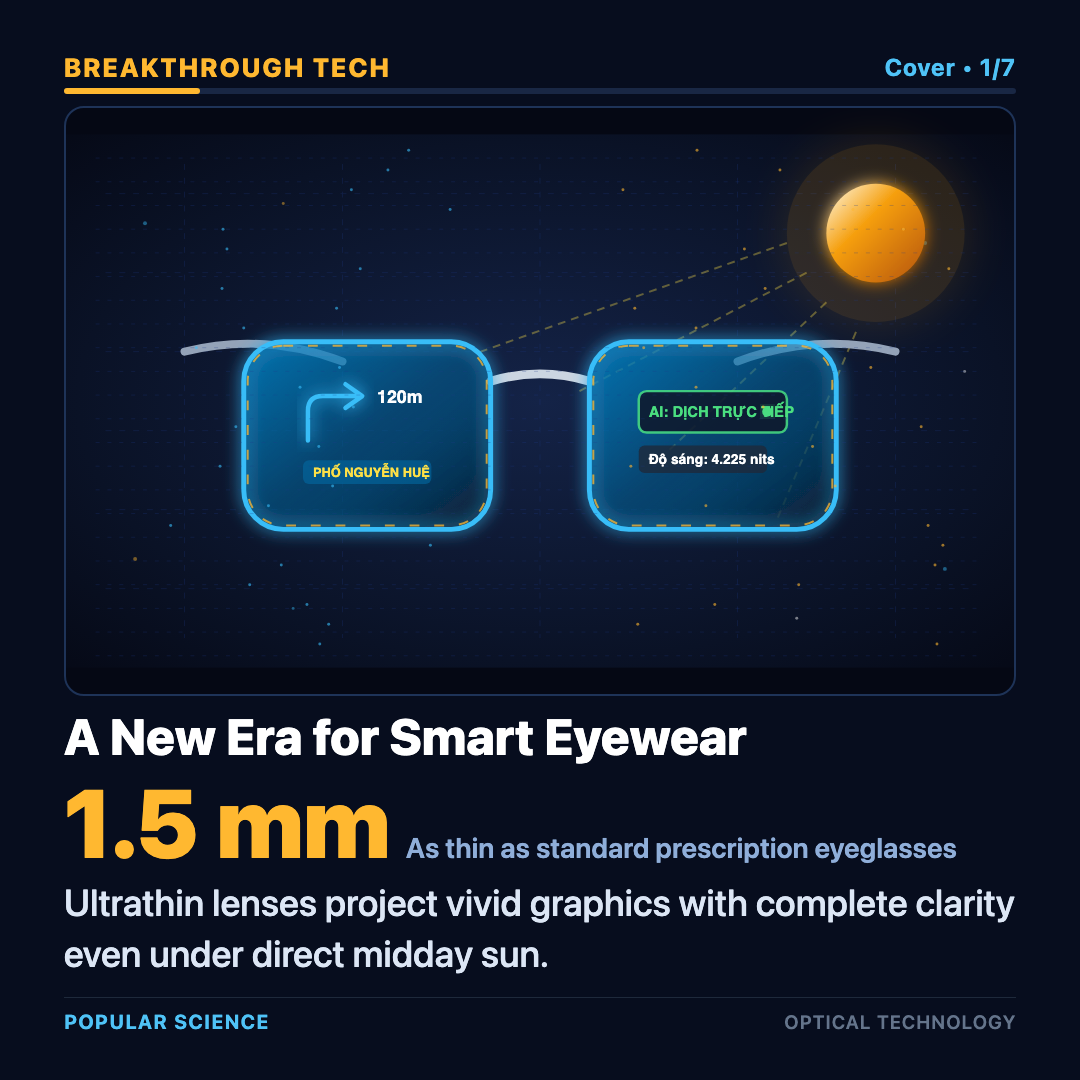
Ultrathin metasurface lenses bring bright augmented reality glasses into everyday sunlight
3 ngày trước
00ULTRATHIN METASURFACE LENSES BRING BRIGHT AUGMENTED REALITY GLASSES INTO EVERYDAY SUNLIGHT
Imagine strolling down a bustling city avenue under the glaring midday sun, wearing what looks like an ordinary pair of prescription glasses, while vibrant navigation arrows and real-time translations float crisply before your eyes. For over a decade, that seamless vision of wearable computing has crashed against a harsh physical wall: achieving readable displays in daylight required bulky projectors and heavy battery packs resembling welding goggles, whereas lightweight frames yielded dim, ghost-like projections that washed out instantly outdoors. On November eleventh, twenty twenty-six, a collaborative team from Pohang University of Science and Technology and Samsung Research published a breakthrough in the journal Nature, unveiling an ultrathin metasurface lens design that dismantles this long-standing optical compromise.
Note – Augmented reality glasses: Eyewear equipped with miniature transparent optics that overlay digital text, graphics, or maps onto the real world, functioning much like an illuminated heads-up film placed across regular eyeglasses.
WHY HAVE SMART GLASSES REMAINED BULKY AND DIM FOR SO LONG?
To transport digital imagery from a micro-projector hidden within the frame directly into the viewer's pupil, optical engineers rely on a flat glass component called an optical waveguide. You can picture this waveguide as a glass pipe for light: rays enter at the corner temple, bounce back and forth between the two polished surfaces via total internal reflection, and finally exit in front of the human eye.
Note – Waveguide: A transparent glass slab engineered to channel light rays from an edge projector directly into the viewer's eye, acting like a conduit pipe tailored specifically for photons.
Note – Total internal reflection: The optical phenomenon where light hitting the boundary of a medium at a shallow angle bounces back completely inside rather than escaping outwards, similar to a billiard ball ricocheting between two parallel rails.
However, conventional waveguides rely on surface relief gratings that resemble parallel plowed furrows in a farmer's field. These rigid grooves can only diffract light along a single fixed vector at each bounce. To spread the beam wide enough to fill the pupil, light must bounce dozens of times across multiple grating zones, causing more than ninety-five percent of the photons to leak out and dissipate. To compensate for this massive energy loss under direct sunlight, designers were forced to crank up projector brightness, requiring hefty battery bricks and cooling fans that weighed down the wearer's nose.
WHAT HAS CHANGED WITH INTERWOVEN METASURFACES?
Instead of carving monotonous straight grooves, the research team adopted an entirely different optical paradigm known as interwoven metasurfaces. They fabricated billions of tiny transparent silicon nitride ceramic pillars measuring just hundreds of nanometers across, smaller than the wavelength of the light traveling through them.
Note – Metasurface: An engineered ultra-thin surface patterned with sub-wavelength nanostructures designed to steer, rotate, or delay light in ways unattainable with conventional natural lenses.
Note – Silicon nitride: A robust, highly transparent ceramic compound commonly utilized in advanced semiconductor fabrication and precision optics for its stability and refractive strength.
While traditional etched grooves act like a one-way railway track, each nanopillar in this novel architecture functions like a miniature intelligent traffic intersection. By tailoring the dimensions and orientations of individual pillars across the glass, the researchers engineered multiple grating vectors simultaneously within a single layer. Light from the micro-display is guided multidirectionally in a synchronized fashion, expanding across the viewing box while keeping parasitic light leakage to an absolute minimum.
HOW DID EXPERIMENTAL EVIDENCE PROVE THE BREAKTHROUGH?
The team from POSTECH and Samsung demonstrated their concept through a fully functioning prototype built around a dual-layer silicon nitride architecture. One layer is tuned to guide blue and green wavelengths, while the second layer pairs green and red light to compensate for the higher propagation attenuation inherent to red light. Each layer is partitioned into twenty-nine distinct optical zones, each featuring an optimized local arrangement of nanopillars calibrated for specific entrance and exit angles.
Laboratory optical measurements revealed an average luminance efficiency of one thousand nine hundred thirty-eight nits per lumen, peaking at an impressive four thousand two hundred twenty-five nits per lumen in optimal regions. This performance surpasses commercial diffractive waveguides by a wide margin. Remarkably, this dual-layer stack measures just one point five millimeters thick, indistinguishable in profile from regular prescription eyewear.
Note – Nits per lumen: A metric quantifying how effectively input optical power is converted into perceived brightness, measuring how dazzling an image appears to the human eye for every unit of light energy supplied.
Real-world field trials conducted under harsh midday sunlight proved that virtual text, navigational arrows, and high-contrast symbols remained vivid, crisp, and easily legible without squinting. Furthermore, the prototype delivered an eyebox measuring eight by eight millimeters square, providing generous freedom for the pupil to glance naturally around without the virtual screen flickering or clipping out of view.
Note – Eyebox: The three-dimensional spatial volume in front of the lens where the user's eye can roam freely while still perceiving the complete, uncropped virtual display.
WHAT DOES THIS MILESTONE MEAN FOR HUMANITY?
This achievement demonstrates that comfortable, all-day smart eyewear wearable from morning to evening is physically and optically achievable. In the near future, visually impaired individuals could receive real-time hazard warnings directly in their line of sight; surgeons could reference vital scans overlaid onto the operating field without turning away; and travelers could navigate foreign cities with live translated subtitles projected naturally before them.
Nevertheless, transitioning from a pristine cleanroom prototype to store shelves involves key developmental milestones. The prototype currently provides a thirty-degree diagonal field of view, which is well-suited for notifications and navigational prompts but not yet wide enough for fully immersive virtual landscapes. Additionally, patterning billions of sub-micron pillars across large lenses demands scalable deep-ultraviolet lithography and nanoimprint techniques to bring production costs down to consumer levels over the coming years. The research consortium is now focused on widening the field of view and optimizing manufacturing methods to bring this technology into everyday reality.
SOURCES
Nature – Metasurface waveguides for all-day augmented reality glasses – https://doi.org/10.1038/s41586-026-11277-x
EurekAlert – Ultra-thin metasurface waveguide brings all-day AR glasses closer to reality – https://www.eurekalert.org/news-releases/1064215
ResearchGate – Metasurface waveguides for all-day augmented reality glasses – https://www.researchgate.net/publication/385732105_Metasurface_waveguides_for_all-day_augmented_reality_glasses
0 comments
Ads
Related Posts
Ads