Ads
Dead star radio pulses unveil magnetic storms on a Sun-like companion
2 ngày trước
00THE MYSTERY OF SLOW COSMIC RADIO PULSES IN DEEP SPACE
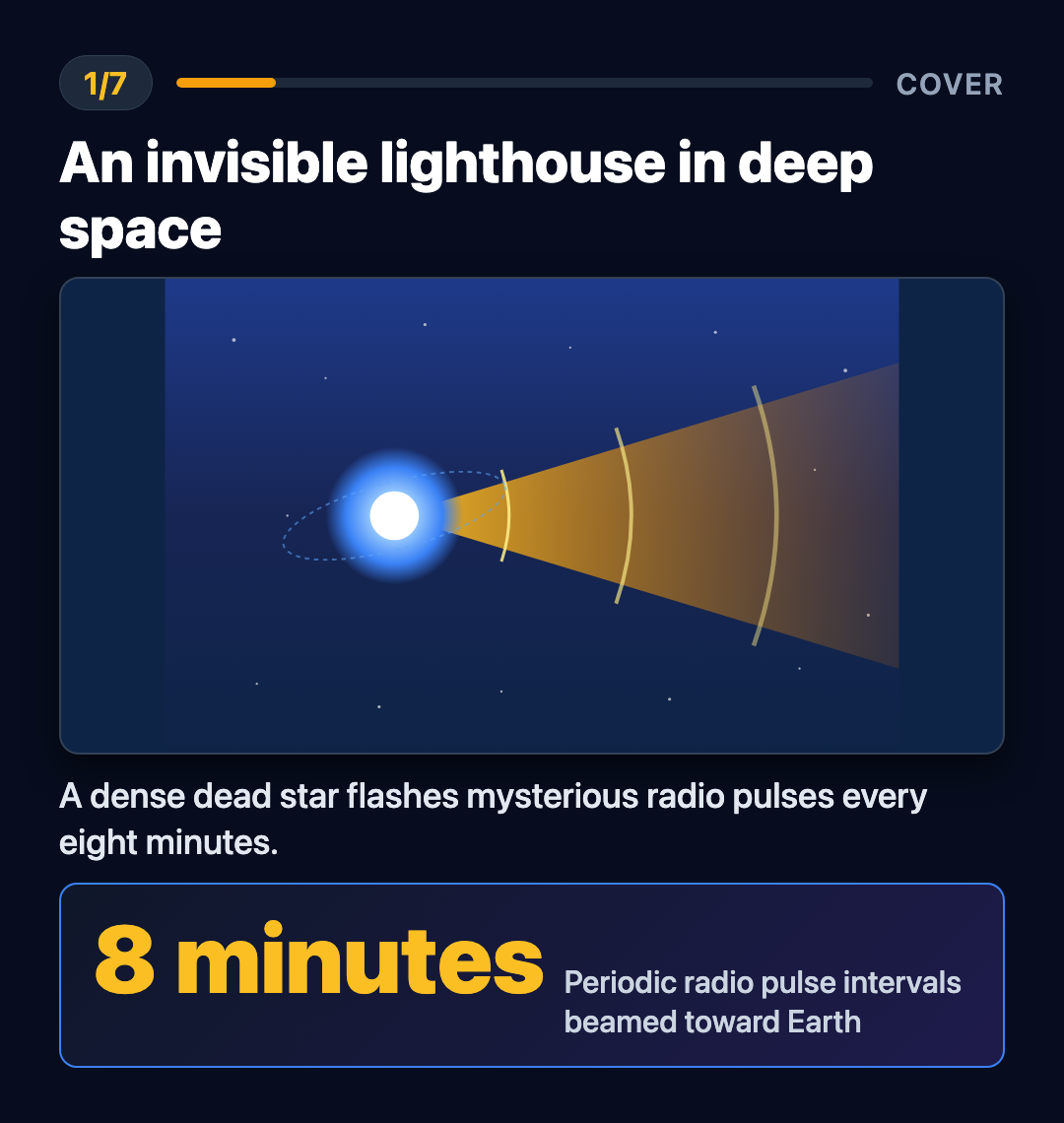
Imagine floating in the middle of a pitch-black ocean at midnight. Every eight minutes, a distant, invisible lighthouse flashes a beam of energy sweeping across the waves. You cannot see the tower, only rhythmic flashes timed as precisely as a giant cosmic pendulum. For years, astronomers worldwide have been puzzled by such slow, recurring radio signals emerging from deep corners of the Milky Way.
Note – Cosmic radio waves: energy waves similar to television or Wi-Fi signals but produced naturally by celestial bodies, allowing scientists to tune in to invisible cosmic events.
On November 12, 2026, in the journal Nature Astronomy, an international research team led by Dr. Samuel J. McSweeney at Curtin University and the International Centre for Radio Astronomy Research (ICRAR) published the answer to this cosmic puzzle. They identified the true nature of a stellar system named GPM J071507-114153, located roughly five thousand light-years away from Earth.
Historically, known cosmic lighthouses like pulsars spin in milliseconds or seconds. When astronomers first uncovered sources pulsing every few minutes, theories suggested they had to be ultra-magnetic neutron stars nearing the end of their lives. Few expected an ordinary dead star core could generate such powerful, periodic radio signals.
Note – Long-period transient: mysterious celestial sources flashing in radio waves every few minutes to tens of minutes, thousands of times slower than typical rotating stars.
A COMPACT DEAD STAR PULSING EVERY EIGHT MINUTES
Observational evidence from the new study overturned that longstanding assumption. The source is not a violent neutron star, but a dense white dwarf orbiting a companion star remarkably similar to our own Sun.
Note – White dwarf: the dense remnant core left behind when a star exhausts its fuel, holding the Sun's mass squeezed into a sphere the size of Earth, like compressing a heavy dump truck into a single pea.
Note – Sun-like star: a main-sequence star possessing mass, size, and surface temperature similar to our Sun, where magnetic storms can directly influence surrounding space environments.
This binary stellar pair functions with mechanical precision. Approximately every 7.9 to 8 minutes, the white dwarf emits a bright pulse of coherent radio waves aimed toward Earth. The system remains active for about six hours, then goes silent for roughly twenty-six hours before repeating its cycle.
LIGHT TRAVEL-TIME DELAYS REVEAL THE CULPRIT
How could astronomers prove beyond doubt that the pulses originate from the tiny white dwarf rather than the companion star or an unrelated background object? The answer lies in a subtle optical physics phenomenon known as the light travel-time delay.
The team utilized the Murchison Widefield Array in Western Australia and the MeerKAT radio telescope in South Africa, paired with optical data from the W. M. Keck Observatory in Hawaii, tracking the system over more than one hundred hours. Supercomputing facilities at the Pawsey Centre processed the massive radio dataset.
Note – Light travel-time delay: the phenomenon where signals arrive seconds earlier or later depending on whether an orbiting source is moving toward or away from the observer.
The measurements revealed the two stars orbit each other every thirty-two hours. When the white dwarf travels along the orbital arc moving toward Earth, its radio pulses arrive a few seconds earlier than expected. Conversely, when it moves away along the opposite arc, the pulses arrive a few seconds later. This timing drift matches the thirty-two-hour orbit down to the second, providing undeniable proof that the white dwarf is the true emitter.
A COSMIC SCANNER FOR MAGNETIC STORMS AND SOLAR DESTINY
This discovery offers scientific value far beyond identifying a single radio emitter. During their orbital dance, the white dwarf regularly passes behind the outer atmosphere and magnetic structures of its Sun-like companion. As the sharp radio beam cuts through glowing plasma streams, the waves bend and disperse. This process effectively turns the white dwarf into a natural cosmic CT scanner.
Note – Stellar prominence: giant loops of magnetized plasma arching hundreds of thousands of kilometers above a star's fiery surface along magnetic field lines.
By analyzing the dispersed radio beams, scientists obtained the first direct measurements of magnetic field structures and solar flares on a Sun-like star five thousand light-years away. This provides astrophysicists with fresh insights into how stellar dynamos trigger extreme space weather and how radiation storms shape planetary atmospheres.
The finding also illuminates the distant destiny of our own solar system. In roughly five billion years, our Sun will consume its nuclear fuel and collapse into a white dwarf. Observing an active binary system in this evolutionary state gives researchers tangible evidence of how stars and planetary remnants behave over cosmic timescales.
Nevertheless, this remains basic exploratory astrophysics, far removed from everyday consumer technology. Scientists still need to decipher the exact physical engine powering such slow, intense radio emissions from a cooling white dwarf. The next step for the research team is to harness the upcoming Square Kilometre Array to survey the southern sky and track down similar binary systems across the galaxy.
SOURCES
Nature Astronomy – A long-period transient with a Sun-like companion – https://doi.org/10.1038/s41550-026-03016-z
Curtin University / ICRAR – Discovery of a long-period transient orbiting a Sun-like star – https://www.icrar.org
Murchison Widefield Array – Radio astronomy survey data – https://www.mwatelescope.org
0 comments
Ads
Related Posts
Ads