Ads
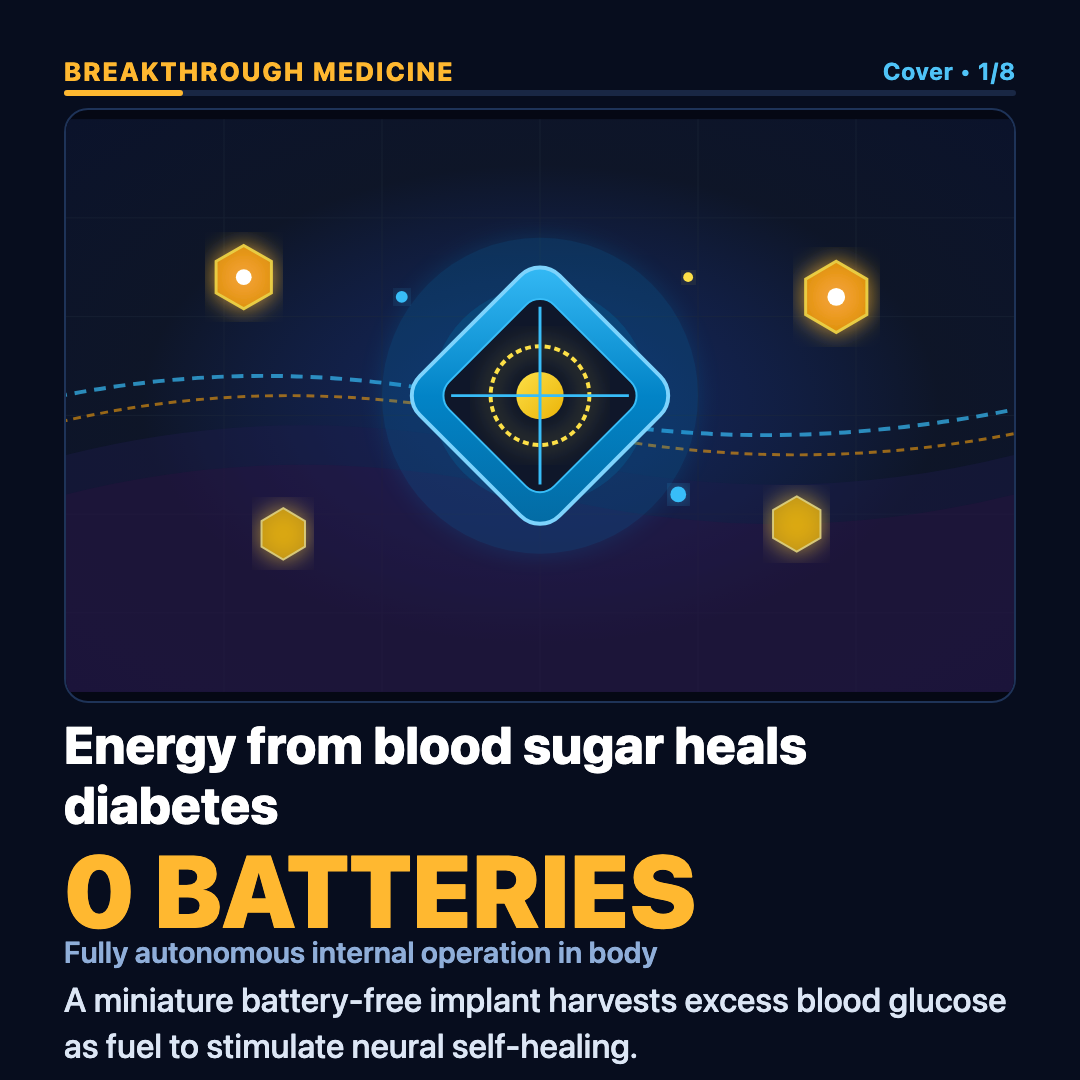
Battery-free implant turns blood sugar into energy to treat diabetes
4 ngày trước
00Imagine your body as a bustling metropolitan city where excessive blood sugar acts like floodwaters threatening to damage highways and vital infrastructure. Instead of deploying bulky external machinery to siphon away the water, an international research team has engineered a microscopic electric waterwheel that taps directly into that flood stream. The miniature machine requires zero batteries, runs autonomously on the very glucose it seeks to control, and uses that harvested bioelectricity to trigger an internal alarm that guides the body back into metabolic balance.
This bioelectronic milestone, named NeuroAxis, was developed by a team led by researchers at the National University of Singapore and Nanjing University of Posts and Telecommunications, and published in the journal Nature on November 18, 2026.
WHY THIS MATTERS AND THE OLD STRUGGLE
More than five hundred million people worldwide live with diabetes today. In their bodies, the pancreas either fails to produce enough insulin to escort glucose into cells, or the cells become resistant to insulin cues. Trapped in circulation, excess sugar sparks persistent low-grade chronic inflammation that silently damages microvessels, eyes, kidneys, and the heart. For generations, medicine has relied on external interventions: finger-prick blood tests multiple times daily, rigid medication schedules, and lifelong insulin injections.
In recent years, bioelectronic medicine emerged as an inspiring drug-free alternative: stimulating the vagus nerve to send natural biological commands that suppress inflammation and prompt glucose uptake. However, existing implantable stimulators share a fatal Achilles heel: rigid chemical batteries. Battery packs are bulky, stiff, prone to chemical degradation, and inevitably demand invasive revision surgeries every few years simply to be replaced.
Note – Vagus nerve: The longest information highway in the body that connects the brain to internal organs like the heart and gut, acting like a master telecommunication cable that helps regulate inflammation and metabolic balance.
Note – Bioelectronic medicine: A therapy approach using targeted micro-electrical pulses on nerves instead of chemical pharmaceutical drugs, akin to flipping an internal biological switch to stimulate self-repair.
THE DUAL-FUNCTION BREAKTHROUGH
The research team inverted traditional bioelectronic design by transforming the pathological culprit into the fuel source. The NeuroAxis implant contains no battery at all; instead, it incorporates a flexible enzymatic biofuel cell. Once implanted into living tissue, this biological turbine contacts surrounding interstitial fluid, converting ambient glucose molecules into a steady stream of bioelectricity.
The engineering brilliance lies in eliminating separate, power-draining glucose sensors. As blood glucose levels spike, the fuel cell output surges proportionally, raising the device terminal voltage in real time. The voltage level itself becomes an accurate, self-powered glucose monitor. When the voltage remains above a threshold of zero point six volts for five consecutive measurements across two and a half hours, the microcircuit recognizes a sustained glycemic spike. It promptly discharges stored energy from a microcapacitor, sending calibrated biphasic pulses directly to the vagus nerve. The entire closed-loop cycle runs autonomously without any patient intervention or external programming.
Note – Biofuel cell: A miniature device that generates electricity directly from chemical substances present inside living bodies, much like a waterwheel generating power from a flowing stream rather than relying on a heavy battery.
Note – Closed-loop feedback: An autonomous system that continuously senses and responds without human intervention, similar to a modern thermostat that automatically turns on cooling when a room overheats and turns off once normal temperature returns.
HOW SCIENTISTS PROVED THE CONCEPT
The findings successfully passed peer review in Nature following extensive preclinical animal investigations. Researchers fabricated an ultrathin, self-healing polymer cuff electrode that gently wraps around the rodent vagus nerve trunk without causing tissue fibrosis or nerve constriction.
Tested in established rat models of both type one and type two diabetes, NeuroAxis delivered remarkable therapeutic benefits. In type one diabetic models, regular ten hertz electrical stimulation dampened destructive autoimmune responses, fostering the survival and regeneration of insulin-producing pancreatic beta-cells. In type two diabetic rats, the pulses reprogrammed proinflammatory macrophages, dramatically quelling systemic inflammation and restoring insulin sensitivity across liver and muscle tissues. Blood sugar stabilized within healthy margins, and this improved glucose tolerance persisted even after stimulation was halted.
Note – Neuroimmune axis: The communication network connecting the nervous and immune systems, functioning like an emergency control room where neural signals instruct defense cells to quiet inflammatory damage.
WHAT THIS MEANS FOR HUMANITY AND THE ROAD AHEAD
This achievement provides a transformative blueprint for implantable medical devices that coexist symbiotically with the human body for life without battery depletion. If fully translated into clinical practice, millions of diabetic patients could one day be liberated from daily injections and painful monitoring routines, drastically reducing the risk of blindness, kidney failure, and cardiovascular disease. The underlying self-powered bioelectronic architecture could also be adapted to treat chronic inflammatory bowel diseases and cardiovascular conditions.
Nevertheless, significant steps remain between rodent laboratories and clinical care, demanding years of rigorous follow-up. This work represents early-stage basic research in rodents and is not an approved therapy; current clinical diabetes regimens must not be altered based on these findings. Human nerves and physiological fluid volumes are vastly larger and more intricate than those of rats. Scientists must rigorously assess the multi-year durability of nanoscale catalysts and ensure electrodes resist biofouling in complex biological environments. The team plans to advance testing into larger animal models before contemplating first-in-human clinical trials.
SOURCES
Nature – A glucose-powered artificial neuroimmune axis for metabolic control – https://doi.org/10.1038/s41586-026-11251-7
Medical Xpress – Battery-free bioelectronic implant taps blood glucose to treat diabetes – https://medicalxpress.com/news/2026-11-battery-free-bioelectronic-implant-glucose-diabetes.html
OncoDaily – Researchers engineer glucose-fuelled artificial neuroimmune axis for metabolic control – https://oncodaily.com/news/researchers-engineer-glucose-fuelled-artificial-neuroimmune-axis-for-metabolic-control
0 comments
Ads
Related Posts
Ads