Ads
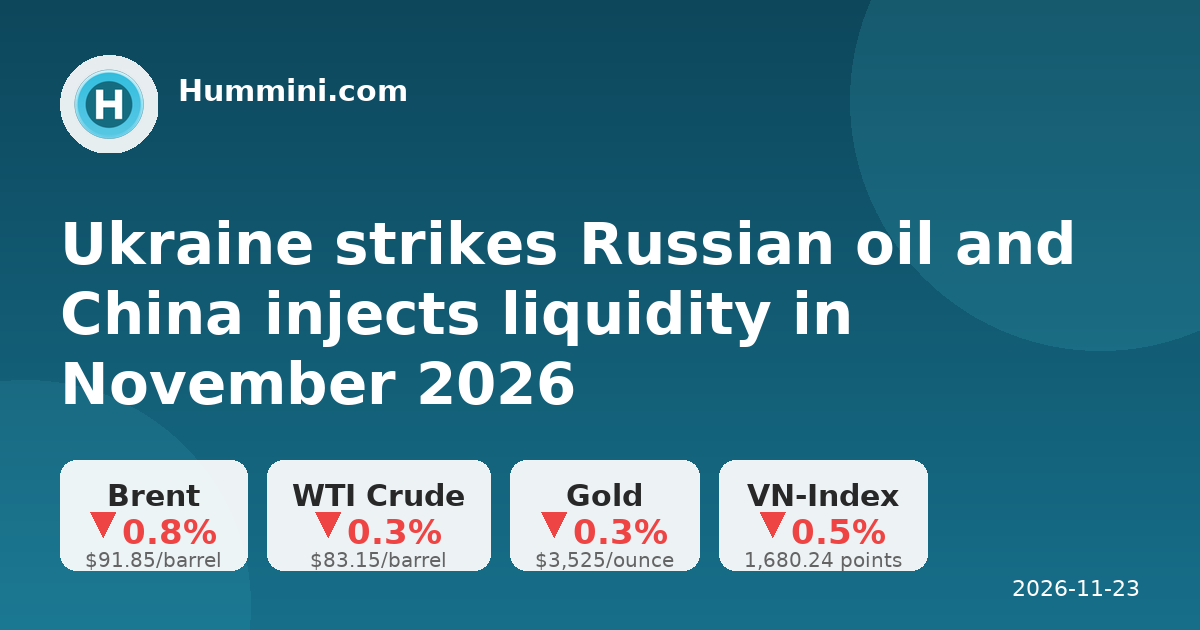
Ukraine strikes Russian oil and China injects liquidity in November 2026
4 ngày trước
00WORLD TEMPERATURE
4/5. Ukraine's deep strikes on Russian oil infrastructure, military warnings of a multi-front Middle East conflict, and China's emergency liquidity measures keep global geopolitical and financial risks elevated.
BRIEFING
Updated from 05:00 to 12:00 on November 23, 2026 (Hanoi time), covering only new stories and developments.
1. Long-range Ukrainian drones struck Russia's Novoshakhtinsk refinery in Rostov and the strategic Kaleikino oil pumping station over 1,300 kilometers deep in Tatarstan.
2. Chinese regulators lowered stock margin requirements to 80% effective November 30, unlocking roughly 400 billion yuan in liquidity to counter market sell-offs.
3. Newly revealed intelligence showed Alice Huang in the Nvidia scandal maintained contact with a Chinese state security officer for over a year during her affair with Jensen Huang.
4. Israeli military intelligence formally warned Prime Minister Benjamin Netanyahu that launching a strike against Iran risks triggering an unmanageable multi-front war.
5. Hours after the corvette Merkury sank, an uncrewed sea drone struck the cargo ship Ascalon off Benghazi, prompting an urgent United Nations warning against proxy conflicts.
6. UN Secretary-General António Guterres affirmed that the COP31 deadlock does not void Paris Agreement obligations as the European Union prepares unilateral carbon border tariffs.
1. UKRAINE LAUNCHES DEEP DRONE STRIKES ON RUSSIAN REFINERY AND OIL PUMPING HUB
Long-range Ukrainian attack drones struck the Novoshakhtinsk oil refinery in Russia's Rostov region and the strategic Kaleikino oil pumping station in Tatarstan early on November 23, according to The Kyiv Independent and Reuters.
In Rostov Oblast, roughly 200 kilometers from the front lines, overnight drone strikes triggered heavy explosions and ignited fires at the Novoshakhtinsk petrochemical plant, a primary fuel supplier for Russian forces in southern sectors. Simultaneously, another wave of uncrewed aircraft flew more than 1,300 kilometers deep into Russian territory, hitting the Kaleikino pumping hub near Almetyevsk in the Republic of Tatarstan. The facility serves as a vital junction feeding crude into the Druzhba export pipeline network. Regional authorities in Rostov and Tatarstan confirmed air defense activations, local flight restrictions, and emergency firefighting efforts. Russian defense sources stated that electronic warfare and interceptors shot down incoming drones, though falling debris ignited localized blazes. Earlier in the night, Russian forces launched their own strikes against power substations across Ukraine's Dnipropetrovsk region and outlying districts of Kyiv.
The cross-border strikes escalated as sub-zero winter temperatures arrived, with both belligerents systematically targeting power grids and fuel depots to degrade logistical resilience.
Strategic significance: Repeatedly reaching industrial targets deeper than 1,000 kilometers demonstrates that Kyiv's domestic long-range drone capabilities have matured to offset Western missile constraints. By pressuring vital transit hubs like Druzhba, Ukraine aims to choke Russian fossil export revenues while forcing Moscow to disperse scarce air defenses away from frontline battlefields to protect deep domestic infrastructure.
2. CHINA CUTS MARGIN REQUIREMENT TO 80% TO UNLOCK 400 BILLION YUAN LIQUIDITY
The China Securities Regulatory Commission and three major bourses announced a reduction in the minimum margin-buying ratio from 100% to 80% effective November 30, according to Xinhua News and South China Morning Post.
The policy applies across the Shanghai, Shenzhen, and Beijing stock exchanges for both new and existing margin contracts, raising maximum investor leverage to 1.25 times. Financial analysts estimate the easing will liberate roughly 400 billion yuan, or around $60 billion, in liquidity to bolster mainland A-share markets. In tandem with the margin adjustment, the exchanges introduced widespread fee reductions, waiving data center charges, listing levies, and bond transaction costs to reduce operating expenses for brokerages.
The move reverses strict margin rules imposed in January 2026, arriving as outstanding margin balances dropped more than 20% from summer peaks and Asian markets navigated volatility spilling over from Wall Street's worst weekly technology rout in 18 months.
Strategic significance: This decisive intervention reveals Beijing's intent to insulate domestic equity markets from global financial contagion. By lowering margin barriers and reducing transactional overhead, Chinese policymakers are seeking to stabilize capital access for domestic technology firms while encouraging institutional participation amid deepening tech frictions with Washington.
3. NVIDIA SCANDAL ESCALATES AS ALICE HUANG LINKED TO CHINESE STATE SECURITY
Fresh reporting on November 23 from The New York Times and Reuters revealed that Alice Huang, a central figure in the Nvidia corporate crisis, maintained direct contact with a Chinese Ministry of State Security officer for over a year.
U.S. intelligence findings indicated that communications spanned from spring 2025 through autumn 2026, coinciding directly with her extramarital affair with former Nvidia CEO Jensen Huang. Alice Huang previously led Megaspeed International, a Singapore-based enterprise that purchased large volumes of Nvidia processors. Federal authorities are investigating whether the firm's network diverted advanced H200 artificial intelligence chips into China via Southeast Asian data hubs in breach of export controls. Appearing on Sunday talk shows, Treasury Secretary Scott Bessent and Director of National Intelligence Jay Clayton confirmed ongoing inquiries, noting that definitive conclusions regarding formal espionage directives remain pending. While President Donald Trump publicly suggested granting Jensen Huang a second chance, Nvidia's board firmly ruled out reappointing the former chief executive.
Strategic significance: This disclosure demonstrates that the semiconductor battle between the two superpowers has shifted from standard tariff policies into targeted counterintelligence scrutiny of corporate boardrooms. Regardless of political overtures from the White House, U.S. national security agencies are poised to tighten oversight on Southeast Asian distribution channels, forcing semiconductor giants to audit third-party hardware intermediaries.
4. ISRAELI MILITARY INTELLIGENCE WARNS OF MULTI FRONT WAR RISK OVER IRAN STRIKE
Israeli military intelligence warned caretaker Prime Minister Benjamin Netanyahu that launching an assault on Iran risks triggering an uncontrolled, multi-front regional war, according to The Times of Israel and Haaretz.
In a classified assessment delivered during closed-door briefings, intelligence officials contradicted assumptions held by Netanyahu and Mossad leadership that an attack against Iranian sites could remain contained within three to five days. The military assessment cautioned that a unilateral strike would inevitably ignite coordinated counterattacks, reigniting hostilities along the Lebanese border with Hezbollah while triggering missile and drone strikes from Syria and Gaza. Regional frictions deepened concurrently as Bahrain confirmed civilian injuries from Iranian-linked projectile strikes on an industrial zone in Sitra. Meanwhile, Turkish Foreign Minister Hakan Fidan publicly warned that Israeli maneuvers risked provoking direct military escalation inside southern Syria.
The stark intelligence warning arrived as domestic coalition negotiations in Tel Aviv collapsed and opposition leaders cautioned that political desperation could drive reckless military adventures.
Strategic significance: This acute friction between political leaders and defense intelligence exposes Israel's strategic dilemma regarding Iran's nuclear posture. Without firm commitments of direct military backing from Washington, unilateral action by Tel Aviv risks engulfing the Middle East in a multi-theater conflagration that would endanger global maritime choke points and shatter regional stabilization efforts.
5. SECOND DRONE STRIKES CARGO VESSEL OFF BENGHAZI, UN CALLS FOR INQUIRY
Hours after the sinking of the Russian corvette Merkury, an explosive sea drone struck the Russia-linked cargo vessel Ascalon off the coast of Benghazi, according to The Guardian and Al-Monitor.
Eastern Libyan naval personnel successfully rescued the crew of the Ascalon after the logistical transport caught fire following the offshore blast. Military forces in eastern Libya reported intercepting several additional uncrewed surface vessels attempting to approach maritime shipping lanes. Responding to the escalating violence, the United Nations Support Mission in Libya issued an urgent statement calling for an immediate, independent, and transparent inquiry, warning that Libya cannot afford to become a proxy battleground for foreign conflicts. Eastern Libyan authorities announced joint technical investigative efforts with Russian personnel at the site of the capsized Merkury inside the naval harbor.
Strategic significance: Consecutive maritime drone strikes within 24 hours indicate an organized campaign designed to sever Russian supply lifelines connecting the Mediterranean to North Africa and Syria. The emergence of asymmetric naval warfare on Europe's southern perimeter will likely compel NATO maritime forces to intensify regional surveillance while placing Libyan authorities under intense pressure regarding foreign military arrangements.
6. UN CHIEF ADDRESSES COP31 CLIMATE SUMMIT COLLAPSE OVER FOSSIL FUEL DEADLOCK
Following the collapse of the COP31 summit in Antalya without a joint agreement, UN Secretary-General António Guterres declared on November 23 that the diplomatic failure does not void legal obligations under the Paris Agreement, according to The Guardian and UN News.
The UN chief warned that the inability to negotiate a formal fossil fuel phase-out cannot alter the reality of planetary warming, urging governments to implement aggressive national climate policies independently. In the wake of his remarks, representatives from the European Union and the United Kingdom affirmed plans to unilaterally enforce carbon border adjustment mechanisms on imports from slower-transitioning nations. The acute rift between climate-vulnerable island states, developed economies, and major oil producers leaves global carbon credit markets facing protracted uncertainty.
NEXT 48–72 HOURS
Global markets and Wall Street will monitor capital flows following Beijing's margin requirement reduction ahead of the official November 30 rollout. In Russia, emergency crews and pipeline operators will assess structural damage and fire containment at the Novoshakhtinsk refinery and Kaleikino pumping hub to stabilize Druzhba export flows. In Washington, congressional oversight panels are expected to request classified briefings from the Justice Department and intelligence directors regarding semiconductor export compliance at Nvidia. In Tel Aviv, the Israeli security cabinet is scheduled to review the military intelligence assessment regarding multi-front escalation risks surrounding Iran. In Libya, the United Nations mission and local authorities will press forward with investigations into the origin of consecutive uncrewed surface drone strikes in Benghazi waters.
SOURCES
Ukraine launches deep drone strikes on Russian refinery and oil pumping hub:
The Kyiv Independent – Ukrainian drones strike Novoshakhtinsk refinery and Tatarstan pumping hub – https://www.kyivindependent.com
Reuters – Long-range drones hit Russian energy facilities in Rostov and Tatarstan – https://www.reuters.com
Meduza – Explosions reported at key oil facilities in southern and central Russia – https://www.meduza.io
China cuts margin requirement to 80% to unlock 400 billion yuan liquidity:
Xinhua News – CSRC lowers margin requirement to 80 percent to support stock liquidity – https://www.news.cn
South China Morning Post – China bourses ease margin leverage rules to inject 400 billion yuan – https://www.scmp.com
Bloomberg – Regulators pivot to bolster liquidity across Chinese stock exchanges – https://www.bloomberg.com
Nvidia scandal escalates as Alice Huang linked to Chinese state security:
The New York Times – Intelligence reveals Nvidia figure contacted Chinese security officer – https://www.nytimes.com
Reuters – US authorities probe chip diversion network linked to Alice Huang – https://www.reuters.com
CNN – Administration officials address semiconductor investigations on Sunday programs – https://www.cnn.com
Israeli military intelligence warns of multi front war risk over Iran strike:
The Times of Israel – Military intelligence cautions Netanyahu on risks of multi-front war – https://www.timesofisrael.com
Haaretz – Classified assessment challenges short-war theory regarding Iran strike – https://www.haaretz.com
Middle East Eye – Turkish foreign minister warns of regional spillover into southern Syria – https://www.middleeasteye.net
Second drone strikes cargo vessel off Benghazi, UN calls for inquiry:
The Guardian – Second drone strike hits cargo vessel off Libyan coast – https://www.theguardian.com
Al-Monitor – UNSMIL urges independent inquiry as maritime attacks shake Benghazi – https://www.al-monitor.com
Daily Maverick – Crew rescued after offshore blast near eastern Libyan port – https://www.dailymaverick.co.za
UN chief addresses COP31 climate summit collapse over fossil fuel deadlock:
The Guardian – COP31 collapses in Antalya as fossil fuel deadlock derails final agreement – https://www.theguardian.com
UN News – Guterres says Paris commitments endure despite conference failure – https://news.un.org
Bloomberg – European Union readies unilateral carbon border measures after COP impasse – https://www.bloomberg.com
0 comments
Ads
Related Posts
Ads