Ads
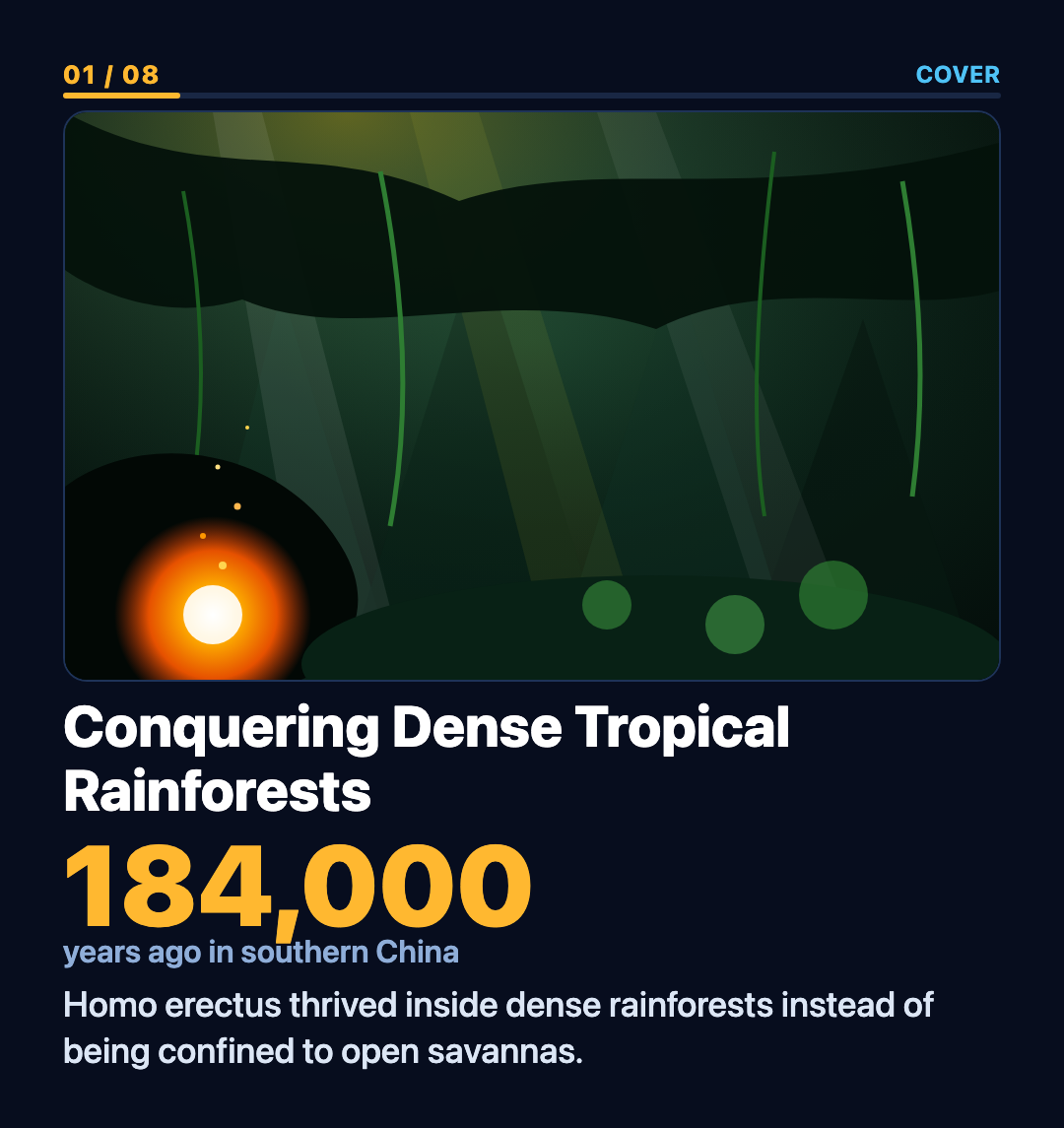
Ancient tooth fossils reveal Homo erectus conquered dense tropical rainforests
6 ngày trước
00WHEN ANCIENT FORESTS SPEAK OF OUR ANCESTORS
Imagine stepping into a dense, humid tropical rainforest where colossal canopy trees block out the sunlight, tangled vines snake across the floor, and the damp ground feels like an endless quagmire. For decades, the scientific consensus held that such a demanding environment formed an impenetrable ecological barrier for early human species, and that only intellectually advanced modern humans equipped with sophisticated tools could ever hope to survive there. However, a stunning archaeological breakthrough has just overturned that long-held dogma. On November 18, 2026, in the journal Nature, an international research consortium led by Dr. Kira Westaway at Macquarie University and Professor Wei Liao at the Guangxi Museum of Nationalities revealed definitive evidence that Homo erectus thrived inside dense tropical rainforests across southern China between 324,000 and 184,000 years ago.
Note – Homo erectus: an extinct archaic human species and the first direct human ancestor to walk fully upright and master fire for cooking, acting as brave pioneers who ventured beyond Africa to explore Eurasia.
WHAT WAS THIS PROBLEM ORIGINALLY ABOUT?
In the grand narrative of human evolution, Homo erectus has long been recognized as the pivotal turning point that transformed primates into true humans. They possessed tall, slender bodies with long legs built for endurance running across sprawling open plains, alongside significantly larger brain sizes compared to earlier australopithecine ancestors. For over a century, anthropologists assumed that their sole evolutionary theater was open savannas and dry open woodlands. Those vast landscapes resembled a natural safari park with unobstructed sightlines, allowing early hunters to spot game easily from afar while keeping clear of dangerous carnivores.
In stark contrast, dense tropical rainforests have always represented an ecological nightmare for predators that rely on distant vision. Inside closed-canopy jungles, sunlight is choked off by dense vegetation, toxic plants grow side by side with edible roots, and prey animals flit rapidly through tree crowns high above ground. Scientists previously insisted that only after modern Homo sapiens arose, armed with projectile spears, traps, and sophisticated botanical knowledge, could humans successfully unlock and colonize this forbidding green fortress.
Note – Tropical rainforest: a perpetually humid, warm ecosystem characterized by dense multi-layered tree canopies that block out sunlight, resembling a mysterious labyrinth rich in hidden resources yet laden with survival hazards.
WHAT HAS CHANGED COMPARED TO PREVIOUS BELIEFS?
Fossilized teeth unearthed from Baxian Cave in southern China's Guangxi region have rewritten this chapter of human history. Stratigraphic evidence and geochemical analyses reveal that Homo erectus did not vanish from mainland East Asia four hundred thousand years ago, as long presumed from the classic Peking Man fossil records. Instead, they persisted on the Asian mainland for an additional two hundred thousand years, enduring until 184,000 years ago. This distant epoch predates the entire recorded written history of human civilization by almost two thousand times.
More importantly, rather than clinging to forest margins, these resilient populations made the deep rainforest their thriving home. Chemical signatures etched into their tooth enamel confirm that they harvested canopy fruits, excavated underground tubers, and hunted forest-dwelling fauna under dense vegetation. This revelation demonstrates that the behavioral plasticity and ecological adaptability of Homo erectus were far more sophisticated than modern anthropologists ever gave them credit for.
HOW DID SCIENTISTS UNCOVER THIS EVIDENCE?
To unlock the secrets preserved deep within the limestone cave, the research team combined several cutting-edge analytical methods. The primary key came from fossilized hominin tooth enamel. As hard as granite, dental enamel functions like an indelible biological black box that locks in precise records of an individual's diet, water sources, and local climate from childhood through adulthood.
Note – Fossil tooth enamel: the ultra-hard mineralized outer shell protecting mammalian teeth, serving like an indestructible biological memory chip that faithfully records the food and water consumed across an ancient lifetime.
By analyzing stable carbon and oxygen isotope ratios locked within the enamel, researchers mapped the exact ecological canopy signatures of the food consumed. The carbon isotopes displayed distinct photosynthetic signatures characteristic of heavy canopy shade, offering undeniable proof that these hominins sourced their nourishment deep within dense closed forests rather than open grasslands.
Furthermore, ultra-fine laser ablation sampling across tooth growth bands unlocked strontium isotope ratios. Different bedrock formations possess unique geological strontium signatures that leach into groundwater and local vegetation. By reading this natural geological passport, researchers discovered that these individuals were far from stationary cave dwellers. Instead, they navigated complex seasonal migration circuits spanning over two hundred and fifty kilometers across rugged karst mountains to harvest seasonal resources.
Note – Strontium isotopes: atomic variants of the element strontium found in regional rocks and soil, functioning like a natural geological tracking beacon that pinpoints exactly where an organism drank water and lived across different seasons.
Finally, the precise timeline was locked down through forty-three independent radiometric dates. The team combined sediment luminescence dating with uranium-series dating applied to flowstones encasing the fossil beds. Interestingly, the researchers received accidental assistance from prehistoric porcupines. These rodents habitually dragged bones and shed teeth into deep cave crevices to grind their growing incisors, unintentionally serving as dedicated librarians that safeguarded early human relics across hundreds of thousands of years.
Note – Luminescence dating: a geochronological technique measuring light emitted from trapped electrons in mineral grains when stimulated by heat or laser light, revealing how long sediment has remained buried in darkness since its last exposure to sunlight.
WHAT DOES THIS BREAKTHROUGH MEAN FOR HUMANITY?
This discovery profoundly reshapes how humanity perceives its evolutionary roots. The human family tree is not a lonely, linear ladder where one superior species effortlessly supplanted its predecessor in neat chronological succession. Rather, it resembles a tangled, vibrant bush with numerous intertwining branches. Approximately two hundred thousand years ago, the Asian continent was a bustling mosaic where resilient Homo erectus shared landscapes with enigmatic Denisovans and early emerging ancestors of modern humans.
Note – Denisovans: an extinct branch of archaic humans who lived across Asia alongside our ancestors, leaving behind critical genetic adaptations that still help modern Tibetan populations thrive in thin high-altitude air today.
This study enriches foundational anthropology, archaeology, and evolutionary biology, overturning outdated prejudices that portrayed archaic humans as rigid or ecologically inept. Nonetheless, this remains fundamental exploratory science that enriches our cultural knowledge rather than providing immediate daily applications. Significant unknowns remain: archaeologists have yet to locate stone tools directly associated with the Baxian Cave teeth, and ancient DNA could not be retrieved because the subtropical warmth and humidity degraded organic molecules over millennia.
Looking ahead, international research teams are expanding their field surveys across the vast karst cave systems stretching from southern China into northern Vietnam and broader Southeast Asia. Future fieldwork promises to clarify whether Homo erectus encountered, traded with, or competed against early waves of our own species as they expanded across prehistoric Asia.
SOURCES
Nature – Rainforest adaptation in late Homo erectus from southern China – https://doi.org/10.1038/s41586-026-11155-6
Nature – Evidence for late Middle Pleistocene Homo erectus in mainland East Asia – https://doi.org/10.1038/s41586-026-11271-3
Macquarie University – Ancient teeth reveal Homo erectus conquered tropical rainforests – https://www.mq.edu.au
Max Planck Institute of Geoanthropology – Late Homo erectus thrived in subtropical China – https://www.shh.mpg.de
0 comments
Ads
Related Posts
Ads