Ads
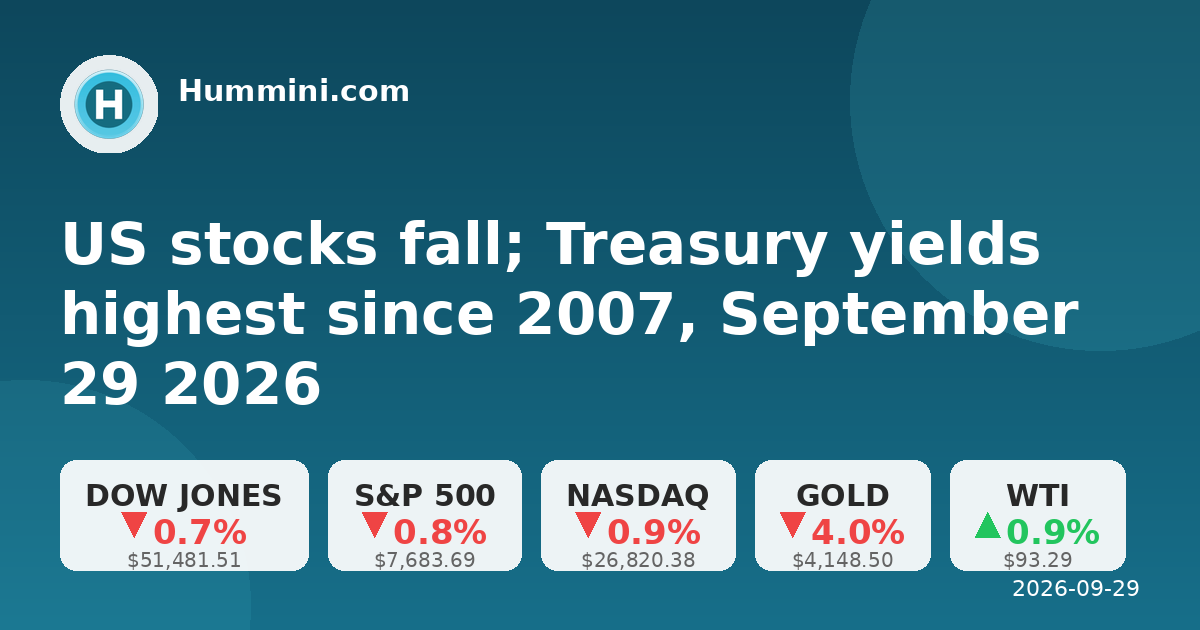
US stocks fall; Treasury yields highest since 2007, September 29 2026
khoảng 1 giờ trước
001. WALL STREET SLIDES, NASDAQ LEADS DECLINE
The Dow Jones Industrial Average fell 0.67% to 51,481.51; the S&P 500 lost 0.77% to 7,683.69; the Nasdaq Composite dropped 0.92% to 26,820.38. Big tech was mostly lower: Meta -4%, Tesla -4%, Amazon -1%, Microsoft -1%, Apple -0.78%, Alphabet -0.34%; Nvidia bucked the trend, rising 1.68%. Nvidia's board approved a USD 150 billion increase to its buyback programme, bringing the total to USD 235 billion through fiscal 2028; AMD agreed to acquire Fei-Fei Li's AI startup World Labs for USD 8.2 billion.
Selling pressure came from rising bond yields, which erode valuations of growth stocks and made investors more cautious.
2. TREASURY YIELDS SURGE, FED RATE RISK REPRICED
The 2-year Treasury yield rose 7.89 basis points to 4.931%; the 10-year rose 7.98 basis points to 5.236%, the highest since 2007; the 30-year rose 6.06 basis points to 5.547%. Fed Governor Lisa Cook said AI-related demand and high oil prices could keep inflation pressure elevated in coming months, and policy moves will be data-driven.
Money markets lifted the odds of an October Fed rate hike to around 70% from 64% a day earlier. The US dollar index added 0.15% to 101.19; the offshore yuan strengthened 104 pips to 6.7127 per dollar.
3. BOEING FALLS AS FAA DELAYS 737 MAX 10 CERTIFICATION
The Federal Aviation Administration said certification of the 737 MAX 10 is delayed over a software issue under review; Boeing shares fell about 6.9%.
The delay prolongs uncertainty over Boeing's aircraft delivery schedule and may affect airline fleet plans and related supply chains.
4. GOLD PLUNGES MORE THAN 4%, SILVER SLIDES
COMEX gold futures fell 4.00% to USD 4,148.50 per ounce; silver futures lost 5.82% to USD 61.03 per ounce. Spot gold fell to an intraday low near USD 4,110, the weakest since 5 August, then closed 3.98% lower at USD 4,115 per ounce.
Rising real yields and a firmer dollar made non-yielding assets less attractive, triggering broad selling.
5. OIL RISES AS HORMUZ TENSIONS PERSIST
WTI's main contract added 0.95% to USD 93.29 a barrel; Brent's main contract gained 1.36% to USD 98.77. Some sources reported Brent around USD 102.6–105.28 depending on contract and timing. President Trump rejected Iran's proposal to reopen the Strait of Hormuz; Iran said it would not soften its conditions; Qatari mediators were due to meet both sides Monday or Tuesday.
Saudi Arabia restored about half the flows through its East-West pipeline, reaching at least 3.5 million barrels per day to the Red Sea. Kpler preliminary data showed Middle East crude exports recovered to 12.8 million bpd in September, the highest since the US-Iran conflict erupted in late February, with Hormuz shipments around 7.4 million bpd.
6. CHINA UNVEILS STIMULUS AND TARIFF-REDUCTION FRAMEWORK
China's National Bureau of Statistics said industrial profits of large industrial enterprises rose 15.7% year-on-year in January-August to CNY 5,271.98 billion. MOFCOM announced a reciprocal tariff-reduction framework involving about USD 30 billion on each side after the 8th round of consultations held 20-23 September in New York and Washington; more than 90% of listed products are exempted from all additional tariffs.
On 28 September, China's State Council pledged stronger counter-cyclical macro policy, faster bond issuance and new measures to stabilise the property market, promote employment and boost domestic demand. The measures aim to reinforce recovery while property confidence remains fragile.
7. RBA SEEN HIKING; ECB FLAGS SLOWER GROWTH
The Reserve Bank of Australia is expected to raise the cash rate by 25 basis points to 4.60% at 2:30pm AEST on 29 September, the highest since November 2011, according to a Bloomberg survey. ECB President Christine Lagarde said the notable rise in long-term interest rates since the September meeting will slow eurozone growth and curb energy cost pass-through to inflation more than projected.
Central banks continue to face a trade-off between controlling inflation and supporting growth; the RBA's move will signal how much tightening remains across the G10.
Key thing to watch today: RBA rate decision at 2:30pm AEST and Qatar-mediated US-Iran talks on Hormuz.
*Information compiled for reference, reflecting multiple sources at the time of publication.*
0 comments
Ads
Related Posts
Ads