Ads
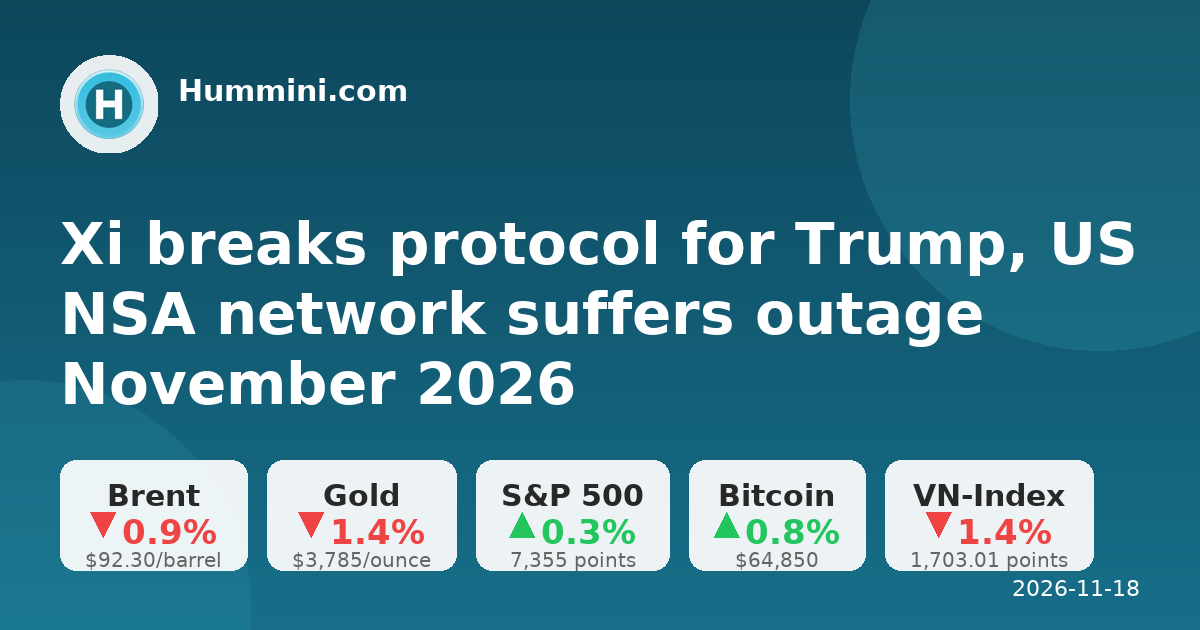
Xi breaks protocol for Trump, US NSA network suffers outage November 2026
1 ngày trước
00WORLD TEMPERATURE
3.9/5. Iran widened attacks to a military base in Kuwait and struck an oil tanker in the Strait of Hormuz, while a major outage paralyzed classified US intelligence communications and Kyiv faced severe winter rolling blackouts.
BRIEFING
Updated from 12:00 to 19:00 on November 18, 2026 (Hanoi time), covering new events and developments only.
1. Chinese President Xi Jinping broke diplomatic protocol to personally greet US President Donald Trump on the airport tarmac in Shenzhen ahead of a historic trilateral summit with Russian President Vladimir Putin.
2. Iran launched drone barrages targeting the Ali Al Salem Air Base hosting American forces in Kuwait and struck an ADNOC commercial oil tanker transiting the Strait of Hormuz.
3. The National Security Agency's classified internal network NSANet suffered a sweeping outage at Fort Meade headquarters, forcing officials to trigger a code yellow alert.
4. Ukraine's capital city Kyiv began enforcing severe rolling power cuts leaving residents with electricity for only four hours daily following Russian strikes on grid infrastructure and Dnipro river bridges.
5. Thousands of garment workers in Gazipur clashed violently with police, blockading primary highways and torching law enforcement vehicles to demand higher minimum wages.
6. Vietnam's stock benchmark VN-Index plummeted 23.71 points to close at 1,703.01 points as foreign investors offloaded over 1.1 trillion VND in shares.
1. XI JINPING BREAKS PROTOCOL TO GREET TRUMP AT SHENZHEN AIRPORT
US President Donald Trump arrived in Shenzhen aboard Air Force One on the afternoon of November 18, receiving an unprecedented welcome from his Chinese counterpart, according to Reuters.
Chinese President Xi Jinping made an extraordinary appearance on the airport tarmac at Shenzhen Bao'an International Airport, waiting at the foot of the aircraft stairs to greet Trump with a handshake and brief embrace before walking the red carpet together. Diplomatic observers noted that the gesture broke longstanding Chinese protocol, especially as Xi had not personally greeted Russian President Vladimir Putin at the airport when he arrived hours earlier. In subsequent bilateral talks with Xi, Putin sharply condemned Western economic sanctions, asserting that Europe was in humiliating decline, while expressing expectations for tangible benefits from the upcoming trilateral meeting. China reaffirmed its commitment to open global trade and supply chain stability. Diplomatic delegations from the United States, China, and Russia are finalizing the agenda for the historic trilateral summit scheduled for November 19, which aims to negotiate pathways toward ending the war in Ukraine and establishing nuclear arms control frameworks.
The high-visibility reception followed Trump's brief stop in Manila to reaffirm mutual defense commitments with the Philippines, underscoring Beijing's intent to establish favorable personal chemistry with the US commander-in-chief.
Strategic significance: The exceptional reception extended to Trump reflects Beijing's calculation that direct rapport with the US president offers the best chance of preventing punitive tariff escalations. All three global powers enter the November 19 talks with distinct agendas: Washington seeks to leverage trade and security pressure to force an end to the Ukrainian conflict, Beijing aims to position itself as an indispensable peacemaker without compromising its strategic alignment with Moscow, and Russia looks to dismantle Western sanctions while securing its geopolitical perimeter. The outcome of the trilateral summit could reshape the international order or cement geopolitical fragmentation if positions remain irreconcilable.
2. IRAN STRIKES KUWAIT AIR BASE AND COMMERCIAL TANKER IN STRAIT OF HORMUZ
Following retaliatory US airstrikes against Iranian missile sites on Qeshm Island, regional tensions flared rapidly on the afternoon of November 18 as Iran expanded its targets into Kuwait and commercial maritime lanes, according to Al Jazeera.
The Kuwaiti military announced that its air defense batteries successfully engaged and downed a barrage of hostile drones targeting the Ali Al Salem Air Base, an installation hosting US personnel and Patriot missile defense systems. Iranian armed forces swiftly claimed responsibility, asserting that the attack was designed to target American missile launch platforms. Kuwait's Foreign Ministry issued a sharp condemnation, calling the bombardment a flagrant violation of its territorial integrity and a reckless regional escalation. Simultaneously in Bahrain, air defense sirens sounded across the capital Manama in the fourth such alert in less than a week after radar systems tracked incoming aerial targets. Compounding maritime dangers, an oil tanker owned by the UAE state energy company ADNOC was struck while traversing the Strait of Hormuz, leaving multiple crew members injured and one person missing. The Gulf Cooperation Council convened an emergency session and called on the United Nations Security Council to intervene immediately against continued Iranian provocations.
The escalation unfolded hours after American fighter jets destroyed Islamic Revolutionary Guard Corps missile installations on Qeshm Island, pushing Persian Gulf waters closer to unchecked conflict.
Strategic significance: Tehran's decision to directly target military installations in Kuwait and strike a commercial oil vessel in the Strait of Hormuz demonstrates an aggressive willingness to draw neighboring Gulf nations into its confrontation with Washington. The maneuver places Arab partners in a difficult dilemma between providing basing access to the Pentagon and accommodating Tehran to protect their own energy infrastructure and shipping corridors. With deterrence degrading across the Strait of Hormuz, further miscalculations in the coming hours could trigger wider naval clashes and induce severe crude supply shocks across global energy markets.
3. CLASSIFIED US NATIONAL SECURITY AGENCY NETWORK SUFFERS SYSTEM OUTAGE
The US National Security Agency confirmed that its primary classified internal network, NSANet, suffered a sweeping system outage at its Fort Meade headquarters in Maryland on November 18, according to CBS News.
The network failure forced leadership at the premier electronic surveillance agency to issue an internal code yellow alert, implement staggered work shifts, and restrict campus access strictly to essential personnel. NSANet serves as the core infrastructure through which intelligence personnel store, analyze, and disseminate sensitive top-secret intelligence. Director of National Intelligence Jay Clayton stated that the disruption resulted from complications during scheduled routine maintenance, specifically tied to applying security patches addressing vulnerabilities in PHP programming language structures. Clayton emphasized that redundant communication links ensured critical intelligence transmissions to President Donald Trump during his travels in Asia remained fully operational and that core defense posture was unaffected. Intelligence officials confirmed that there was no evidence suggesting cyberattacks or malicious foreign interference.
The outage follows a succession of technological disruptions across the United States over the past week, including widespread Microsoft cloud service interruptions and a nationwide air traffic ground stop initiated by the Federal Aviation Administration.
Strategic significance: The paralysis of America's most secure intelligence intranet at a moment of acute Middle Eastern escalation and ahead of a historic nuclear summit in China exposes deep systemic vulnerabilities within classified digital infrastructure. Even as officials attribute the collapse to internal maintenance errors, the inability of key intelligence nodes to process battlefield data in real time raises pressing questions regarding the resilience and operational redundancy of national security architecture under complex conditions.
4. KYIV ENFORCES HARSH ROLLING BLACKOUTS RESTRICTING POWER TO FOUR HOURS DAILY
Residents across the Ukrainian capital of Kyiv faced the most severe electricity restrictions of the year on the afternoon of November 18 as rolling blackouts left households with power for just four hours a day, according to The Guardian.
The capital's electrical grid experienced catastrophic degradation following intensive Russian ballistic missile strikes targeting substation hubs and two critical crossings over the Dnipro River, the Pivnichnyi and Pivdennyi bridges. State grid operator Ukrenergo imposed sweeping emergency curtailments, extending scheduled outages of up to 20 hours daily across Kyiv as well as Dnipropetrovsk, Kharkiv, Zaporizhzhia, Poltava, and Sumy regions. The crisis is acutely dangerous as temperatures in northern Ukraine plunge below freezing, depriving hundreds of thousands of urban residents of heating and centralized water supplies. Politically, the energy breakdown triggered fierce domestic friction, with Kyiv Mayor Vitali Klitschko coming under heavy scrutiny from parliamentary representatives and the public over city administration preparations for mobile generators and heating centers.
Ukraine has lost more than half of its total generating capacity to sustained Russian bombardment since the onset of the war, and newly pledged European Union funding for hardened underground defense workshops will take months to translate into operational capacity.
5. BANGLADESH GARMENT WORKERS CLASH VIOLENTLY WITH POLICE OVER WAGES
Thousands of garment workers in the industrial manufacturing hub of Gazipur near Dhaka took to the streets on November 18 to demand higher minimum wages, sparking violent confrontations with law enforcement, according to AP.
Demonstrators threw blockades across critical national highways linking Dhaka to northern industrial provinces, hurled stones at security forces, and set fire to at least one police vehicle. In response, riot police deployed tear gas canisters and rubber bullets to disperse crowds and restore traffic along export supply arteries. The spontaneous labor actions forced dozens of ready-made garment factories producing goods for major international fashion brands to shut down operations to safeguard staff and industrial facilities. Workers voiced frustration over rising living costs, demanding that factory associations implement promised wage adjustments to match high domestic inflation.
The ready-made garment sector represents the economic backbone of Bangladesh, accounting for over 80 percent of total export earnings and employing four million workers. The renewal of unrest presents a major test of stability for the interim administration led by Muhammad Yunus, threatening delivery schedules for North American and European retailers heading into peak holiday retail cycles.
6. VN-INDEX DROPS NEARLY TWENTY-FOUR POINTS ON RECORD FOREIGN SELLOFF
Vietnam's benchmark VN-Index recorded a steep loss of 23.71 points, or 1.37 percent, closing the November 18 trading session at 1,703.01 points, according to official data from the Ho Chi Minh Stock Exchange.
Selling momentum accelerated sharply upon the afternoon market open, briefly pushing the headline index below the psychologically significant 1,700-point threshold before selective bottom-fishing pared losses slightly into the close. Declining stocks broadly dominated trading boards, led by heavy selling in market heavyweight banking and real estate equities. Trading volume expanded noticeably compared to recent sessions, signaling widespread institutional and retail distribution. Foreign investors maintained aggressive selling behavior, registering net outflows exceeding 1.1 trillion VND on the main exchange.
The sustained outflow of foreign capital reflects persistent strength in the US dollar index and elevated global bond yields, which have kept pressure on the domestic exchange rate and prompted institutional funds to trim equities ahead of global geopolitical events.
NEXT 48–72 HOURS
A historic trilateral summit between US President Donald Trump, Chinese President Xi Jinping, and Russian President Vladimir Putin is scheduled to convene in Shenzhen on November 19 on the sidelines of the APEC summit, focusing on a negotiated settlement for Ukraine and the framework of future nuclear arms treaties.
The ultimatum issued by Iraqi Prime Minister Ali al-Zaidi ordering the Kataib Hezbollah militia to vacate the Jurf al-Sakhar enclave expires at 20:00 on November 20, marking a critical deadline that could trigger direct armed conflict between government forces and Iran-backed militias.
The COP31 climate conference in Antalya, Turkey, concludes on November 20 following final ministerial negotiations aimed at resolving deep deadlocks over mobilizing at least 120 billion dollars annually in adaptation finance for developing nations.
SOURCES
1. XI JINPING BREAKS PROTOCOL TO GREET TRUMP AT SHENZHEN AIRPORT
Reuters – Xi Jinping breaks protocol to greet Donald Trump at Shenzhen airport – https://www.reuters.com/world/china/xi-greets-trump-shenzhen-airport-apec-2026-11-18/
CNN – Trump arrives in China for historic trilateral summit with Xi and Putin – https://www.cnn.com/2026/11/18/asia/trump-xi-putin-shenzhen-apec-summit-intl/
2. IRAN STRIKES KUWAIT AIR BASE AND COMMERCIAL TANKER IN STRAIT OF HORMUZ
Al Jazeera – GCC condemns drone strikes on Kuwait and Bahrain as ADNOC tanker hit – https://www.aljazeera.com/news/2026/11/18/kuwait-bahrain-intercept-drones-adnoc-tanker-hormuz/
Financial Times – Gulf tensions soar after drone attacks on Kuwait base and Hormuz shipping – https://www.ft.com/content/kuwait-ali-al-salem-drone-strike-hormuz-tanker-2026/
3. CLASSIFIED US NATIONAL SECURITY AGENCY NETWORK SUFFERS SYSTEM OUTAGE
CBS News – NSA classified communications network suffers major outage at Fort Meade – https://www.cbsnews.com/news/nsa-classified-network-outage-code-yellow-fort-meade-2026/
CNN – Intelligence chief Jay Clayton explains classified network disruption during maintenance – https://www.cnn.com/2026/11/18/politics/nsa-network-disruption-clayton-fort-meade/
4. KYIV ENFORCES HARSH ROLLING BLACKOUTS RESTRICTING POWER TO FOUR HOURS DAILY
The Guardian – Kyiv plunged into crisis with electricity limited to four hours daily – https://www.theguardian.com/world/2026/nov/18/kyiv-blackouts-energy-crisis-dnipro-bridges-klitschko/
Kyiv Independent – Emergency blackouts sweep across Ukraine following devastating strikes – https://kyivindependent.com/emergency-power-cuts-kyiv-dnipro-bridges-winter/
5. BANGLADESH GARMENT WORKERS CLASH VIOLENTLY WITH POLICE OVER WAGES
AP News – Bangladeshi garment workers clash with police over minimum wage demands – https://apnews.com/article/bangladesh-garment-protests-gazipur-dhaka-wages-2026/
Reuters – Police fire tear gas as garment worker protests block highways in Bangladesh – https://www.reuters.com/world/asia-pacific/bangladesh-garment-worker-clashes-gazipur-dhaka-2026-11-18/
6. VN-INDEX DROPS NEARLY TWENTY-FOUR POINTS ON RECORD FOREIGN SELLOFF
Báo Mới – VN-Index thủng mốc 1.700 điểm trước áp lực xả ròng dữ dội của khối ngoại – https://baomoi.com/vn-index-giam-sau-phien-18-11-khoi-ngoai-xa-rong-1100-ty-c50754890.epi
VietnamPlus – Thị trường chứng khoán chìm trong sắc đỏ, khối ngoại bán ròng hơn 1.100 tỷ đồng – https://www.vietnamplus.vn/chung-khoan-ngay-18-11-vn-index-giam-gan-24-diem-post993450.vnp
FINANCIAL MARKETS
NDTV Profit – Global markets trade cautious ahead of tech earnings, Brent hovers near 92 dollars – https://www.ndtvprofit.com/markets/asian-markets-live-updates-november-18-2026/
Trading Economics – Asian commodity and stock market benchmarks November 18 – https://tradingeconomics.com/markets/asia-2026-11-18/
0 comments
Ads
Related Posts
Ads