Ads
Physicists catch quantum tornadoes swirling inside a paradoxical supersolid
9 ngày trước
00PHYSICISTS CATCH QUANTUM TORNADOES SWIRLING INSIDE A PARADOXICAL SUPERSOLID
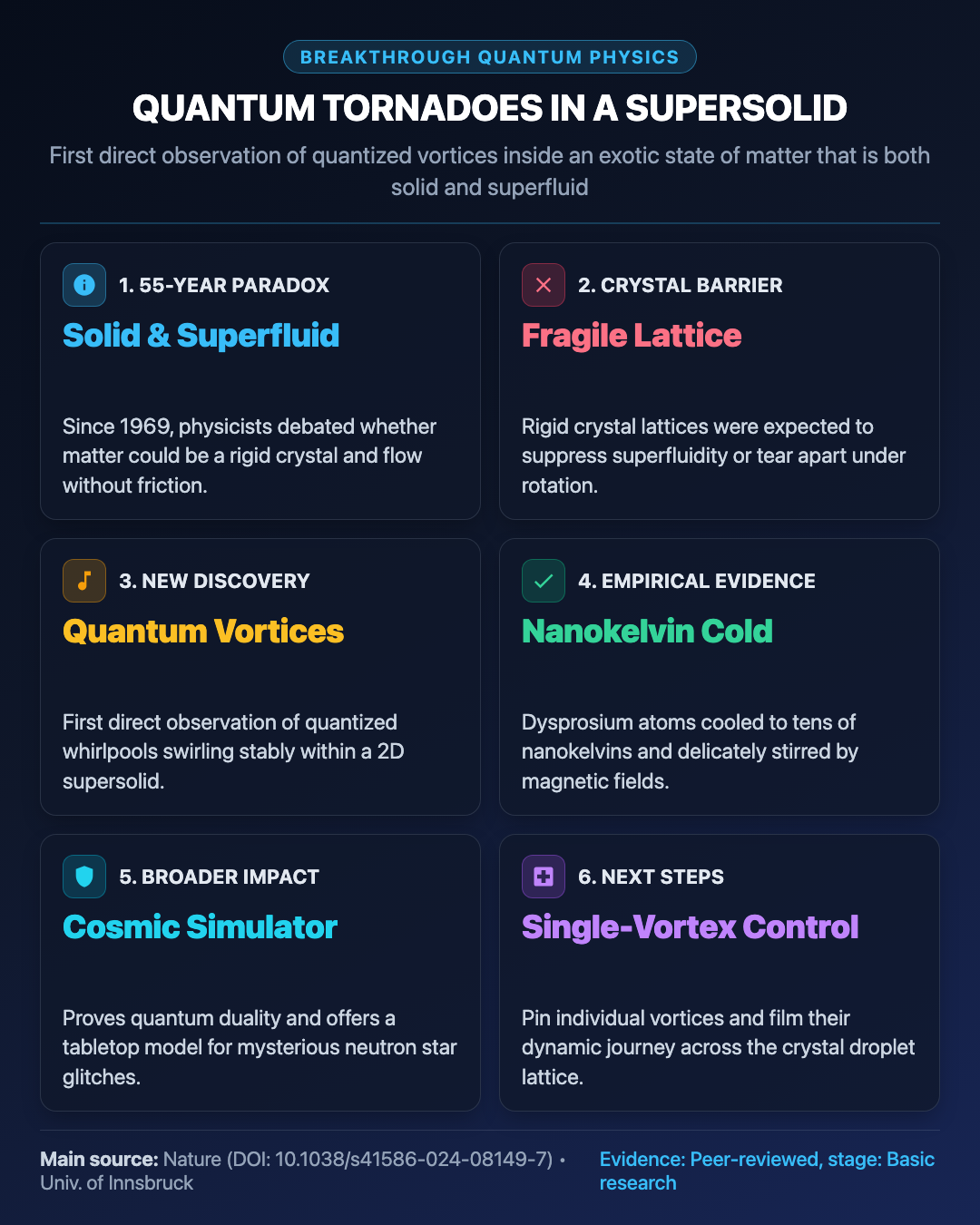
Imagine stirring your morning coffee with a spoon: the liquid swirls into a gentle whirlpool at the center, but the moment you stop stirring, friction quickly brings the surface back to rest. Drop an ice cube into the cup, and it remains a solid block that sinks to the bottom, entirely incapable of flowing freely into the surrounding drink. In our everyday experience, solids and liquids represent two mutually exclusive states of matter. Yet in a landmark study published in the journal Nature on November 6, 2024, a research team led by Professor Francesca Ferlaino at the University of Innsbruck and the Austrian Academy of Sciences demonstrated something seemingly impossible: they directly captured microscopic quantum whirlpools spinning inside a substance that simultaneously possesses a rigid crystal structure and flows with zero friction.
WHAT WAS THIS PROBLEM IN THE FIRST PLACE?
More than half a century ago, in 1969, leading theoretical physicists posed a puzzling paradox: could a single substance exist as both a solid crystal and a frictionless superfluid at the exact same time? In daily life, solidifying requires atoms to lock neatly into fixed grid positions like bricks in a wall, whereas frictionless flow demands that particles move completely unrestricted past one another. This exotic combination was termed a supersolid.
Note – Supersolid: A bizarre state of matter where atoms simultaneously arrange themselves into a rigid crystal lattice like ice while flowing smoothly through each other with zero friction like a frictionless liquid.
To appreciate why this state is so elusive, one must recall the concept of a superfluid, a marvel of quantum mechanics discovered at ultracold temperatures. If you stir a superfluid inside a container, it will swirl perpetually without slowing down because there is zero friction to dissipate energy. When a superfluid rotates, it does not produce a smooth, single whirlpool like water draining down a sink. Instead, it breaks into a constellation of tiny, discrete whirlpools known as quantized vortices.
Note – Superfluid: A special fluid state formed at ultra-low temperatures that flows forever without losing any energy to friction, akin to a skater gliding endlessly across a perfectly frictionless ice rink without needing to push.
Note – Quantized vortex: A microscopic whirlpool with an empty center formed when a superfluid rotates. Unlike household whirlpools that can spin at any arbitrary strength, each quantum vortex carries a fixed, indivisible packet of rotational circulation dictated by quantum rules.
WHAT HAS CHANGED COMPARED TO FORMER BELIEFS?
For decades, attempts to produce supersolids in solid helium met dead ends because atoms were packed far too tightly to swap places easily. It was not until 2019 that physicists successfully created the first supersolids using ultracold magnetic quantum gases. Optical images showed atoms clustering into an orderly lattice of tiny droplets, proving crystalline structure. However, the other half of the riddle remained unconfirmed: did the background connecting those droplets truly flow as a superfluid?
Many theorists suspected that a rigid crystal lattice would choke superfluid flow, or that the mechanical stress of rotation would tear the fragile crystal apart before circulation could establish. No one knew whether quantized vortices, the undisputed hydrodynamic smoking gun of superfluidity, could survive and navigate within a crystal of droplets. The new Innsbruck experiment shattered this skepticism by directly imaging quantized vortices entering and thriving stably inside a two-dimensional supersolid.
HOW DID SCIENTISTS UNCOVER THE CLUES?
To accomplish this feat, the researchers cooled tens of thousands of atoms of dysprosium, a rare-earth metal endowed with extraordinarily strong atomic magnetic moments. Trapped in laser light fields, the atoms were chilled to mere tens of nanokelvins above absolute zero, millions of times colder than deep interstellar space. At this ultra-frigid threshold, individual atomic identities merged into a unified Bose-Einstein condensate.
Note – Dysprosium: A rare-earth chemical element possessing very strong magnetic properties at the atomic level, acting like tiny microscopic compass needles that allow physicists to steer and organize them using magnetic fields.
Note – Bose-Einstein condensate: A phenomenon where millions of ultra-cooled atoms lose their individual identities and behave in perfect unison as a single giant super-atom, much like a massive choir singing exactly the same note at the same time.
Leveraging the potent magnetic dipole interactions of dysprosium, the atoms interacted across distance like miniature bar magnets. By carefully tuning interatomic forces, the team guided the gas cloud into spontaneously assembling into a two-dimensional triangular array of crystal droplets, while preserving a delicate, dilute superfluid background bridging the droplets together.
The crucial challenge was to rotate this delicate supersolid without shattering its structure. Instead of any mechanical stirrer, the researchers gently rotated an external magnetic field, generating a subtle hydrodynamic torque. When the atomic cloud was released and imaged under specialized microscopes after expansion, the team observed distinct dark hollows. These were quantized vortices, stably lodged within the inter-droplet interstitial channels, delivering irrefutable peer-reviewed experimental proof of superfluidity.
WHAT DOES THIS DISCOVERY MEAN FOR US?
This milestone carries immense fundamental significance, settling a fifty-five-year scientific debate by proving that crystalline spatial order and frictionless superfluid transport can peacefully coexist in a single entity. It expands humanity's grasp of quantum mechanics and illustrates the profound richness of the subatomic realm.
Beyond resolving an academic enigma in the laboratory, the breakthrough provides a unique portal into astrophysics. Thousands of light-years away, spinning neutron stars are thought to possess a solid crystalline crust enveloping an interior of superfluid neutrons. Astronomers periodically observe these pulsars abruptly speeding up, a mysterious phenomenon known as a rotational glitch. Physicists can now utilize this miniature tabletop supersolid to recreate and study how quantized vortices pin and unpin from a crystal lattice, shedding light on cosmic giants that humans can never visit directly.
Note – Neutron star: The ultradense remnant of a collapsed giant star where matter is packed so tightly that a teaspoonful would weigh as much as a mountain on Earth, consisting of a solid crystal crust surrounding a mysterious superfluid interior.
Nonetheless, this finding represents basic science in extreme cryogenic conditions and ultra-high vacuum, far removed from immediate consumer applications. Generating and maintaining supersolids requires massive, expensive laser and magnetic systems, and the state lasts only fractions of a second. Scientists have yet to uncover how vortices interact in larger droplet arrays or how to completely eliminate residual thermal disturbances.
The next milestone for the research group is to trap and manipulate individual quantum vortices, while boosting imaging resolution to record real-time films of vortices nucleating and migrating across the crystal droplet landscape. This voyage into exotic quantum territory has only just begun, paving the way for deeper explorations of unmapped phases of matter.
SOURCES
Nature – Observation of vortices in a dipolar supersolid – https://doi.org/10.1038/s41586-024-08149-7
University of Innsbruck – Quantum vortices confirm superfluidity in supersolid – https://www.uibk.ac.at/en/newsroom/2024/quantum-vortices-confirm-superfluidity-in-supersolid/
Quanta Magazine – Physicists Spot Quantum Tornadoes Twirling in a 'Supersolid' – https://www.quantamagazine.org/physicists-spot-quantum-tornadoes-twirling-in-a-supersolid-20241106/
arXiv – Observation of vortices in a dipolar supersolid – https://arxiv.org/abs/2403.18510
0 comments
Ads
Related Posts
Ads