Ads
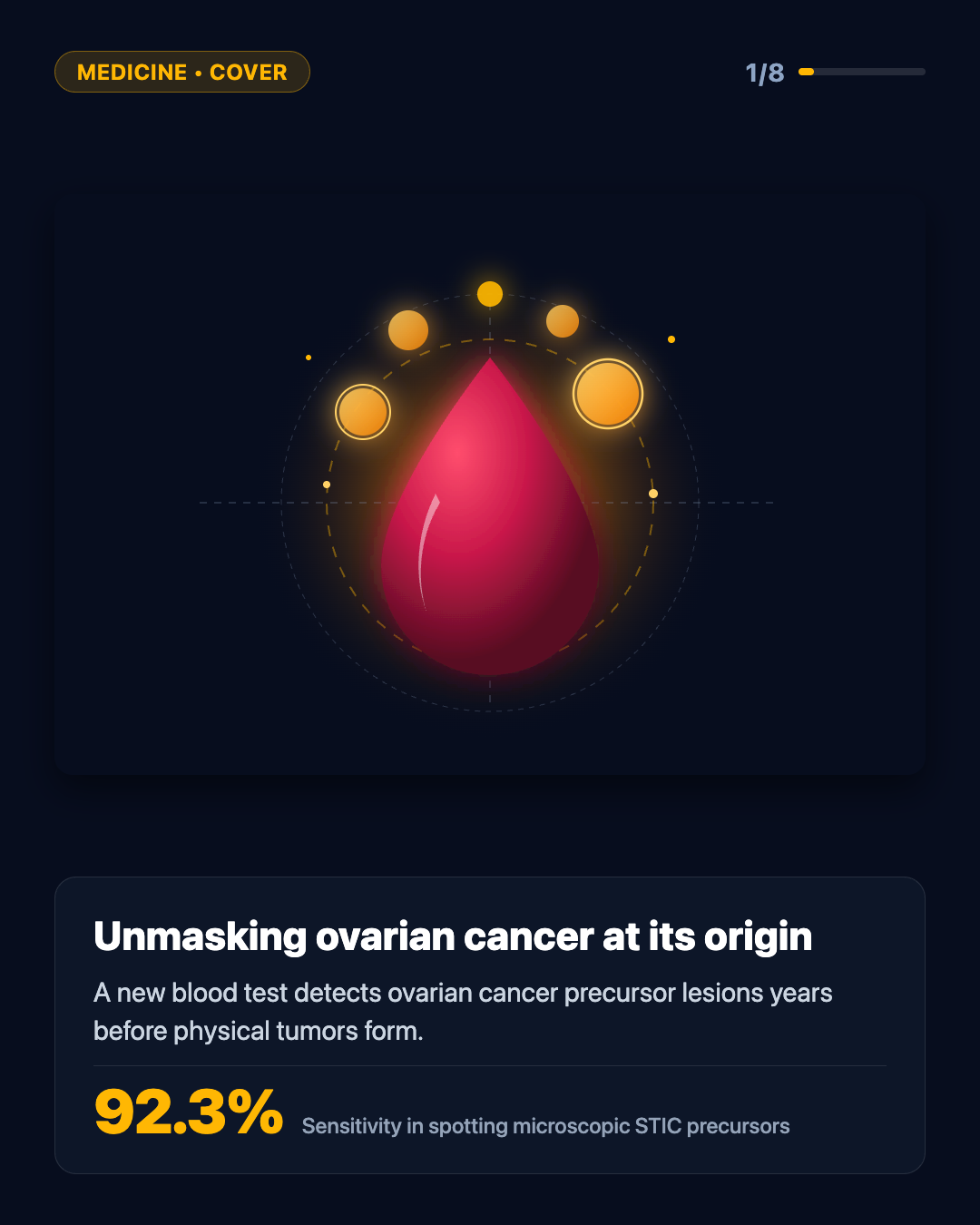
Blood test unmasks silent ovarian cancer killer at its earliest origin
6 ngày trước
00BLOOD TEST UNMASKS SILENT OVARIAN CANCER KILLER AT ITS EARLIEST ORIGIN
Imagine an unnoticed spark falling into a hidden corner of your attic. You smell no smoke, you see no flames, until the roof collapses and it is too late. In medicine, ovarian cancer behaves exactly like that quiet danger, claiming tens of thousands of lives each year because it is overwhelmingly diagnosed in advanced stages. On November 10, 2026, in the journal Nature Medicine, an international research team led by Dr. Rajan Gogna and Dr. Esha Madan at the Hoag Family Cancer Institute announced a landmark discovery: A blood-based molecular warning signal can unmask ovarian cancer when it is still nothing more than microscopic precursor cells tucked deep inside the fallopian tubes.
WHERE DOES THE SILENT KILLER TRULY BEGIN?
More than three-quarters of ovarian cancer patients learn about their illness only after tumors have already spread across the abdomen. At that point, five-year survival drops below thirty percent. Current blood tests such as CA-125 and conventional ultrasound scans only register signals once tumors are large and destructive. A pivotal finding in recent years demonstrated that most aggressive ovarian tumors do not originate in the ovaries, but rather spark within the fallopian tubes as microscopic lesions known as STIC. Because these precursor cells are exceedingly small and non-invasive, they remain completely invisible to modern hospital imaging.
Note – STIC: Serous tubal intraepithelial carcinoma, microscopic precancerous lesions in the fallopian tube lining that act like hidden embers before flaring into full tumors.
A WARNING SIGNAL CARRIED BY NANO MESSAGE BOTTLES
Medical dogma long held that microscopic precursor lesions could never leave detectable traces in circulating blood. However, the researchers discovered that these abnormal cells do not sit quietly. In their struggle to claim territory, they actively bully and weaken neighboring healthy cells. During this competitive takeover, they release extracellular vesicles packed with a distinctive molecular marker named Tu-Stroma. Even before a tangible tumor forms, these microscopic bubbles seep quietly into the bloodstream like message bottles carrying an urgent distress call.
Note – Extracellular vesicles: Tiny fluid-filled bubbles released by cells to ferry cargo, acting like miniature message bottles drifting through the bloodstream.
Note – Tu-Stroma: A specific long non-coding RNA molecule released into the blood when precancerous cells crowd out and weaken surrounding healthy tissue.
CONVINCING EVIDENCE FROM THE LABORATORY
The team validated their liquid biopsy approach across 506 human serum samples, including healthy volunteers, women with benign pelvic masses, isolated STIC lesions, and advanced ovarian cancers. The peer-reviewed findings revealed that the test achieved a 92.3% sensitivity in identifying microscopic STIC lesions and a 98.2% specificity among healthy controls. This means nearly all early-stage warning signs were correctly captured without triggering unnecessary false alarms.
Note – Liquid biopsy: A non-invasive blood test designed to trace molecular breadcrumbs of disease, avoiding the need for surgical tissue cutting.
Note – Sensitivity and specificity: Sensitivity measures the test's ability to correctly spot those with disease, while specificity ensures healthy individuals are not falsely alarmed.
A LIFELINE FOR WOMEN WITH HIGH GENETIC RISK
For women harboring inherited BRCA gene mutations, the lifetime probability of developing ovarian cancer exceeds forty percent. At present, the primary safeguard is preventative surgery to remove both ovaries and fallopian tubes at a young age, forcing difficult sacrifices on natural childbearing and triggering premature menopause before age forty. This discovery offers hope for regular non-invasive blood surveillance, potentially allowing high-risk women to safely delay irreversible surgery until clear biological signals warrant intervention.
Note – BRCA gene mutation: Inherited glitches in cellular repair genes that significantly increase a person's lifetime risk of developing ovarian and breast cancers.
HOW FAR REMAINS FROM LAB TO CLINIC?
This research opens a promising path to transform a lethal malignancy into a preventable condition caught at its inception. Nevertheless, these results stem from retrospective serum validation. Before becoming an approved clinical test in hospitals, this method will require years of prospective clinical trials across thousands of diverse individuals worldwide. Clinicians must also define clear protocols on surgical timing following a positive reading to avoid overtreatment. The immediate next step for the team is initiating prospective clinical screening trials and seeking formal regulatory evaluations.
SOURCES
Nature Medicine – Blood-based RNA biomarker for the early detection of ovarian cancer – https://doi.org/10.1038/s41591-026-04732-9
Hoag Family Cancer Institute – World-first discovery enables early blood-based detection of ovarian cancer precursor lesions – https://www.hoag.org/news/ovarian-cancer-early-detection-study/
The Guardian – Blood test could detect ovarian cancer years before symptoms appear – https://www.theguardian.com/society/2026/nov/ovarian-cancer-blood-test-breakthrough
0 comments
Ads
Related Posts
Ads