Ads
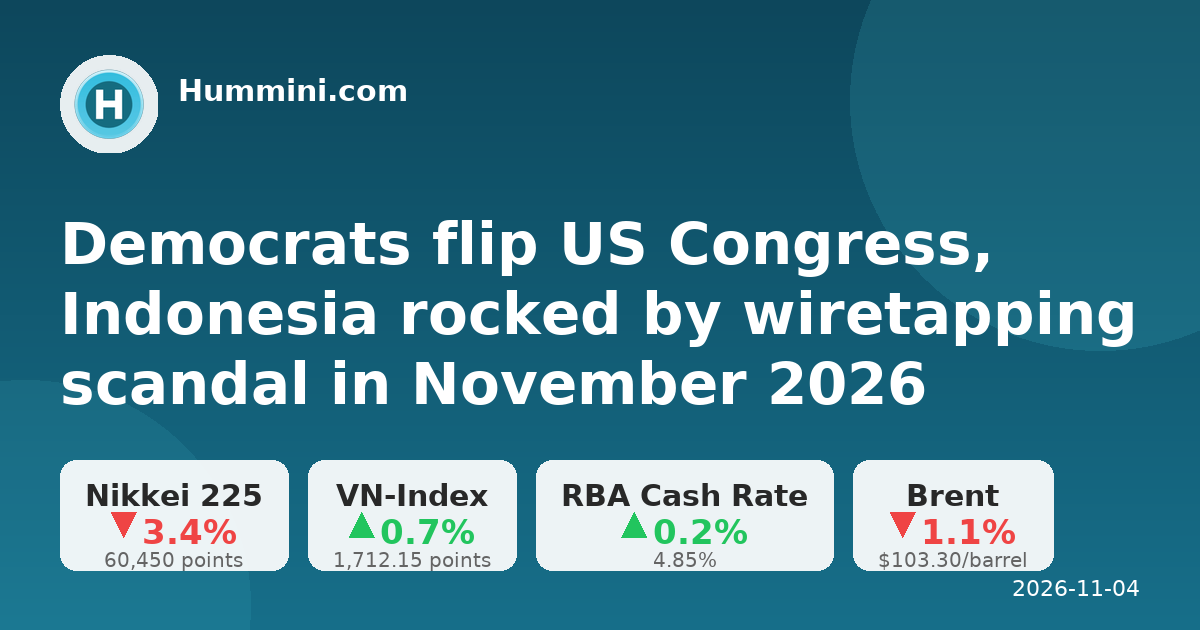
Democrats flip US Congress, Indonesia rocked by wiretapping scandal in November 2026
khoảng 1 giờ trước
00WORLD TEMPERATURE
4.0/5. The American political landscape undergoes a major shift following midterms while Indonesia is rocked by a top-tier wiretapping scandal.
BRIEFING
Updated from 05:10 to 12:00 on November 4, 2026 (Hanoi time), covering only new events and fresh developments.
1. Democrats secured the 218-seat threshold to reclaim the US House of Representatives and flipped control of the Senate following key battleground upsets.
2. Indonesian police arrested Presidential Chief of Staff Listyo Sigit Prabowo and two senior generals over an illegal wiretapping network targeting President Prabowo Subianto.
3. The Reserve Bank of Australia raised its cash rate by 25 basis points to an 18-year high of 4.85% to counter persistent inflationary pressures.
4. Western security advisers convened in Brussels to draft post-war security commitments for Ukraine as Russian strikes knocked out three of five major DTEK thermal plants.
5. Tehran unveiled a maximum deterrence doctrine and a five-point framework aimed at removing the US military security architecture in the Strait of Hormuz.
6. Tokyo's Nikkei 225 tumbled over 2,200 points amid tech regulatory anxieties following the US elections, while Vietnam's VN-Index rebounded past 1,710 points.
1. DEMOCRATS WIN BOTH HOUSES OF CONGRESS, TRUMP FACES DIVIDED GOVERNMENT
By midday November 4 Vietnam time, major American news networks confirmed that Democrats had won enough seats to secure majorities in both the House and the Senate for the 120th Congress, according to the Associated Press.
Following poll closures on the West Coast, Democrats officially surpassed the 218-seat threshold required to regain control of the House of Representatives. The outcome reverses the slim 218–212 Republican majority held prior to election day, positioning House Minority Leader Hakeem Jeffries to become the next Speaker of the House. Major district flips materialized across North Carolina, Pennsylvania, Colorado, and Iowa, reflecting voter discontent with elevated living costs and trade tariffs.
Simultaneously, the balance in the Senate underwent a dramatic realignment as Democrats erased the Republicans' 53–47 edge. In Texas, state lawmaker James Talarico delivered a historic upset by defeating Attorney General Ken Paxton, becoming the first Democrat to win a Texas Senate seat in decades. Decisive victories by former Governor Roy Cooper in North Carolina and state representative Josh Turek in Iowa propelled Democrats across the majority threshold, while incumbents held critical territory in Georgia and New Hampshire.
Strategic significance: A dual-chamber turnover places the remainder of President Donald Trump’s second term on deep legislative and budgetary defense. Democratic control of Capitol Hill ensures aggressive congressional inquiries, freezes conservative judicial confirmations, and elevates the risk of fiscal gridlock. On the international stage, this rebalancing will likely compel Washington to preserve traditional security assistance for European and Asian allies while curtailing unilateral tariff initiatives.
2. INDONESIAN GENERALS ARRESTED OVER HIGH-LEVEL WIRETAPPING NETWORK
The Indonesian National Police Criminal Investigation Agency detained Presidential Chief of Staff Listyo Sigit Prabowo and two high-ranking police generals over an illegal wiretapping operation targeting the head of state, according to The Washington Post.
The detained officers include General Listyo Sigit Prabowo, who recently stepped down as National Police Chief to assume his cabinet-level post, Inspector General Ahrie Sonta Nasution, head of the legal division, and Inspector General Eko Hadi Santoso, a senior police academy instructor. Investigators charged the suspects with unlawful access to electronic networks, non-procedural interception of confidential communications, and deliberate deletion of digital records to conceal evidence. The surveillance program spanned from 2025 into late 2026, intercepting communications belonging to President Prabowo Subianto, cabinet ministers, military officers, business leaders, journalists, and civil society activists.
Coordinating Minister Yusril Ihza Mahendra confirmed that current National Police Chief Suyudi Ario Seto directly briefed President Prabowo, stressing that the state views unauthorized surveillance of executive leadership as an extraordinary national security breach, though initial findings reveal no evidence of treason.
The explosive scandal unfolds as the Prabowo administration contends with slower economic growth and public friction over subsidy adjustments. Factional rivalries within Indonesia's security architecture have simmered since the 2024 elections, where access to intelligence apparatuses increasingly functioned as political leverage.
Strategic significance: The detentions expose deep security vulnerabilities within Jakarta's innermost ruling circle, threatening the institutional coherence of Southeast Asia's largest economy. By moving against a formidable former police chief, President Prabowo signals an unyielding drive to enforce command discipline and purge rival intelligence networks. Nonetheless, the domestic turmoil may prompt international investors to reassess sovereign and institutional stability across Indonesian markets.
3. AUSTRALIA LIFTS CASH RATE TO 18-YEAR PEAK TO TACKLE STUBBORN INFLATION
The Reserve Bank of Australia’s Monetary Policy Board increased the official cash rate target by 25 basis points to 4.85%, taking effect on November 4, according to Reuters.
The decision establishes the highest benchmark borrowing cost in Australia since the 2008 global financial crisis and represents the central bank's fifth rate hike during 2026. The move passed via a 6–3 majority, underscoring intense internal division as three dissenting board members favored holding rates steady at 4.60% to cushion heavily indebted households from further financial distress.
Defending the aggressive tightening, Governor Michele Bullock stated that underlying inflation remains unacceptably elevated and "some pain now will prevent even worse pain down the track." Recent economic data demonstrated that services inflation, housing rents, and utility tariffs have stayed stubbornly resilient despite protracted monetary restraint, squeezing mortgage holders across the country.
Australia’s policy trajectory stands in contrast to major Western peers, including the US Federal Reserve and the European Central Bank, which have initiated interest rate reductions to support economic growth.
Strategic significance: Canberra’s divergence from the global monetary easing cycle illustrates that localized stagflation risks remain acute in commodity-dependent and import-sensitive developed economies. The hike heightens recessionary strains on domestic retail spending and property valuations while compounding political headwinds for Prime Minister Anthony Albanese’s government ahead of upcoming budget revisions.
4. WESTERN ALLIES CONVENE ON UKRAINE SECURITY AMID CRIPPLING POWER BARRAGE
National security advisers from the United States, France, Germany, Britain, and NATO assembled at European Commission headquarters in Brussels on the morning of November 4 to negotiate post-war security guarantees for Ukraine, according to Eurointegration.
The Brussels summit aims to establish legally binding multi-year security commitments, laying the groundwork for US-mediated trilateral talks between Russia, Ukraine, and the United States scheduled in Abu Dhabi on November 10–11 under Envoy Steve Witkoff. However, deep skepticism persists, with German Chancellor Friedrich Merz noting in a joint press conference with President Volodymyr Zelenskyy that Berlin sees no tangible evidence Moscow genuinely seeks an authentic ceasefire.
On the ground, Ukrainian private power operator DTEK reported that three of its five thermal power stations were knocked completely offline following a synchronized Russian barrage utilizing 289 attack drones and 76 missiles. The strikes triggered emergency blackouts and imperiled municipal heating networks across Kyiv and Odesa as freezing winter temperatures set in. Concurrently, the confirmed death toll from a strike against a humanitarian distribution depot in Komyshuvakha, Zaporizhzhia, rose to 33 civilians.
Security guarantee negotiations had previously convened in Miami, but the Brussels session marks the first comprehensive engagement involving European powers and the World Bank to structure deterrence financing and mutual defense protocols.
Strategic significance: The stark disconnect between diplomatic discussions in Brussels and Ukraine's damaged electrical grid highlights a deliberate escalation to extract concessions before entering closed negotiations. By crippling civilian energy systems ahead of winter, Moscow seeks to exhaust Ukrainian societal endurance to force territorial compromises in Abu Dhabi. Conversely, Western partners are accelerating security architecture frameworks to anchor Kyiv firmly against renewed aggression if current diplomatic openings collapse.
5. TEHRAN EXPANDS OFFENSIVE DETERRENCE AND ADVANCES HORMUZ SECURITY FRAMEWORK
Iranian Supreme Leader Mojtaba Khamenei ordered the armed forces to transition to a posture of maximum deterrence, warning of strikes without geographical limits should the US or Israel execute further military actions, according to Press TV.
Marking a national anniversary, Armed Forces General Staff Chief Major General Ali Abdollahi presented a five-point strategic security framework for the Persian Gulf. The platform calls for an immediate cessation of hostilities in Gaza and Lebanon, the total revocation of economic sanctions, comprehensive war reparations, and the establishment of a localized "Hormuz mechanism" to supplant the US naval presence in the region.
The declaration follows escalating friction in the Strait of Hormuz, including maritime mine deployments and projectile attacks against commercial tankers. The Islamic Revolutionary Guard Corps asserted electronic dominance following limited US airstrikes against surface-to-air missile installations on Qeshm Island on November 2. Although diplomatic backchannels via Qatar and Pakistan remain operational, negotiations are paralyzed over the sequencing of sanctions relief and maritime passage protocols.
Tehran’s doctrinal shift marks an evolution from conventional territorial defense toward preemptive posture, as regional proxy architectures sustain structural losses from sustained aerial campaigns.
Strategic significance: Proposing an indigenous security framework to replace American naval escorts represents a bold Iranian bid to reshape Persian Gulf hegemony while Washington is consumed by its domestic midterm aftermath. By linking maritime transit security directly to sanctions removal, Tehran positions the Strait of Hormuz—conduit for a fifth of global petroleum—as an existential bargaining chip to compel energy-importing Asian economies to lobby Washington for concessions.
6. NIKKEI 225 SHEDS OVER 2,200 POINTS AS VIETNAMESE EQUITIES BOUNCE BACK
Tokyo’s Nikkei 225 plummeted more than 3% during morning trading on November 4 following an aggressive sell-off in semiconductor stocks, while Vietnam’s VN-Index recovered above 1,710 points, according to NHK World and Vietnam Investment Review.
In Japan, the benchmark Nikkei 225 shed over 2,200 points, trading near 60,450 points by the midday intermission. The sell-off was concentrated in artificial intelligence and semiconductor heavyweights, including Tokyo Electron, Advantest, SoftBank Group, and Kioxia. Investors grew wary that Democratic control of the US Congress would accelerate antitrust scrutiny of AI infrastructure, tighten technology export restrictions, and curtail data center tax incentives.
In contrast, the Ho Chi Minh Stock Exchange witnessed a decisive turnaround as the VN-Index climbed 0.74% to 1,712.15 points by midday, halting a four-session losing streak. Dip-buying emerged across financial counters, notably securities firms such as SSI and VCI alongside heavyweight lenders like Vietcombank and VPBank. A return to net-buying by foreign institutions in select tech bellwethers like FPT provided market stability, restoring the benchmark above the 1,700 psychological threshold breached the previous day.
Regional trading reflected sharp divergence as market participants absorbed the confluence of US midterm outcomes, Australia's unexpected rate hike, and the US Dollar Index's rangebound performance.
Strategic significance: The wide divergence across Asian bourses underscores distinct systemic sensitivities to macroeconomic and geopolitical shocks. High-tech manufacturing hubs like Tokyo remain acutely vulnerable to prospective regulatory shifts in Washington, whereas emerging frontiers like Vietnam exhibit resilience underpinned by domestic liquidity and appealing valuations following technical corrections.
NEXT 48–72 HOURS
Election authorities across US states will conclude mail-in ballot processing to confirm final seat margins for the 120th Congress, while Republican legal teams may initiate targeted challenges in narrow contests. In Europe, security envoys will finalize draft guarantee protocols for Ukraine ahead of the November 10 trilateral summit in Abu Dhabi. Concurrently, global energy markets will track shipping security through the Strait of Hormuz under Iran’s newly expanded deterrence doctrine alongside Kyiv’s emergency grid stabilization efforts.
SOURCES
2026 US Midterm Elections:
AP News – AP Decision Desk: Democrats win control of US House of Representatives – https://apnews.com
CBS News – 2026 Midterm Results: Democrats flip Senate with key battleground victories – https://www.cbsnews.com
The Guardian – Midterms 2026 live: Blue wave flips Congress as Trump agenda faces pushback – https://www.theguardian.com/us-news
Indonesian Wiretapping Scandal:
Washington Post – Indonesian police arrest three generals including presidential chief of staff in wiretapping scandal – https://www.washingtonpost.com/world
The Japan Times – High-ranking Indonesian generals detained over illegal wiretapping of President Prabowo – https://www.japantimes.co.jp/news
Antara News – Bareskrim confirms probe into unlawful surveillance of state officials – https://en.antaranews.com
Reserve Bank of Australia Interest Rate:
Reuters – Reserve Bank of Australia lifts cash rate by 25 bps to 18-year high of 4.85% – https://www.reuters.com/markets
The Guardian – RBA raises rates to 4.85% in split vote as Bullock defends tough medicine – https://www.theguardian.com/business
Trading Economics – Australia Interest Rate Decision November 2026 – https://tradingeconomics.com/australia/interest-rate
Ukraine Security Guarantees and Power Grid:
Eurointegration – High-level security guarantees talks for Ukraine convene at EC headquarters in Brussels – https://www.eurointegration.com.ua
Kyiv Independent – DTEK says 3 out of 5 thermal power plants offline following massive Russian barrage – https://kyivindependent.com
The Guardian – Trilateral talks between US, Ukraine and Russia scheduled for Abu Dhabi – https://www.theguardian.com/world
Iran Deterrence Doctrine and Strait of Hormuz:
Press TV – Iran adopts maximum deterrence doctrine with no geographical limits – https://www.presstv.co.uk
Tehran Times – General Abdollahi unveils 5-point security plan for Persian Gulf – https://www.tehrantimes.com
Al Jazeera – Tensions mount in Strait of Hormuz as Iran outlines regional security framework – https://www.aljazeera.com/news
Asian Financial Markets and Vietnam:
NHK World – Nikkei 225 plunges over 2,200 points on tech sell-off following US election results – https://www3.nhk.or.jp/nhkworld
Báo Đầu tư – VN-Index lấy lại mốc 1.710 điểm nhờ lực cầu bắt đáy nhóm tài chính – https://baodautu.vn
Bloomberg – Asian stocks diverge as Tokyo tech slides and domestic equities rebound – https://www.bloomberg.com/markets
0 comments
Ads
Related Posts
Ads