Ads
Solving the mystery of Earth's missing one billion years of history
1 ngày trước
00Imagine picking up a comprehensive encyclopedia that documents the entire history of your family home. As you turn the pages, you are stunned to discover that someone tore out over a thousand pages right from the middle, cleanly pasting a modern chapter directly onto the ancient beginning. There is no explanation, and not a single torn scrap remains. That is precisely the baffling riddle that geologists across the world have struggled to decipher for more than a century and a half.
On November 4, 2026, in the prestigious scientific journal Nature, an international research team led by PhD candidate Santosh Dhungana and Associate Professor Nicolas Flament from the University of Wollongong in Australia published a compelling resolution to this enduring planetary puzzle.
WHAT WAS THIS ENIGMA IN THE FIRST PLACE?
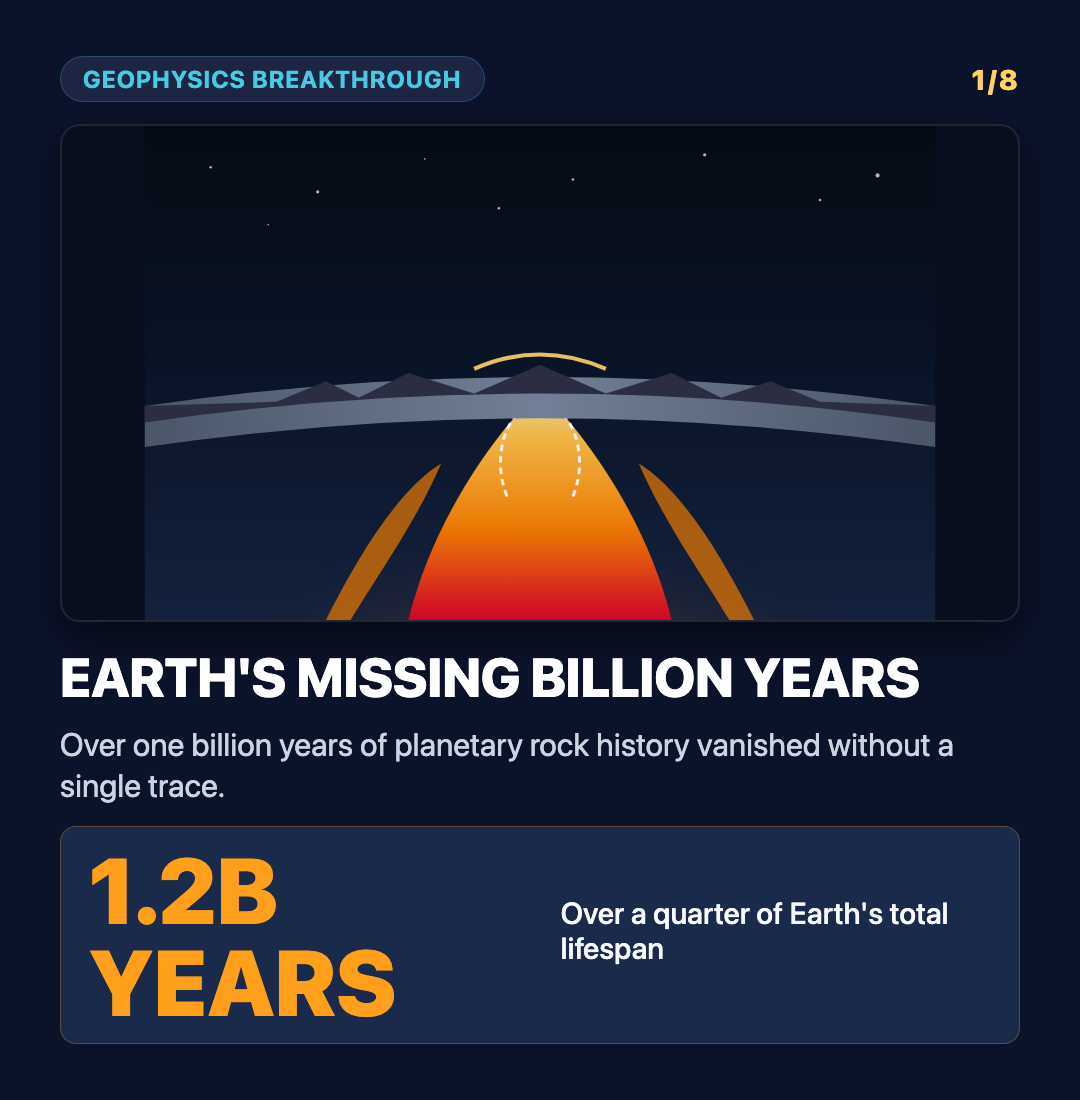
In 1869, while charting the monumental walls of the Grand Canyon in North America, geologist John Wesley Powell spotted a striking horizontal divide exposed across the cliff faces. Below the line lay dark crystalline rocks dating back more than one point seven billion years. Yet resting immediately above them were layered Cambrian sandstones only about five hundred million years old. More than one billion years of geological history, representing over a quarter of our planet's total lifespan, had completely vanished without a trace. Geologists named this planetary gap the Great Unconformity.
Note – Great Unconformity: A massive chronological gap in the rock record where two geological layers differing in age by hundreds of millions to over a billion years lie directly on top of each other, like gluing today's newspaper onto a parchment from the Middle Ages while losing all the intervening books.
Note – Crystalline basement rock: The ancient and intensely durable foundational crust of the Earth, formed by deep magma cooling or transformed under tremendous heat and pressure over billions of years, serving as the solid concrete slab beneath a continent.
HOW HAS OUR UNDERSTANDING OVERTURNED PAST BELIEFS?
For decades, Earth scientists remained divided between two competing hypotheses. One camp argued that during the global Snowball Earth climate crisis, planetary ice sheets miles thick bulldozed across continents, stripping away surface strata like an immense mechanical ice scraper. Another school maintained that tectonic collisions that assembled the ancient supercontinent Rodinia shoved mountain ranges skyward, triggering extreme erosion.
However, this newly published study unveils an entirely different driving force. The primary culprit was neither an atmospheric ice storm nor surface mountain building. Instead, the true engine operated thousands of kilometers beneath our feet, deep within the churning thermal mantle of the Earth.
Note – Snowball Earth: A catastrophic climatic epoch when glaciers covered the entire surface of our planet from the poles down to the equator, turning Earth into a brilliant white icy marble adrift in space.
Note – Mantle convection: The sluggish circulatory motion of hot, semi-molten rock deep inside Earth's mantle, behaving like a thick pot of soup simmering on a stove where hot fluid ascends while cooler, denser material descends.
HOW DID RESEARCHERS UNCOVER THE EVIDENCE?
To test their dynamic hypothesis, the Wollongong team developed high-resolution three-dimensional mantle convection models that simulated the global drift of ancient continental plates over hundreds of millions of years. Their work underwent rigorous independent peer review in Nature prior to release.
The computer simulations revealed that beneath ancient continental cratons such as North America, Baltica, and North China, massive thermal plumes welled up from the deep mantle. This buoyant thermal upwelling acted like a giant planetary elevator, hoisting vast landmasses one to two kilometers above sea level.
Suspended high in the atmosphere over hundreds of millions of years, the elevated landmasses underwent relentless weathering from wind, water, and ancient glaciers. This geological planer stripped away three to five kilometers of solid rock crust. The sheer volume of rock erased equals the entire bulk of the European Alps ground down to sea level.
Eventually, as the underlying mantle circulation cooled and began to sink, the geological elevator reversed direction, drawing the eroded continents down below ocean level. Flooding Cambrian shallow seas swept across the leveled bedrock, blanketing it in fresh layers of sand. This new sedimentary deposit functioned like a protective quilt, freezing the eroded boundary in place for hundreds of millions of years.
Note – Dynamic topography: The vertical lifting or subsidence of Earth's surface crust driven by the upward or downward hydrodynamic drag of churning mantle currents, similar to how boiling bubbles in a pot of porridge push up the surface crust before it settles back down.
Note – Cambrian sediments: Ancient layers of marine sand, silt, and minerals laid down around five hundred million years ago, which famously preserve the earliest fossilized shells and hard skeletons of complex animal life.
WHAT DOES THIS DISCOVERY MEAN FOR HUMANITY?
This breakthrough delivers profound value by bridging deep planetary thermodynamics with the history of living things on the surface. As three to five kilometers of continental crust eroded away, an unprecedented surge of essential minerals including calcium, phosphorus, potassium, and iron washed down into the ancient oceans. This massive geochemical influx fundamentally altered seawater composition, providing the vital raw materials that fueled the Cambrian Explosion. During this evolutionary burst, primitive single-celled life rapidly diversified into complex multicellular creatures with shells and skeletons, laying the direct foundation for modern animal ecosystems and our own ancestors.
These findings directly benefit geologists, planetary scientists, and paleoclimate researchers seeking to understand Earth's long-term carbon and climate cycles. Decoding ancient sedimentary strata also aids exploration geophysicists in pinpointing deep groundwater basins and valuable mineral deposits.
Nonetheless, this is foundational basic research grounded in geodynamic supercomputer modeling and stratigraphic data, not an industrial product ready for immediate commercial deployment. Ancient continental reconstructions still carry uncertainties regarding localized erosion rates, particularly across southern hemisphere landmasses.
The next step for the research community involves collecting isotopic rock samples across Africa and Antarctica to refine the mantle models, illuminating how the silent furnace deep within Earth has sculpted our living world across deep geological time.
SOURCES
Nature – The deep Earth origin of the Great Unconformity – https://doi.org/10.1038/s41586-026-11156-5
University of Wollongong – Solving the mystery of Earth's missing billion years – https://www.uow.edu.au/media/2026/solving-the-mystery-of-earths-missing-billion-years.php
Smithsonian Magazine – What Caused the Great Unconformity? – https://www.smithsonianmag.com/science-nature/what-caused-the-great-unconformity-180979603/
0 comments
Ads
Related Posts
Ads