Ads
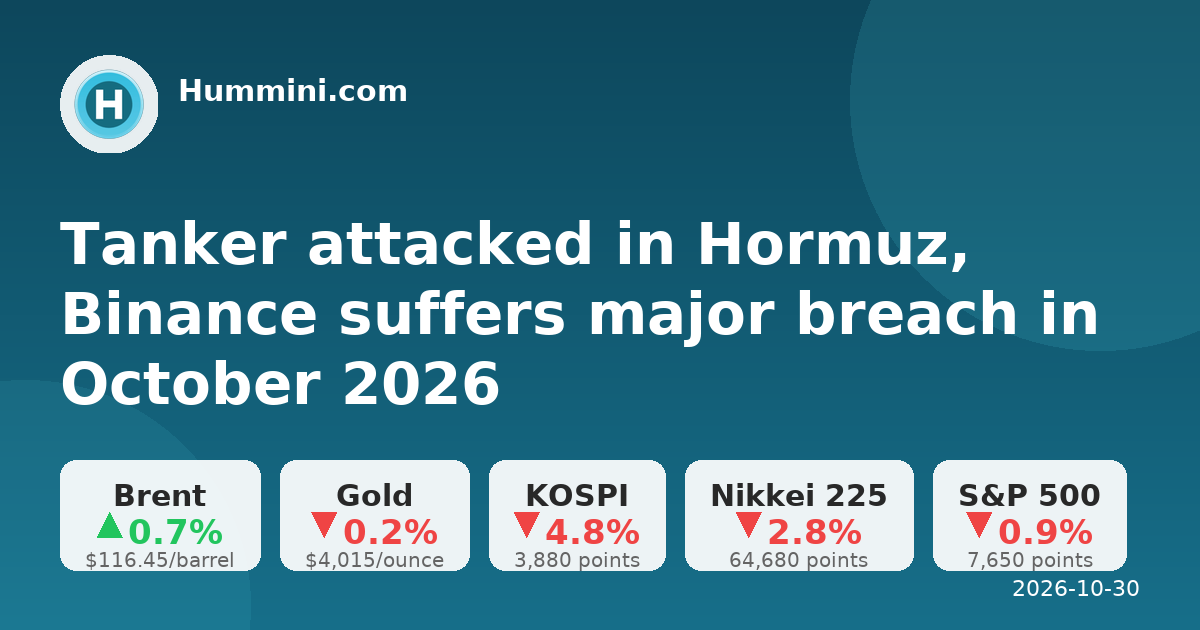
Tanker attacked in Hormuz, Binance suffers major breach in October 2026
khoảng 3 giờ trước
00WORLD TEMPERATURE
4/5. An explosive attack on an oil tanker in the Strait of Hormuz elevates energy security risks, while global financial and crypto markets reel from a historic security breach and tech sell-offs.
BRIEFING
Updated from 05:10 to 12:00 on October 30, 2026 (Hanoi time), covering only new events and fresh developments.
1. The oil tanker Louise 1 suffered an engine room fire after a small boat attached explosives to its hull in the Strait of Hormuz off Oman.
2. Cryptocurrency exchange Binance temporarily suspended all withdrawals after an exploit caused an estimated $6.3 billion in asset losses.
3. South Korea activated an emergency sell-side sidecar halt as KOSPI 200 futures dropped 5.12% amid mounting Big Tech AI spending concerns.
4. Expelled Cuban diplomat Richard Tur de la Concepción landed in Havana and received an official state welcome from Foreign Ministry leaders.
5. Israeli President Isaac Herzog publicly denied rumors of a backchannel pardon deal for Prime Minister Netanyahu and warned against repeat elections.
6. Senior US military commanders assessed that North Korean units in Russia are actively acquiring modern drone warfare lessons to bring home.
1. OIL TANKER ATTACKED WITH EXPLOSIVES IN STRAIT OF HORMUZ
The Panama-flagged oil tanker Louise 1 was approached by a small boat that attached explosive devices to its port hull in the southern corridor of the Strait of Hormuz on the morning of October 30, igniting an engine room fire and temporarily disabling the vessel, according to United Kingdom Maritime Trade Operations UKMTO.
The assault took place approximately 25 nautical miles northeast of Khasab, Oman, directly along the primary shipping route carrying one-fifth of the world's petroleum supply. UKMTO confirmed that the vessel's crew successfully extinguished the blaze after a two-hour battle and secured control of the tanker without suffering casualties or environmental oil spills. Conversely, Iran's Islamic Revolutionary Guard Corps IRGC claimed that the vessel detonated a naval mine after intentionally entering an unauthorized zone with its automatic identification transponders turned off.
The attack occurred as mediation efforts led by Qatar and Pakistan to restore maritime stability across the Persian Gulf faced persistent friction, just two days after an armed attack struck Saudi Arabia's East-West pipeline infrastructure.
Strategic significance: The boat-borne explosive attack introduces a dangerous asymmetrical tactic into the world's narrowest energy corridor. If regional actors continue conducting deniable guerrilla strikes against commercial vessels, commercial maritime war-risk premiums will surge, pushing major energy-importing powers toward stronger naval deterrent actions.
2. BINANCE SUFFERS 6.3 BILLION DOLLAR BREACH SUSPENDING WITHDRAWALS
Cryptocurrency exchange Binance announced on the morning of October 30 that it has temporarily suspended all network deposits and withdrawals after detecting a security breach resulting in an estimated $6.3 billion in digital asset losses, according to Bloomberg News.
According to preliminary findings by the exchange, an intruder compromised a DevOps engineer's workstation, gaining unauthorized access to an internal service container to initiate fraudulent withdrawal transactions to external addresses. Binance stressed that user wallet private key storage remained uncompromised. Binance co-founder Yi He pledged that the exchange will deploy its Secure Asset Fund for Users SAFU and corporate reserves to reimburse 100% of affected user funds. Through urgent coordination with stablecoin issuers Tether and Circle alongside law enforcement agencies, roughly $3 billion of the stolen tokens have already been frozen on-chain.
The breach represents the largest cyber loss in cryptocurrency history, unfolding while global capital markets are already experiencing elevated volatility from geopolitical friction and central bank interest rate adjustments.
Strategic significance: The historic incident exposes severe structural vulnerabilities within internal operational controls at major centralized crypto institutions. Beyond driving short-term capital flight from leading digital tokens, the breach is likely to give financial regulators in the United States and Europe fresh ammunition to enforce stringent custodial rules and cross-border oversight standards.
3. SOUTH KOREAN STOCKS TRIGGER SIDECAR HALT OVER AI SPENDING FEARS
The Korea Exchange activated an emergency sell-side sidecar order halt on the morning of October 30 to temporarily curb programmatic sell orders after KOSPI 200 futures plunged more than 5.1%, according to the Yonhap News Agency.
The five-minute program selling suspension took effect at 10:04 AM local time, representing the first sell sidecar triggered on the Seoul bourse in 11 trading sessions. By midday, the main KOSPI index traded down nearly 4.9%, led by steep drops in bellwether semiconductor makers with SK Hynix tumbling 8.5% and Samsung Electronics shedding more than 5%. Tokyo equities faced similar selling pressure as the Nikkei 225 declined 2.78% amid heavy liquidation across chip-making equipment manufacturers, despite the Bank of Japan deciding to maintain its benchmark policy rate at 1.25%.
The broad retreat across East Asian exchanges mirrored overnight selling on Wall Street, where tech giants including Amazon and Alphabet reported aggressive artificial intelligence infrastructure expenditure alongside extended free cash flow deficits.
Strategic significance: The erosion of confidence among Asian investors signals that global capital is increasingly scrutinizing the immediate commercial profitability of artificial intelligence capital spending. Until major technology providers demonstrate financial returns commensurate with hundreds of billions of dollars in capital expenditure, semiconductor and hardware supply chains throughout East Asia will remain vulnerable to severe valuation swings.
4. EXPELLED CUBAN DIPLOMAT WELCOMED HOME IN HAVANA AS HERO
Following an expulsion order issued by the United States giving him 24 hours to depart the country after a confrontation at the United Nations General Assembly, Cuban First Secretary Richard Tur de la Concepción arrived on an emergency flight at José Martí International Airport in Havana on the morning of October 30, according to Cuban state television.
First Deputy Minister of Foreign Affairs Gerardo Peñalver Portal and senior diplomatic staff met Tur directly at the aircraft stairs to welcome him as a defender of national sovereignty. The Cuban Ministry of Foreign Affairs released an official statement commending Tur for demonstrating firmness and dignity in the face of what it characterized as disrespectful provocation by the US delegation. In a public message, Tur declared that the Cuban people will stand firm against external pressure.
The government in Havana maintained that Washington's aggressive diplomatic action was designed to obscure its diplomatic isolation, coming immediately after the UN General Assembly voted by a margin of 130 votes to approve a resolution demanding the termination of the US trade embargo.
5. ISRAELI PRESIDENT REJECTS BACKROOM DEAL AND WARNS AGAINST REPEAT ELECTION
With the legislative vote count concluding in total parliamentary gridlock, Israeli President Isaac Herzog issued a formal statement on the morning of October 30 firmly dismissing media reports regarding a secret power-sharing and pardon agreement involving Prime Minister Benjamin Netanyahu, according to The Times of Israel.
President Herzog affirmed that his office will conduct statutory government-formation consultations strictly within constitutional procedures, beginning only after receiving verified election returns from the Central Elections Committee. The Israeli head of state urged leaders of all parliamentary factions to put aside factional rivalries, emphasizing that every measure must be taken to prevent the country from slipping into a fourth general election within two years.
The stalemate between Netanyahu's 53-seat bloc and the 48-seat opposition bloc headed by former IDF Chief of Staff Gadi Eisenkot leaves Arab factions holding 19 seats as potential kingmakers, though both main blocs remain hesitant to engage in direct negotiations with them.
6. US WARNS NORTH KOREAN TROOPS IN RUSSIA GAIN MODERN WARFARE LESSONS
Senior US military commanders in the Asia-Pacific region issued a strategic warning on October 30 stating that North Korean forces deployed in Russia are acquiring invaluable modern battlefield experience that they will take back to Pyongyang, according to Reuters.
Lieutenant General Joseph Hilbert, commander of the US Eighth Army, indicated that the deployment of an estimated 16,000 to 22,000 North Korean soldiers to Russia's Kursk region has afforded Pyongyang's military its first large-scale exposure to high-intensity warfare since 1953. North Korean personnel are actively adapting to tactical coordination involving reconnaissance drones, loitering suicide munitions, electronic warfare measures, and long-range logistics operations. In return for providing troops and millions of artillery shells to Moscow, Pyongyang is reportedly securing Russian ballistic missile telemetry technology alongside production capabilities for autonomous aerial drones.
The strategic intelligence assessment comes as intense border combat persists across the Kursk region while diplomatic mediation efforts in the Middle East have yet to achieve a decisive breakthrough.
Strategic significance: The transfer of operational doctrine and technological experience from European battlefields back to the Korean peninsula creates a potent asymmetrical security challenge for US allies across East Asia. As North Korean armed forces update their military posture with modern drone and missile systems supplied by Russia, traditional regional deterrence equations will face severe strain in the coming years.
NEXT 48–72 HOURS
In the Persian Gulf, international naval patrols are increasing surveillance along the western approaches to the Strait of Hormuz to guard against further small-boat explosive attacks against commercial energy shipments.
In Singapore and New York, technical teams from Binance are collaborating with blockchain forensics specialists to complete codebase security audits and publish an operational schedule for resuming withdrawal channels.
In Jerusalem, President Isaac Herzog formally receives finalized election certificates from the Central Elections Committee before opening a week-long schedule of direct consultations with faction leaders.
In Seoul and Tokyo, financial authorities and securities regulators will closely monitor market openings at the start of next week to evaluate systemic stability following Friday's semiconductor sell-off.
In Washington and Havana, diplomatic observers are monitoring potential secondary consular actions between both governments after the expelled Cuban envoy completed his return travel.
SOURCES
Event 1: UKMTO – Incident report: Explosion and fire on vessel 25NM NE of Khasab Oman – https://www.ukmto.org/incident-reports/2026/10/30/hormuz-louise1
Event 1: Reuters – Tanker catches fire in Strait of Hormuz after suspected explosive boat attack – https://www.reuters.com/world/middle-east/tanker-catches-fire-strait-hormuz-attack-2026-10-30/
Event 2: Bloomberg – Binance halts withdrawals after $6.3 billion security exploit – https://www.bloomberg.com/news/articles/2026-10-30/binance-halts-withdrawals-crypto-hack
Event 2: CoinDesk – Binance investigates container breach as $3 billion frozen on-chain – https://www.coindesk.com/policy/2026/10/30/binance-safu-devops-hack-freeze/
Event 3: Yonhap – Kospi 200 futures tumble triggers sell-side sidecar on KRX – https://en.yna.co.kr/view/AEN20261030004500320
Event 3: Nikkei Asia – Asian tech shares slide after Amazon capex shock and BOJ rate hold – https://asia.nikkei.com/Markets/Equities/Asian-tech-shares-slide-capex-amazon-boj
Event 4: Prensa Latina – Diplomático cubano regresa a La Habana tras expulsión de EEUU – https://www.prensa-latina.cu/2026/10/30/cuba-recibe-a-diplomatico-tras-arbitraria-expulsion-de-eeuu
Event 4: AP News – Expelled Cuban envoy lands in Havana to official welcome after UN clash – https://apnews.com/article/un-cuba-diplomat-welcome-havana-2026-10-30
Event 5: The Times of Israel – President Herzog rejects secret coalition deals, urges consensus to avert repeat vote – https://www.timesofisrael.com/herzog-rejects-backchannel-deal-urges-consensus-deadlock-2026/
Event 5: Haaretz – Herzog prepares party consultations as Knesset stalemate cements – https://www.haaretz.com/israel-news/elections/2026-10-30/herzog-consultations-stalemate-repeat-vote/
Event 6: Reuters – US generals say North Korean troops in Russia gaining critical drone war experience – https://www.reuters.com/world/asia-pacific/us-generals-north-korea-troops-russia-drone-experience-2026-10-30/
Event 6: The Wall Street Journal – North Korea parlays troop deployment into Russian tech and warfare training – https://www.wsj.com/world/asia/north-korea-troops-russia-tech-transfer-2026-10-30
Markets: Trading Economics – Global commodity markets and Asian trading indexes – https://tradingeconomics.com/commodity/brent-crude-oil
Markets: Investing.com – Global crypto and equity markets intraday update – https://www.investing.com/crypto/bitcoin
0 comments
Ads
Related Posts
Ads