Ads
The nuclear pendulum and a monumental leap in timekeeping
khoảng 2 giờ trước
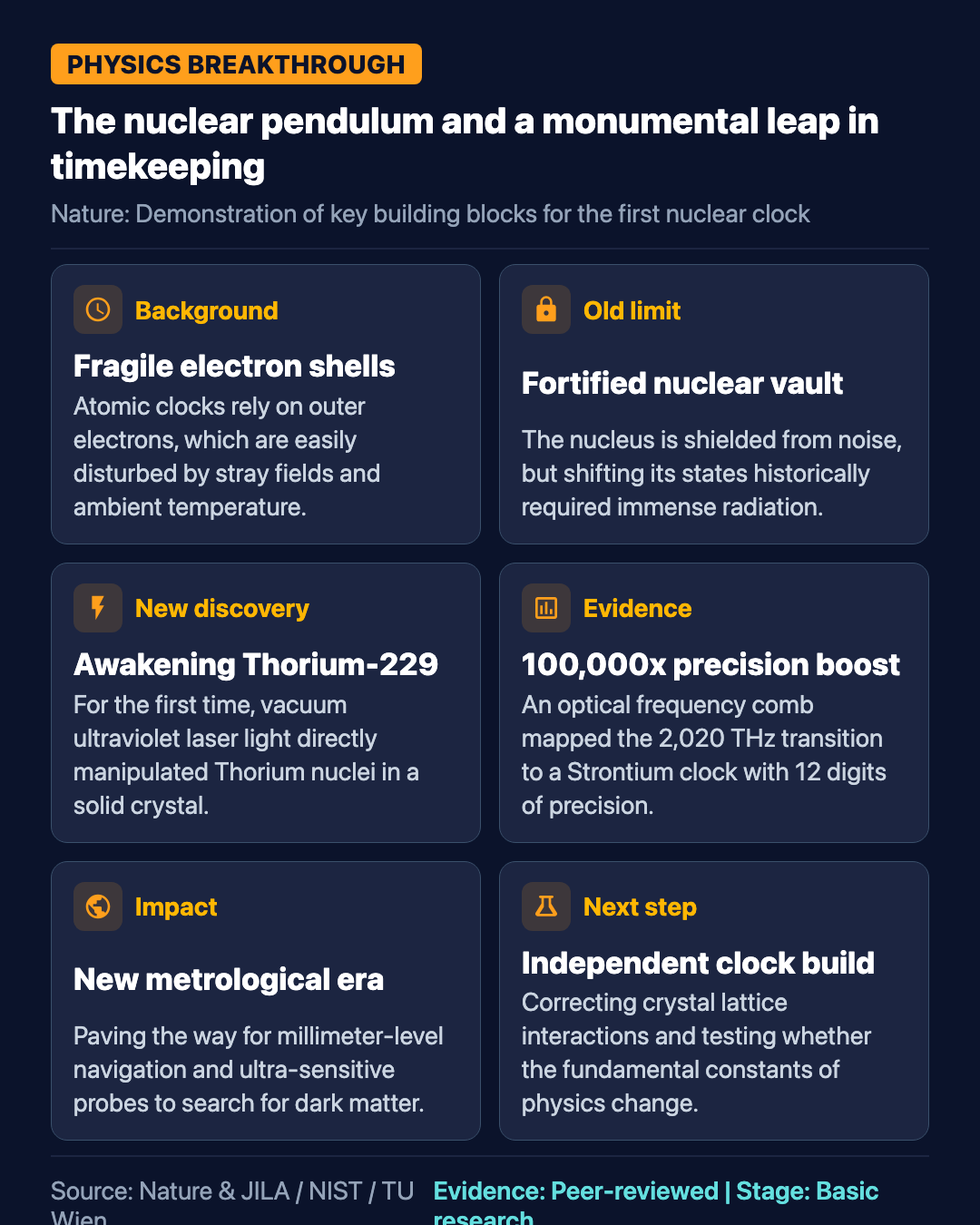
00If you have ever watched a grandfather clock sway, you know that the steady rhythm of a pendulum is the very soul of keeping time. Across our modern world, navigation satellites, the Internet, and financial transactions rely entirely on the invisible, rapid ticks of atomic clocks. Now, a historic milestone has been reached as physicists at JILA, together with the Vienna University of Technology, announced in Nature in September 2024 that they have successfully demonstrated all the essential building blocks of the world first nuclear clock.
Note – Atomic clock: A timekeeping device that tracks time by counting the regular energy jumps of electrons orbiting an atom, much like counting the steady rotations of a fan blade to measure seconds.
WHERE IS THE SECRET HIDDEN INSIDE THE ATOMIC HEART?
For nearly a century, humanity has measured time by bathing atoms in laser light or microwaves to count the rapid energy transitions of outer electrons. While today best optical atomic clocks lose less than one second over tens of billions of years, they possess an inherent vulnerability. The cloud of electrons sits on the atom outer fringes, leaving it sensitive to wandering stray magnetic fields and minute temperature fluctuations.
Physicists have long envisioned a nuclear clock, where the ticking originates not from the fragile outer shell, but from the dense atomic nucleus itself. Because the nucleus is insulated by the surrounding electron cloud, it acts like a clock pendulum sheltered inside a heavy bank vault, largely impervious to external electromagnetic noise.
Note – Atomic nucleus: The minuscule dense core at the center of an atom, roughly 100,000 times smaller than the atom itself, yet packing almost all of its mass.
Note – Nuclear clock: A proposed next-generation clock that measures time using oscillations deep inside the atomic nucleus, similar to placing a clock pendulum inside a fortified vault where outside storms cannot disturb it.
A BEAM OF LIGHT AWAKENS A QUIET NUCLEUS
Putting a clock inside a nuclear vault sounds appealing, but triggering it was long considered practically impossible. Shifting protons and neutrons between energy levels normally demands immense bursts of gamma radiation or violent nuclear reactions. No benchtop laser on Earth could gently steer such extreme energies.
Nature, however, provided a single extraordinary exception in the isotope Thorium-229. Among thousands of known atomic nuclei, Thorium-229 possesses an unusually tiny energy gap between its ground state and its excited state, placing it uniquely within reach of vacuum ultraviolet lasers.
Note – Thorium-229: A rare metallic isotope possessing a uniquely low-energy nuclear state, allowing its core particles to rearrange using a modest pulse of ultraviolet laser light.
The researchers embedded trillions of Thorium-229 nuclei into a transparent calcium fluoride crystal. By leveraging the solid-state crystal lattice, the nuclei were held firmly in place without the complex vacuum traps and laser cooling setups traditionally required for atomic clocks.
Note – Calcium fluoride crystal: A transparent mineral lattice resembling clear glass that securely holds billions of atomic nuclei in place without absorbing the laser beams used to read them.
A PRECISE RULER LINKS TWO GENERATIONS OF TIME
To detect the subtle nuclear ticks inside the crystal, the JILA team deployed a specialized vacuum ultraviolet optical frequency comb. They locked this frequency comb directly to the world leading Strontium-87 optical atomic clock. When the ultraviolet light illuminated the crystal, the comb teeth gently excited the Thorium nuclei, recording their transition frequency with an exceptional 12 digits of precision.
Note – Optical frequency comb: A specialized laser that emits thousands of sharp, evenly spaced wavelengths resembling the teeth of a hair comb, acting as an ultra-precise ruler for light frequencies.
The measurement pinpointed the nuclear transition at approximately 2,020 terahertz, representing more than two quadrillion oscillations per second. This experiment boosted measurement precision by a factor of 100,000 compared to prior attempts. By establishing a direct ratio between the Thorium nuclear oscillation and the Strontium atomic tick, the scientists forged the vital metrological bridge linking two timekeeping eras.
OPENING A GATEWAY INTO COSMIC MYSTERIES
This milestone delivers profound foundational value for humanity understanding of nature. For the first time, scientists have demonstrated coherent laser control over an atomic nucleus, opening a completely new frontier where laser spectroscopy meets nuclear physics.
When fully developed into an independent clock, this technology will benefit multiple high-tech domains. Deep-space navigation systems could carry rugged timekeepers immune to solar radiation. On Earth, millimeter-level satellite geodesy could monitor subtle shifts in tectonic plates to track seismic risks. Furthermore, embedding the nuclei inside a solid crystal promises much more compact and portable designs than current room-sized optical clock laboratories.
Significant distance remains, however, between this laboratory proof-of-principle and daily practical use. The research represents basic science demonstrating that all components can function together, rather than a standalone operational clock. While solid crystals offer portability, subtle interactions between the crystal lattice and the nuclei introduce small frequency shifts that require further characterization and systematic correction.
The next steps for researchers involve refining laser stability, synthesizing ultra-pure thorium crystals, and harnessing these nuclear oscillations to test whether fundamental physical constants remain truly constant over cosmic time.
SOURCES
Nature – Dawn of a nuclear clock: frequency ratio of the 229mTh isomeric transition and the 87Sr atomic clock – https://doi.org/10.1038/s41586-024-07839-6
National Institute of Standards and Technology (NIST) – Dawn of a Nuclear Clock: JILA and Partners Demonstrate All Key Components of a Nuclear Clock – https://www.nist.gov/news-events/news/2024/09/dawn-nuclear-clock-jila-and-partners-demonstrate-all-key-components-nuclear
TU Wien – Breakthrough for the Nuclear Clock – https://www.tuwien.at/en/tu-wien/news/news-articles/news/durchbruch-fuer-die-kernuhr
0 comments
Ads
Related Posts
Ads