Ads
A Simple Metal Hides a Strange New Form of Magnetism
2 ngày trước
00Place a paperclip next to a fridge magnet and it snaps right on. Place that same paperclip next to a deeply cooled crystal of europium silicide and nothing happens at all. Yet beneath that seemingly non-magnetic metal surface lies an unusual magnetic order that physicists had struggled to see clearly in a simple conductor. On November 18, 2026, an international team of 38 researchers from 19 institutions—led by Dr. Erjian Cheng and Prof. Claudia Felser at the Max Planck Institute for Chemical Physics of Solids in Dresden, alongside collaborators at ShanghaiTech University, the Hong Kong University of Science and Technology, and Oak Ridge National Laboratory—published compelling experimental evidence in Nature for p-wave magnetism inside metallic europium silicide, or EuSi.
HOW DO MAGNETS WORK INSIDE A PIECE OF METAL?
To understand why EuSi stands out, picture every electron moving through a metal as a tiny marble carrying a built-in microscopic compass needle. Physicists call this intrinsic quantum compass property spin.
Note – Electron spin: Spin is a fundamental quantum property that makes each electron behave like an ultra-tiny bar magnet with a north and south direction. Electrons are not physically spinning like toy tops, yet their spin governs how they respond to magnetic forces.
Inside an ordinary refrigerator magnet, billions of those tiny compasses line up in the same direction. Their pulls add together, creating an external magnetic field strong enough to cling to steel. By contrast, in another class of materials called antiferromagnets, neighboring atomic compasses point in strictly opposite directions like evenly matched tug-of-war teams, canceling out every trace of external magnetic pull.
Note – Ferromagnets and antiferromagnets: Ferromagnets are familiar magnets whose atomic magnetic moments align parallel to create an outward field. Antiferromagnets arrange neighboring moments antiparallel so their macroscopic pulls cancel to zero.
Materials scientists care deeply about these hidden magnetic orders because future electronics aim to encode information using electron spin rather than pushing bulky electric charges through wires, a shift that could cut heat and power waste.
WHAT CHANGED INSIDE EUROPIUM SILICIDE?
For years, theorists predicted a bizarre third category called p-wave magnetism. In this state, a material shows zero overall magnetic pull on the outside, yet electrons traveling inside experience striking spin rules. Earlier candidate materials were either electrical insulators, required extreme cooling down near 8 kelvin, or carried weak leftover magnetization that muddied experimental measurements.
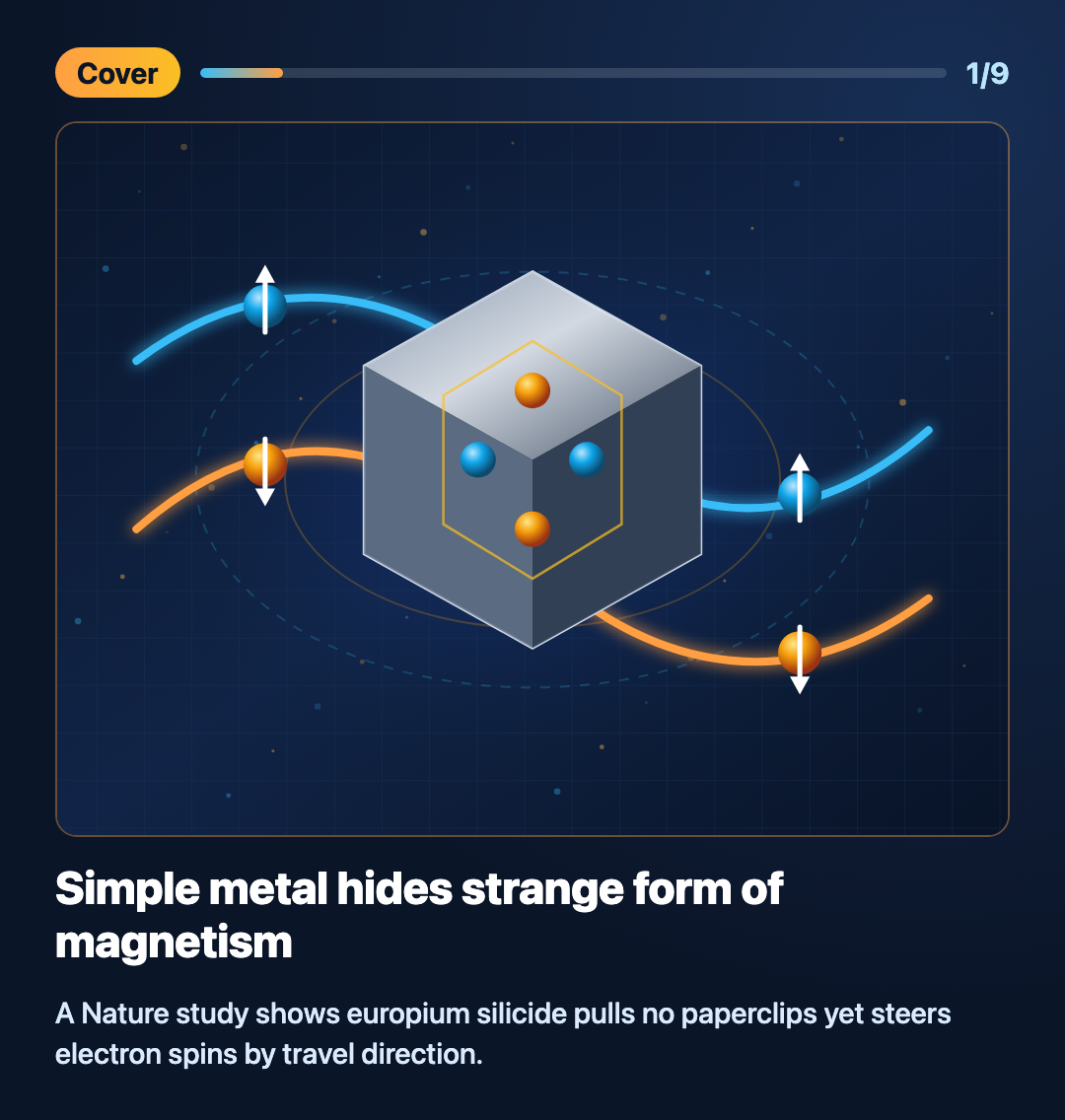
Note – p-wave magnetism: This unconventional magnetic state cancels out macroscopically like an antiferromagnet yet breaks spatial inversion symmetry so electrons moving in opposite directions carry opposite spins. Picture a two-lane highway where every eastbound car flashes a green beacon while every westbound car flashes an amber one.
In the new Nature study, the Dresden team grew high-purity single crystals of EuSi and cooled them into a window between 33.4 and 62 kelvin. Neutron measurements revealed that the magnetic moments of the europium atoms twist into a neat, repeating corkscrew spiral every three crystal steps. Because the spiral completes balanced turns across the lattice, outward magnetic pulls cancel completely, leaving zero net magnetization.
Note – Kelvin scale: Scientists measure absolute temperature in kelvin, where zero kelvin is the coldest possible state in nature at minus 273.15 degrees Celsius. The 33.4 to 62 kelvin window equals roughly minus 240 to minus 211 degrees Celsius, even colder than liquid nitrogen at minus 196 degrees Celsius.
Even without an external magnetic field, that internal spiral steers passing electrons strongly. Electrons racing one way carry one spin orientation, whereas electrons racing the opposite way carry the reversed spin orientation—driven mainly by direct magnetic exchange rather than weak relativistic effects.
HOW DID SCIENTISTS PROVE THE SPIRAL PATTERN?
The peer-reviewed Nature paper rests on four complementary experimental probes paired with theoretical symmetry calculations on real EuSi crystals.
First, the researchers sent beams of neutrons through cooled EuSi using neutron diffraction, much like taking an atomic-scale magnetic X-ray. The scattering confirmed that between 62 and 33.4 kelvin, europium moments settle into a flat chiral spiral phase matching p-wave symmetry criteria, before shifting into a conical arrangement below 33.4 kelvin.
Next, the team turned to angle-resolved photoemission spectroscopy, or ARPES, to track how electrons actually move inside the metal. Below 62 kelvin, magnetic ordering dramatically reshapes electron energy bands, opening magnetism-driven energy splits exceeding 100 millielectronvolts—far stronger than typical relativistic spin-orbit effects.
Note – Angle-resolved photoemission spectroscopy (ARPES): This laboratory tool shines intense light onto a crystal surface to knock electrons free, much like tapping a tray so marbles pop out. Measuring each escaped electron's exit angle and energy lets physicists reconstruct how electrons moved inside the solid.
To capture the signature of p-wave magnetism directly, the scientists added spin resolution to ARPES to sort outgoing electrons by spin direction. They observed the spin polarization flipping sign across successive magnetic momentum zones and dropping near theoretical zero-crossing regions. The authors note carefully that multiple folded electron bands overlap near that energy window, meaning the signal provides strong spectroscopic evidence consistent with a p-wave spin texture rather than isolating a single textbook band.
Finally, magnetic force microscopy and spatially focused photoemission with circularly polarized light revealed that EuSi naturally splits into spiral patches twisting in opposite directions, each roughly 10 micrometers wide—about one-tenth the thickness of a human hair. Left-twisting and right-twisting regions responded differently to twisted light, confirming that spiral handedness directly shapes electron behavior.
Note – Chirality: Chirality describes two shapes that are mirror images of each other yet cannot be overlaid cleanly, just like your left and right hands. Inside EuSi, even though the atomic framework looks symmetric, the magnetic spiral can twist either left-handed or right-handed.
WHAT DOES THIS MEAN FOR FUTURE TECHNOLOGY?
First and foremost, EuSi expands fundamental physics by providing a chemically simple, clean metallic platform where p-wave magnetism emerges without stray external fields. Because single crystals can be grown reliably and its spiral window sits well above earlier 8-kelvin metal candidates, EuSi gives condensed-matter physicists, spintronics engineers, and quantum-matter researchers a practical workbench to test odd-parity quantum predictions.
Note – Spintronics: Spintronics is an emerging approach to computing and memory that uses electron spin rather than electric charge flow alone to carry information. Because it avoids moving large currents through resistive wires, spin-based hardware could run faster and cooler.
Still, this milestone remains strictly basic laboratory research, many years away from everyday electronics. Its sharpest practical limitation is temperature: the p-wave spiral phase disappears above 62 kelvin, requiring specialized cryogenic cooling. Moreover, the researchers emphasize that predicted payoffs—such as spin-polarized currents without an external magnet or unconventional superconductivity—have not yet been demonstrated in EuSi itself. Next, teams plan to drive electrical currents across individual chiral domains to test spin transport directly while searching for related metals that preserve p-wave magnetism closer to room temperature.
SOURCES
Nature – Evidence for p-wave magnetism in electronic band structure of metallic EuSi – https://www.nature.com/articles/s41586-026-11295-9
Max Planck Institute for Chemical Physics of Solids – A New Kind of Magnetism in a Simple Metal – https://www.cpfs.mpg.de/3772423/20261118
ScienceDaily – A simple metal is hiding a strange new form of magnetism – https://www.sciencedaily.com/releases/2026/11/261123005341.htm
0 comments
Ads
Related Posts
Ads