Ads
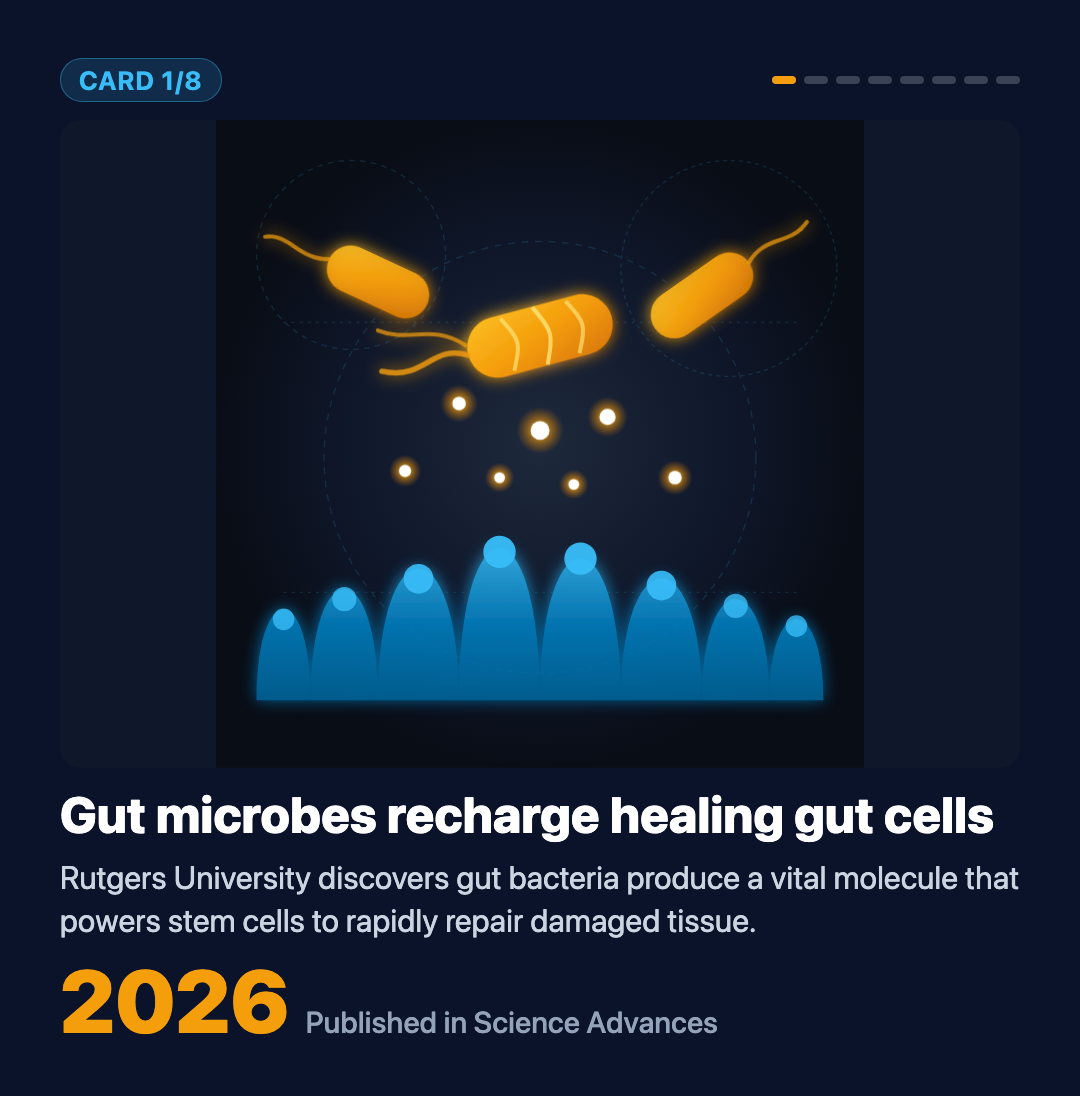
Gut microbes fuel stem cells to heal the intestines
4 ngày trước
00WHY THE GUT NEEDS CONSTANT REPAIR
Our digestive tract resembles a bustling tiled hallway where billions of food particles and microbes continuously transit each day. To prevent the surface from grinding down or breaking open, the body completely replaces its entire mucosal lining every three to five days. On November sixth twenty twenty-six, researchers at Rutgers University published a striking discovery in the journal Science Advances, revealing that beneficial gut bacteria produce a specialized molecule capable of directly recharging master stem cells to rapidly repair severely ulcerated intestinal tissue.
Note – Commensal gut bacteria: Friendly microorganisms naturally residing within the digestive tract, acting like a specialized custodial and defense crew that helps digest food and guard against harmful pathogens.
HOW CELLULAR BATTERIES NORMALLY WORK
Inside every living cell, vital metabolic activities depend on an essential helper molecule called NAD+. One can envision NAD+ as a miniature rechargeable battery that transports energy packets to allow the cell machinery to divide, repair wear, and maintain life. Hidden deep inside intestinal crypts are master stem cells tasked with molding fresh mucosal lining tiles. Working around the clock, these biological bricklayers consume enormous amounts of energy. However, with aging or during chronic intestinal inflammation, cellular NAD+ stores plunge drastically, bringing tissue construction to a halt and leaving painful ulcers wide open.
Note – NAD+ coenzyme: A vital helper molecule found inside every living cell, functioning like a rechargeable battery that shuttles energy to maintain cellular metabolism and tissue renewal.
Note – Intestinal stem cells: Specialized master cells stationed at the base of the intestinal lining, acting like dedicated builders that continuously produce new cells to replace worn tissue.
WHAT CHANGED ABOUT OUR SCIENTIFIC UNDERSTANDING
Biomedical scientists long believed that humans could only rely on dietary precursors for cells to slowly synthesize NAD+, or on external supplements that struggle to survive digestion intact. Methylated molecular fragments were traditionally written off as useless metabolic waste meant for urinary excretion. Yet the Rutgers research team uncovered a surprising biological reversal. Certain beneficial gut bacteria generate an isomer molecule termed N-MNA. Unlike human metabolic waste, this bacterial molecule possesses a distinct structural shape that intestinal cells can rapidly absorb and convert directly into active NAD+ batteries without complex intermediate steps.
Note – N-MNA molecule: A distinct chemical metabolite produced by beneficial gut microbes, shaped like a custom key that intestinal cells can rapidly absorb and convert into ready-to-use NAD+ batteries.
HOW RESEARCHERS UNCOVERED THE CELLULAR EVIDENCE
Employing stable-isotope tracing and modern sequencing, the team tracked individual atoms of the bacterial N-MNA molecule as they journeyed straight into animal and human intestinal cells. Laboratory assays confirmed that when exposed to N-MNA, gut stem cells immediately ramped up proliferation and tissue regeneration.
Note – Stable-isotope tracing: A technique that tags molecules with heavier atomic labels to follow their exact journey through living systems, much like tracking a parcel using GPS.
In preclinical animal experiments using mice suffering from severe ulcerative colitis, the therapeutic difference was remarkable. Untreated control mice lost twenty percent of their body weight and faced severe mortality due to intestinal necrosis. In contrast, mice receiving N-MNA supplementation lost only around five percent of their weight, displayed drastically reduced ulceration, and experienced rapid tissue healing with surging survival rates. In fruit fly models with chemically damaged gut walls, the molecule similarly extended lifespan and fortified gut barrier integrity. Crucially, when examining stool samples from human patients with active inflammatory bowel disease, researchers detected severely depleted levels of N-MNA compared to healthy controls, linking the absence of this microbial metabolite directly to human gut pathology.
Note – Inflammatory bowel disease (IBD): A group of chronic conditions involving long-term inflammation of the digestive tract, causing painful tissue ulceration and breaking down the gut protective barrier.
WHAT THIS MEANS FOR THE FUTURE OF MEDICINE
This breakthrough grants science a clearer window into the profound mutualistic bond between the human microbiome and our tissue regeneration systems. Rather than viewing gut bacteria merely as passive guests consuming food remnants, the study reveals they function as mobile recharging stations directly fueling the host biological machinery.
The primary future beneficiaries will be tens of millions of people currently enduring chronic inflammatory bowel conditions such as ulcerative colitis and Crohn disease. Instead of relying indefinitely on heavy immunosuppressant medications that carry severe side effects, modern medicine could engineer targeted next-generation probiotics or metabolic therapies that stimulate the intestinal lining to heal naturally from within.
Nevertheless, the road from laboratory discovery to approved pharmacy medicine will still require several years of extensive research. These findings represent preclinical research validated in animal models and human biological specimens, not an approved clinical therapy, and patients must never alter their medical treatments based on preliminary findings. Key scientific unknowns remain, including whether prolonged supplementation might cause unexpected effects on other organs or whether cancer cells could potentially exploit this fuel source.
The next steps for the research team include pinpointing the exact bacterial strains with the highest N-MNA synthesis capacity and optimizing formulation delivery for forthcoming human clinical safety trials.
SOURCES
Science Advances – The (amide-)N-methylnicotinamide is a microbe-derived NAD+ precursor that drives gut stem cell renewal – https://doi.org/10.1126/sciadv.aef2882
Rutgers University – Microbe-Derived Metabolite Powers Gut Regeneration – https://www.rutgers.edu/news/microbe-derived-metabolite-powers-gut-regeneration
EurekAlert – Gut microbes produce novel NAD+ precursor that fuels intestinal healing – https://www.eurekalert.org/news-releases/1063421
0 comments
Ads
Related Posts
Ads