Ads
Forty year mystery of high temperature superconductivity finally resolved
khoảng 7 giờ trước
00FORTY YEAR MYSTERY OF HIGH TEMPERATURE SUPERCONDUCTIVITY FINALLY RESOLVED
Imagine your smartphone charging all day without warming up a single degree, or a massive bullet train gliding quietly above its tracks with zero friction. This is not science fiction, but the long-held promise of superconductivity, where electricity flows forever without resistance. Yet for over a century, the dream of bringing superconductors into daily life has been blocked by an unforgiving temperature barrier colder than deep space.
On November 5, 2026, an international research team led by physicists from Leiden University, Utrecht University, and LMU Munich published a milestone discovery in the journal Science. Using a specialized electron microscope, they discovered that electrons secretly pair up at room temperature long before resistance disappears, completely overturning a forty-year paradigm in condensed matter physics.
WHAT WAS THIS PROBLEM ORIGINALLY ABOUT?
Normally, electrical current flowing through a metal wire resembles a hurried crowd pushing through a narrow, cluttered street. Moving electrons constantly collide with vibrating atoms in the wire, losing kinetic energy as wasted heat. This resistance is why lightbulbs glow and computers heat up during heavy workloads.
Superconductivity occurs when this electrical resistance drops entirely to zero. To achieve this marvel, two electrons, which naturally repel each other due to matching negative charges, must overcome their aversion and bind into a Cooper pair. Once paired, they behave like synchronized ice skaters holding hands, smoothly gliding past obstacles without colliding. In traditional superconductors, however, this bond is as fragile as a spider silk. If the temperature rises above minus two hundred and sixty degrees Celsius, violent thermal vibrations tear the pairs apart, destroying superconductivity instantly.
Note – Superconductivity: A physical state in which materials conduct electrical current without resistance or heat generation, like a frictionless slide that lets an object coast indefinitely.
Note – Cooper pair: Two electrons temporarily bound together in quantum coordination to glide through matter without colliding, like two dancers holding hands through a crowd.
WHAT HAS CHANGED COMPARED TO BEFORE?
In 1986, scientists discovered copper-oxide materials known as cuprate crystals, which can superconduct at significantly warmer temperatures, though still requiring liquid nitrogen cooling at minus one hundred and forty degrees Celsius. Curiously, when cuprates are warmed to room temperature, an enigmatic energy void appears, known as the pseudogap.
For forty years, a fierce debate divided physicists worldwide. One camp argued the pseudogap signaled preformed electron pairs that had formed but were not yet coordinating. The opposing camp maintained the pseudogap was a rival state acting like potholes that actively prevented pairs from forming. Most experts assumed that at room temperature, environmental thermal energy was simply too violent for any electron pairs to survive.
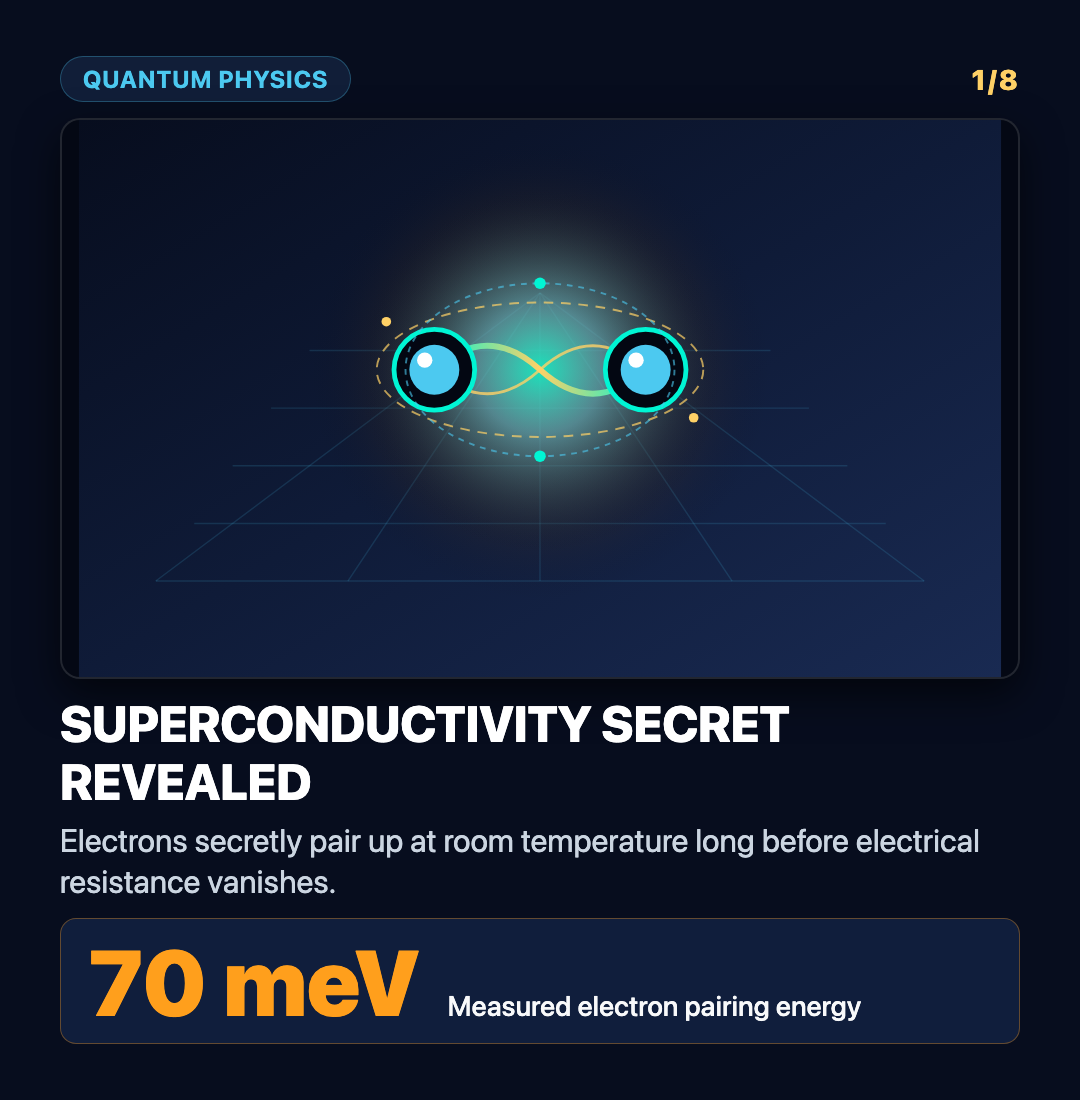
The study in Science ended four decades of debate with direct experimental data. The researchers demonstrated that the pseudogap energy matches the electron pairing energy. Electron pairs can indeed stably form and persist at room temperature, exhibiting local binding energies reaching up to 70 millielectronvolts. The primary barrier to room-temperature superconductivity is not forming pairs, but an entirely different requirement: phase coherence.
Note – Cuprate crystal: A family of ceramic materials containing alternating copper and oxygen planes, capable of superconductivity at much higher temperatures than conventional metals.
Note – Pseudogap: A peculiar electronic state in cuprate materials at warm temperatures where electrons appear primed for superconductivity but electrical resistance still persists.
HOW DID SCIENTISTS PROVE THIS?
To crack this puzzle, researchers at Leiden University and Utrecht University deployed local shot-noise spectroscopy combined with scanning tunneling microscopy on a cuprate crystal called Bi-2212. Think of listening to raindrops on a metal roof. Single raindrops produce distinct gentle taps, whereas raindrops falling in bonded pairs create a louder, rhythmic crackle with a distinct acoustic signature.
By bringing an atomically sharp metal tip within nanometers of the crystal surface, the physicists collected tiny currents tunneling across the vacuum gap. The ultrasensitive shot-noise detector recorded the crackle of the quantum current. When analyzing this noise, the instruments detected electric charges equal to twice the charge of an ordinary electron, providing undeniable proof of Cooper pairs actively tunneling.
Surveying numerous locations across the crystal, the researchers found that wherever a pseudogap opened up, paired electron currents were invariably detected. The measured pseudogap energy aligned with the energy required to break an electron pair. This peer-reviewed experimental study provided quantitative evidence, replacing decades of theoretical speculation.
Note – Shot noise: Electronic noise caused by the discrete arrival of individual charge carriers, like pebbles rattling against the metal bed of a moving truck.
WHAT DOES THIS FINDING MEAN FOR HUMANITY?
The greatest fundamental value of this breakthrough is redrawing humanity's roadmap for superconductivity research. We now know the real bottleneck blocking ambient-temperature superconductors. Nature already allows electrons to bind into pairs at room temperature. The remaining hurdle is guiding these pairs into global phase coherence.
Picture a vast ballroom where thousands of couples are holding hands. The couples have formed, but each pair is dancing to an independent rhythm, leaving the floor congested. Phase coherence is the shared musical beat broadcast across loudspeakers that causes every couple to step in unison. When millions of electron pairs march to a single quantum wave, they flow through the atomic lattice like a frictionless fluid, and electrical resistance vanishes.
Energy and technological sectors stand to benefit tremendously once humanity learns to conduct this shared quantum rhythm. Today, approximately fifteen percent of global electricity is lost as heat along power transmission lines. Room-temperature superconducting cables would allow transporting clean energy from desert solar farms across continents without losing a single kilowatt. Furthermore, hospital MRI scanners could become far more compact and affordable without requiring thousands of liters of expensive liquid helium. High-speed transportation could also see widespread levitating maglev trains gliding quietly at airplane speeds.
Nevertheless, the road from basic physics to everyday devices remains a multi-year journey. This is foundational science that resolves a core theoretical bottleneck rather than an immediate commercial product. Scientists still need to understand why electron pairs lose phase alignment as temperatures rise, and how crystal structures can be tailored to preserve their unified rhythm.
The next step for the scientific community is synthesizing new cuprate formulations and exploring external triggers, such as chemical pressure or tailored electromagnetic fields, to lock the electron pairs into phase synchrony. The gateway to a frictionless energy era is now open wider than ever.
Note – Phase coherence: A quantum condition in which waves oscillate in perfect synchrony, like an entire orchestra performing in lockstep with the conductor's baton.
SOURCES
Science – Equivalence of pseudogap and pairing energy in a cuprate high-temperature superconductor – https://doi.org/10.1126/science.adt3444
Universiteit Utrecht – Cooper pairs form at much higher temperatures than expected – https://www.uu.nl/en/news/cooper-pairs-superconductivity-pseudogap
Universiteit Leiden – Resolving the 40-year pseudogap mystery in high-temperature superconductors – https://www.universiteitleiden.nl/en/news/2026/cooper-pairs-pseudogap
0 comments
Ads
Related Posts
Ads