Ads
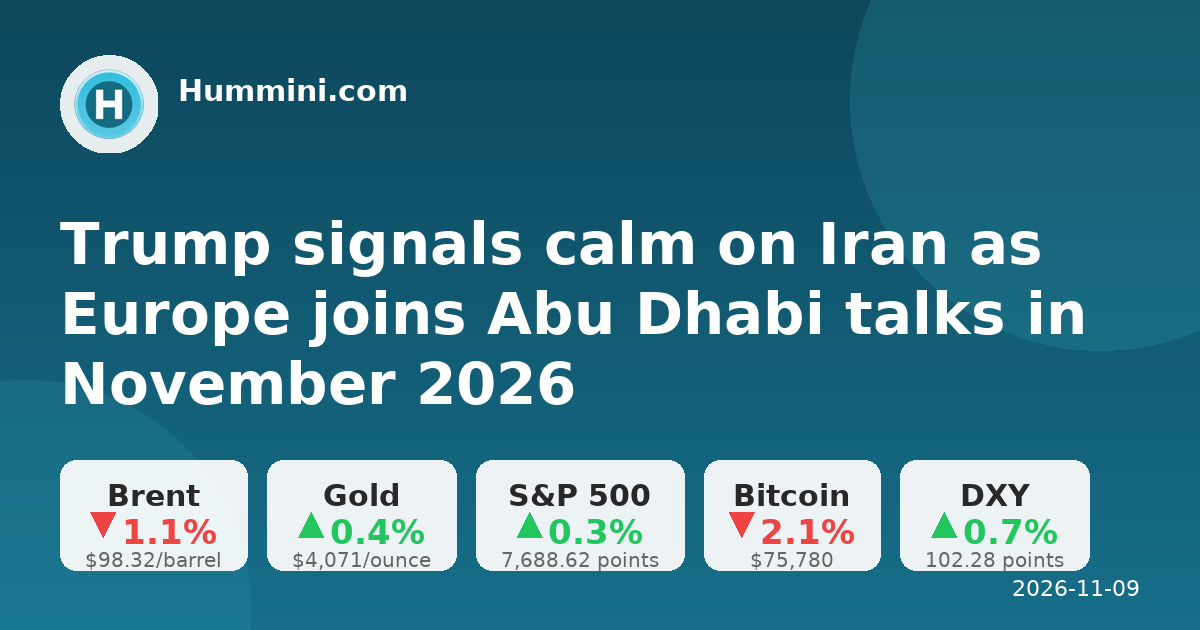
Trump signals calm on Iran as Europe joins Abu Dhabi talks in November 2026
khoảng 3 giờ trước
00WORLD TEMPERATURE
4.0/5. Diplomatic signals of de-escalation in the Middle East and multilateral maneuvers surrounding Ukraine offer a slight counterbalance to devastating strikes on energy grids and post-election political friction.
BRIEFING
Updated from 19:10 on November 8 to 05:00 on November 9, 2026 (Hanoi time), covering only new events and fresh developments.
1. President Donald Trump announced that fresh U.S. military strikes against Iran are highly unlikely if talks progress, even as CENTCOM activated a new task force to squeeze overland logistics.
2. French Foreign Minister Jean-Noël Barrot confirmed that European nations will attend the November 10–11 Abu Dhabi security talks, rejecting Moscow's efforts to exclude Europe.
3. Russian forces launched over 160 drones and missiles cutting power to 850,000 Ukrainian consumers, while Ukrainian drones struck a critical bridge along the R-280 highway in Rostov.
4. Staff at CAISSI, the federal frontier AI safety watchdog under the Commerce Department, were instructed to informally report directly to the White House.
5. U.S. Treasury Secretary Scott Bessent pressed Chinese Vice Premier He Lifeng to immediately honor Busan trade commitments regarding rare earths and farm purchases ahead of APEC.
6. Financial markets displayed sharp divergence as gold held firm above 4,000 dollars an ounce, Brent crude settled near 98 dollars a barrel, and Bitcoin retreated to 75,780 dollars.
1. TRUMP SIGNALS EASING OF IRAN STRIKES AS CENTCOM LAUNCHES TASK FORCE IRON GATE
On the evening of November 8, U.S. President Donald Trump stated that ordering fresh military strikes against Iran is currently highly unlikely, provided that ongoing indirect negotiations continue to yield genuine progress, according to an interview with CNN. Trump stressed that averting further military escalation hinges entirely on Tehran signing a very strong agreement to curb its nuclear ambitions and guarantee the full reopening of maritime traffic through the Strait of Hormuz. While dialing down immediate threats of air campaigns, the U.S. leader cautioned that Washington has mapped out 38 critical bridges across Iranian territory that could be destroyed in literally one hour if negotiations collapse, emphasizing that three U.S. aircraft carrier strike groups remain deployed in the region at maximum operational readiness.
Simultaneously, U.S. Central Command (CENTCOM) formally activated a dedicated specialized cell designated as Task Force Iron Gate, headquartered at MacDill Air Force Base in Florida. Shifting operational focus away from the maritime blockade of southern ports, the interagency team of approximately 20 military and civilian personnel will coordinate with the Treasury Department to track and choke illicit flows of weapons, dual-use industrial hardware, and covert revenue streams across Iran's land borders with Iraq, Turkey, and Pakistan, as well as Caspian Sea routes connected to Russia. Spokespersons for the Islamic Revolutionary Guard Corps (IRGC) swiftly dismissed the initiative, characterizing the American unit as mere wordplay and asserting that Washington cannot isolate Tehran or sever its cross-border commerce with regional neighbors.
Strategic significance: The severe political setbacks suffered by Republicans in the recent midterm elections have heightened pressure on the White House to engineer an off-ramp from a costly foreign entanglement, though the preconditions demanded by Washington remain extraordinarily steep for Tehran. The rollout of Task Force Iron Gate signals a strategic transition from kinetic airstrikes toward prolonged economic strangulation and supply-chain interdiction, designed to coerce Iranian concessions at the bargaining table without the domestic risks of igniting an uncontrollable regional war.
2. FRANCE AND EUROPEAN UNION CONFIRM PARTICIPATION IN ABU DHABI PEACE TALKS
Responding to Kremlin attempts to sideline European capitals from upcoming security talks, French Foreign Minister Jean-Noël Barrot declared on November 8 that European nations, including France, will be present in Abu Dhabi to take part in negotiations scheduled for November 10–11, according to RTL radio. The French diplomatic chief insisted that Europe will be thoroughly represented and stated firmly that continental powers will not let anyone speak on their behalf. The message was delivered directly to American mediators led by Special Envoy Steve Witkoff, making clear that European leaders will reject any post-war security framework negotiated bilaterally between Washington and Moscow that ignores continental interests.
The public stance from Paris directly upends the restrictive trilateral format advocated by Moscow, following remarks from Kremlin spokesman Dmitry Peskov who insisted that the discussions in the United Arab Emirates should involve solely the United States, Russia, and Ukraine. Friction escalated further as Pyotr Tolstoy, Chairman of the State Duma Foreign Affairs Committee, reiterated that Moscow views the prospective deployment of Western peacekeeping or security forces on Ukrainian soil as an unacceptable red line.
Strategic significance: The firm stance taken by Paris exposes deep anxieties among European leaders that their core security interests could be compromised in an expedited deal struck between Washington and Moscow. By asserting an undeniable seat at the Abu Dhabi summit, France and EU allies are erecting a diplomatic firewall to deter unilateral American concessions, ensuring that any future ceasefire architecture incorporates binding, enforceable guarantees anchored in Europe's broader defensive posture.
3. RUSSIAN STRIKES LEAVE 850,000 WITHOUT POWER AS UKRAINE HITS ROSTOV BRIDGE
Russian forces unleashed a massive wave of over 160 attack drones and cruise missiles targeting Ukraine's power grid early on November 8, plunging nearly 850,000 consumers into widespread blackouts, according to Al Jazeera. The eastern Dnipropetrovsk region sustained the heaviest blow with more than 600,000 residents left without electricity following catastrophic damage to transmission substations, forcing critical medical facilities onto emergency generators, according to private energy operator DTEK. Utility officials warned that secondary aerial bombardments severely hampered grid restoration efforts. In neighboring Kharkiv, an infrastructure strike near Zlatopil severed electricity for another 250,000 customers. Concurrently, the Russian Defense Ministry claimed its strikes hit two power substations feeding Ukraine's military-industrial complex and crippled three cargo vessels docked at Odesa and Chornomorsk alleged to be carrying Western munitions.
In retaliation, Ukrainian long-range strike drones targeted energy installations and scored a direct hit on the vital bridge spanning the Mius River along the R-280 highway in Russia's Rostov Oblast, according to the Kyiv Independent. The attack inflicted substantial structural damage on the bridge, causing localized outages and choking a primary logistical artery linking mainland Russia with military formations across occupied southern Ukraine and the Crimean peninsula.
This exchange of heavy strikes occurred on the eve of the Abu Dhabi diplomatic summit and as freezing winter weather sets in, transforming public utility networks into primary theaters of attrition.
Strategic significance: The mutual surge in infrastructure destruction demonstrates that both Moscow and Kyiv are attempting to lock in maximum battlefield leverage ahead of diplomatic engagement. Russia is weaponizing the onset of winter to break Ukrainian civilian resilience through systematic grid degradation, while Ukraine is targeting narrow logistical chokepoints like the Rostov transit route to starve Russian frontline logistics and disrupt troop repositioning.
4. WHITE HOUSE DIRECTS FEDERAL AI SAFETY REGULATOR TO BYPASS NORMAL REPORTING
Technical staff at the Center for Advancing Innovation and Standards for Super Intelligence (CAISSI), the specialized federal division under the Commerce Department, were recently instructed to informally report directly to a White House office, according to an investigative report published on November 8 by the Associated Press. The unusual directive bypassed established scientific oversight channels within the National Institute of Standards and Technology (NIST) and coincided with an unannounced halt in the release of CAISSI's public safety evaluation reports. The agency has been operating without a permanent director following successive departures of leadership earlier in 2026 over strategic disputes.
Policy analysts from the Federation of American Scientists (FAS) and members of Congress voiced urgent alarm that subjecting a technical evaluation unit to executive political supervision threatens its scientific objectivity. Critics cautioned that crucial assessments concerning biological weapons risks, cyber vulnerabilities, and autonomous model behavior could be toned down or shelved to advance deregulatory agendas and protect domestic tech commercialization.
The internal shakeup emerged shortly after Nobel laureate Geoffrey Hinton and European Catholic bishops warned against catastrophic threats posed by autonomous artificial intelligence, conflicting with the Trump administration's commitment to eliminating regulatory obstacles for American tech enterprises.
Strategic significance: Consolidating White House oversight over CAISSI highlights an acute clash between the drive for private-sector technological supremacy and the responsibility to insulate society from catastrophic systemic hazards. By eroding independent technical verification, the administration is clearing path friction for commercializing next-generation frontier models, even as scientific consensus warns of unverified risks.
5. US PRESSES CHINA ON BUSAN TRADE ACCORD AHEAD OF POTENTIAL APEC SUMMIT
Following confirmation that Beijing and Moscow are exploring a trilateral summit between Xi Jinping, Donald Trump, and Vladimir Putin at the APEC forum in Shenzhen, Washington applied immediate economic pressure through a virtual conference between Treasury Secretary Scott Bessent, Trade Representative Jamieson Greer, and Chinese Vice Premier He Lifeng, according to the South China Morning Post. The American delegation demanded that Beijing immediately and fully implement provisions of the Busan trade truce, emphasizing the unhindered flow of rare earth exports, access to key industrial data, and accelerated purchases of American farm goods. Bessent stated on social media that substantive progress in bilateral economic relations must be grounded in concrete results rather than diplomatic platitudes.
Vice Premier He Lifeng countered by raising sharp objections against recent unilateral technology export bans imposed by Washington. The Chinese official maintained that expanded commodity purchases remain contingent upon the reciprocal reduction and dismantling of U.S. tariffs. Despite contentious friction over compliance, both economic powers agreed to keep communication channels open to prevent trade disputes from spoiling broader bilateral engagements.
Strategic significance: This economic clash illustrates Washington's playbook of leveraging high-stakes summitry to secure immediate commercial concessions. By exerting aggressive pressure on rare earths and agricultural procurement on the eve of APEC, the U.S. administration aims to constrain China's host leverage, demanding substantive trade compliance as the price of admission for a symbolic diplomatic victory.
6. GOLD HOLDS ABOVE 4,000 DOLLARS AS BITCOIN SLIPS TOWARD 75,000 DOLLARS
Global financial markets began the trading week on November 9 in a state of pronounced divergence, with spot gold maintaining its ground above the historic 4,000 dollar per ounce threshold while Bitcoin retreated toward 75,780 dollars, according to data from Bloomberg and Trading Economics.
Spot gold traded near 4,071 dollars per ounce, consolidating its most substantial weekly advance in months as investors sought refuge against heightened geopolitical uncertainty across the Middle East and Eastern Europe, shrugging off a brief pullback spurred by stronger-than-expected U.S. employment figures on November 7. Concurrently, Brent crude held steady near 98.32 dollars a barrel as traders weighed conciliatory signals from the U.S. president regarding Iran against persistent transit risks. In stark contrast to precious metals, Bitcoin failed to defend the 80,000 dollar high reached immediately following the U.S. midterms, slipping back to 75,780 dollars amid persistent net redemptions from digital asset ETFs and cautious rotation out of high-beta tech holdings.
The opposing flows between defensive and speculative assets underline market caution as traders position for upcoming U.S. consumer inflation data and the geopolitical outcomes of upcoming peace summits.
NEXT 48–72 HOURS
The trilateral security talks regarding Ukraine in Abu Dhabi are scheduled to convene on November 10–11, featuring the participation of French and European diplomats aiming to safeguard continental interests against bilateral compromises between Washington and Moscow.
The COP31 UN Climate Change Conference in Antalya, Turkey, begins ministerial plenary discussions on November 9 focusing on loss-and-damage financing mechanisms, without formal U.S. federal delegation attendance.
In Israel, opposition leader Gadi Eisenkot commences his 28-day constitutional mandate to assemble a national emergency coalition, confronting fierce political resistance from Benjamin Netanyahu's conservative bloc.
The U.S. Department of Labor is scheduled to release October Consumer Price Index (CPI) inflation data midweek, serving as a critical barometer for Federal Reserve rate policy following the shift in congressional control.
SOURCES
Trump signals easing of Iran strikes as CENTCOM launches Task Force Iron Gate:
CNN – Donald Trump says new military strikes on Iran highly unlikely as talks continue – https://cnn.com/2026/11/08/politics/trump-iran-cnn-interview
CENTCOM – Establishment of Task Force Iron Gate to counter illicit Iranian supply networks – https://centcom.mil/media/press-releases/task-force-iron-gate-iran
The Jerusalem Post – Trump says 38 Iranian bridges identified if strikes resume – https://jpost.com/middle-east/iran-news/article-828104
France and European Union confirm participation in Abu Dhabi peace talks:
RTL – Jean-Noël Barrot confirme la présence de la France aux négociations d'Abou Dabi – https://rtl.fr/actu/international/guerre-en-ukraine-pourparlers-abou-dabi-barrot-7900438192
The Kyiv Independent – France announces European participation in Abu Dhabi talks despite Russian objections – https://kyivindependent.com/france-announces-europe-abu-dhabi-talks
Ukrainska Pravda – European officials coordinate stance ahead of UAE security summit – https://pravda.com.ua/eng/news/2026/11/08/7483521
Russian strikes leave 850,000 without power as Ukraine hits Rostov bridge:
Al Jazeera – Russian strikes knock out power for 850,000 consumers across Ukraine – https://aljazeera.com/news/2026/11/08/ukraine-blackouts-russian-strikes-energy
DTEK – Emergency restoration ongoing after massive hits on Dnipropetrovsk grid – https://dtek.com/en/media-center/press/blackouts-dnipro-region
The Kyiv Independent – Ukrainian drones strike strategic Mius River bridge in Rostov Oblast – https://kyivindependent.com/ukrainian-drone-strike-rostov-bridge
White House directs federal AI safety regulator to bypass normal reporting:
Associated Press – Staff at federal AI safety institute directed to report to White House – https://apnews.com/article/ai-safety-caissi-white-house-oversight-commerce
PBS News – Concerns mount over political interference in US super intelligence safety office – https://pbs.org/newshour/politics/ai-safety-watchdog-white-house-reporting
US presses China on Busan trade accord ahead of potential APEC summit:
South China Morning Post – Bessent and Greer press Beijing on Busan trade compliance before APEC – https://scmp.com/economy/china-economy/article/3285194/us-china-trade-talks-busan-bessent
Bloomberg – US demands concrete progress on rare earths and agriculture from China – https://bloomberg.com/news/articles/2026-11-08/us-china-trade-truce-enforcement-he-lifeng
Gold holds above 4,000 dollars as Bitcoin slips toward 75,000 dollars:
Bloomberg – Gold holds key 4,000 dollar level amid geopolitical tensions – https://bloomberg.com/markets/commodities/gold-november-high
Trading Economics – Crude oil Brent stabilizes near 98 dollars as diplomacy advances – https://tradingeconomics.com/commodity/brent-crude-oil
CoinGecko – Bitcoin slips back to 75,000 dollar range after post-election rally – https://coingecko.com/en/coins/bitcoin
0 comments
Ads
Related Posts
Ads