Ads
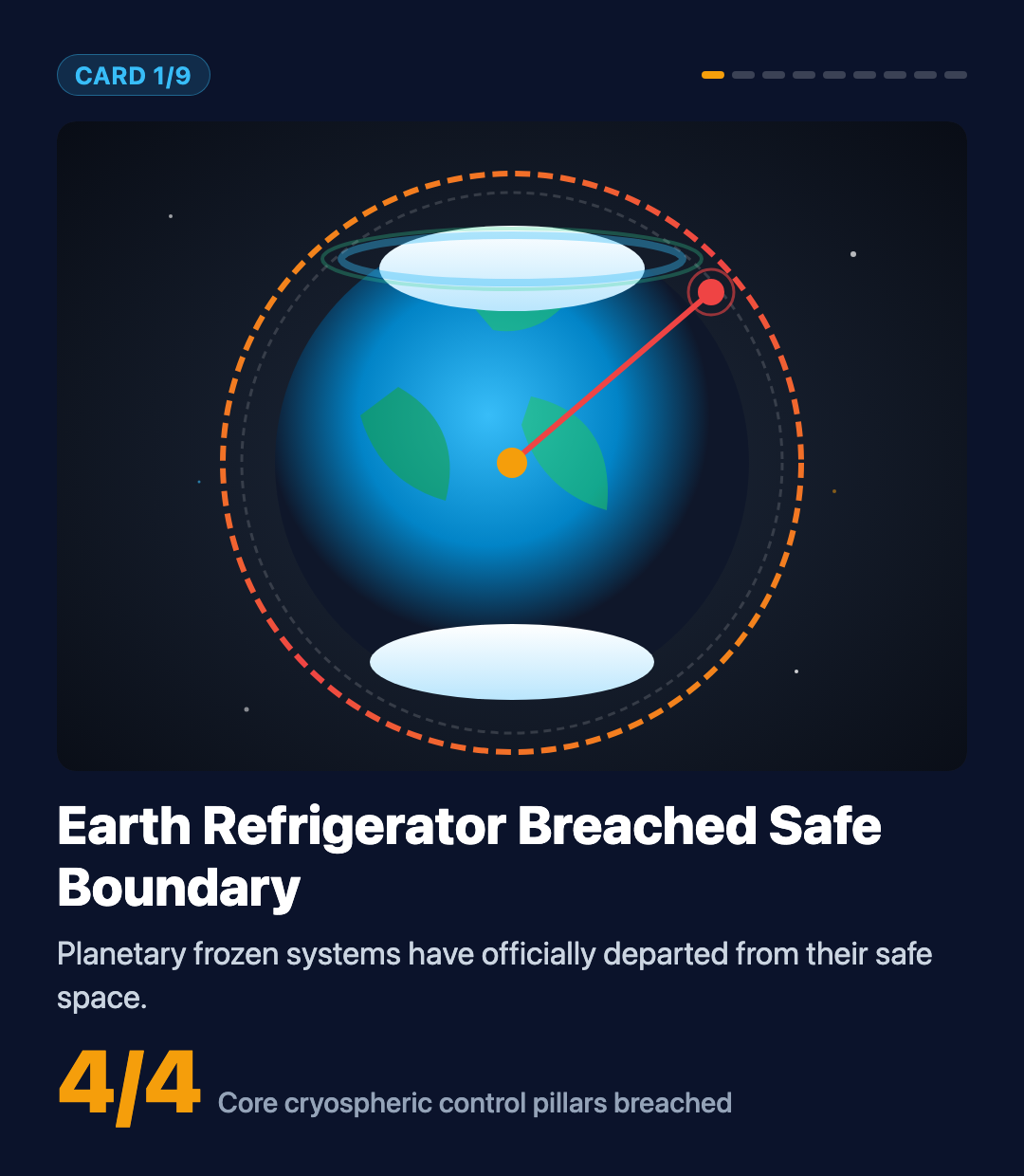
Earth natural giant refrigerator has officially breached its planetary safe boundary
4 ngày trước
00Imagine the main refrigerator in a bustling household suddenly unplugged on a sweltering summer afternoon. At first, the dense frozen meat and thick ice blocks in the freezer maintain a chilling chill. But as the edges begin dripping water, the internal balance rapidly disintegrates, setting off an irreversible spoilage cycle. Our home planet relies on an eerily similar natural refrigeration vault, where millions of cubic kilometers of pure ice and snow have maintained global climate balance across millennia.
On November 12, 2026, coinciding with the COP31 global climate summit, an international team of over thirty leading Earth system scientists led by Dr. Bo Su and Professor Johan Rockström published a momentous investigation in the journal Science. By conducting a rigorous global assessment of the cryosphere through the lens of planetary boundaries, the researchers announced that Earth natural frozen refrigerator has officially breached its safe operating space.
Note – Cryosphere: All frozen water across Earth, including polar ice sheets, mountain glaciers, permafrost, and seasonal snow cover. It acts like a giant planetary refrigerator that helps keep global temperatures stable.
WHAT WAS THIS ISSUE ORIGINALLY ABOUT?
For roughly ten thousand years, human civilization enjoyed an exceptionally gentle and stable geological epoch known as the Holocene. During this remarkable window, Earth climate remained in a state of delicate equilibrium, resembling a home with a perfectly calibrated climate control system. Snow and thick ice sheets capping the poles and towering mountain crests acted as a giant natural mirror, bouncing incoming solar radiation back into space and driving steady ocean currents. Thanks to this long-lasting planetary stability, our ancestors were able to abandon nomadic foraging, establish agriculture, construct enduring cities, and build modern society.
Note – Holocene: The geological epoch spanning roughly the last ten thousand years, during which Earth climate remained unusually mild and stable. This golden window allowed humans to transition from foraging to agriculture, build cities, and develop modern civilization.
Note – Safe operating space: The stable environmental boundary within which Earth can maintain balance and human society can thrive safely. Like keeping a house at a comfortable room temperature, crossing this boundary means the house enters extremes that regular ventilation can no longer fix.
WHAT HAS CHANGED COMPARED TO PREVIOUS ASSUMPTIONS?
Historically, both the general public and mainstream policy frameworks treated polar ice caps and glaciers as mere passive victims of global warming. The standard assumption held that human greenhouse gas emissions warmed the atmosphere, causing ice to melt like an ice cream left on a summer table. Environmental damages were viewed in isolated local terms, with the optimistic belief that cutting emissions in the future would gradually allow the polar ice to refreeze.
However, the landmark Science investigation overturns that simplistic assumption. The cryosphere is not a passive victim on the sidelines, but an active, foundational control system governing the entire planetary engine. Once shoved beyond its safe operating threshold, the cryosphere transforms into an aggressive risk amplifier. Its degradation does not follow a slow, predictable linear slope; instead, it unleashes potent self-reinforcing feedback loops that destabilize interconnected Earth systems worldwide.
Note – Albedo effect: The ability of Earth surfaces to reflect sunlight back into outer space. Just like wearing a white shirt on a sunny summer day keeps you cool, bright snow and ice bounce back most solar heat, while dark open ocean absorbs heat like a black jacket.
HOW DID SCIENTISTS FIGURE THIS OUT?
To reach this groundbreaking conclusion, the international SOS-Cryo research team synthesized decades of high-precision satellite telemetry, deep subsurface ground monitoring networks, and advanced supercomputer climate simulations. Rather than tracking isolated icebergs, they evaluated the global integrity of the cryosphere across four vital control variables. Alarmingly, every single one of these four pillars has departed from its safe historical baseline.
The first control variable is land ice volume, encompassing the massive Greenland and Antarctic ice sheets alongside thousands of high-altitude mountain glaciers. Gravitational satellite measurements show these ice masses shedding hundreds of gigatons of meltwater each year, pouring freshwater into the oceans and distorting key marine circulation highways.
The second metric is polar sea-ice extent. Arctic summer sea ice has shrunk precipitously compared to Holocene averages. When brilliant white ice that reflects up to 85 percent of solar rays disappears, it exposes dark open water that absorbs over 90 percent of incoming solar energy, trapping enormous heat in a vicious marine warming spiral.
The third indicator lies buried beneath the northern tundra: the mean temperature of permafrost. Subterranean soils are warming at historic rates. This deep-freeze vault holds vast quantities of prehistoric plant and animal remains. Thawing permafrost awakens ancient microbes, prompting rapid decomposition that threatens to belch thousands of gigatons of carbon dioxide and methane into the skies.
Note – Permafrost: Ground, rock, and ancient organic remains that have remained completely frozen underground for thousands of years in polar and high-mountain regions. Like a deep freezer packed with old food, if it thaws, microbes wake up and decompose this organic matter into heat-trapping greenhouse gases.
The fourth pillar is northern hemisphere seasonal snow cover. Spring snowmelt is arriving weeks earlier than normal, parching continental river basins and robbing landmasses of their early-season cooling shield.
WHAT DOES THIS MEAN FOR HUMANITY?
This discovery fundamentally reshapes human awareness regarding planetary limits. It demonstrates that climate destabilization is no longer a distant theoretical scenario; one of Earth foremost natural safeguards has already been compromised. Pushing the cryosphere beyond safe boundaries increases the acute danger of triggering irreversible tipping cascades.
The ramifications extend far beyond the desolate polar circles into the daily lives of billions. Hundreds of millions of residents inhabiting low-lying deltas and global coastal hubs such as Ho Chi Minh City, Shanghai, and New York face recurring storm surges and long-term inundation from meters of committed sea-level rise over the coming centuries. Concurrently, more than two billion people across Asia and the Americas who rely on glacial meltwater for drinking, sanitation, and agriculture face severe dry-season water shortages and crop failures.
Note – Climate tipping points: Critical thresholds where a natural system abruptly shifts into a completely new state and cannot return, even if the initial trigger stops. It is like tilting a glass of water until a tipping point is reached, causing it to fall over and spill completely without any way to undo it mid-collapse.
Moving from basic scientific research to practical societal protection remains a monumental challenge. The researchers emphasize that while the safe operating boundary has been breached, humanity has not yet fallen past the point of catastrophic, irreversible collapse. A viable window remains to avert runaway tipping points if aggressive mitigation takes place in this decisive decade.
Nonetheless, the study candidly outlines existing scientific uncertainties. Current computational models cannot pinpoint the exact calendar year when the West Antarctic or Greenland ice sheets might experience unstoppable disintegration due to complex internal ice dynamics. Furthermore, profound ethical questions remain unresolved regarding global burden-sharing: industrialized nations historically responsible for the majority of emissions must support highly vulnerable coastal and mountain communities who contributed least to the crisis.
The next priority for the international scientific community involves deploying ultra-high-resolution orbital radar constellations and in-situ subglacial seismic arrays under the auspices of the United Nations Decade of Action for Cryospheric Sciences (2025–2034). Only through rigorous real-time monitoring and aggressive curbs on greenhouse gases and black carbon can humanity hope to stabilize its unraveling natural shield.
SOURCES
Science – The Cryosphere Beyond a Planetary Safe Operating Space – https://doi.org/10.1126/science.aef5636
Stockholm Resilience Centre – Planetary boundaries assessment of Earth frozen systems – https://www.stockholmresilience.org/research/research-news/2026-11-12-cryosphere-planetary-boundary.html
Potsdam Institute for Climate Impact Research (PIK) – Cryosphere breaches safe operating space – https://www.pik-potsdam.de/en/news/latest-news/cryosphere-breaches-safe-operating-space
EurekAlert – Landmark global study warns Earth cryosphere breached safe operating space – https://www.eurekalert.org/news-releases/1064563
0 comments
Ads
Related Posts
Ads