Ads
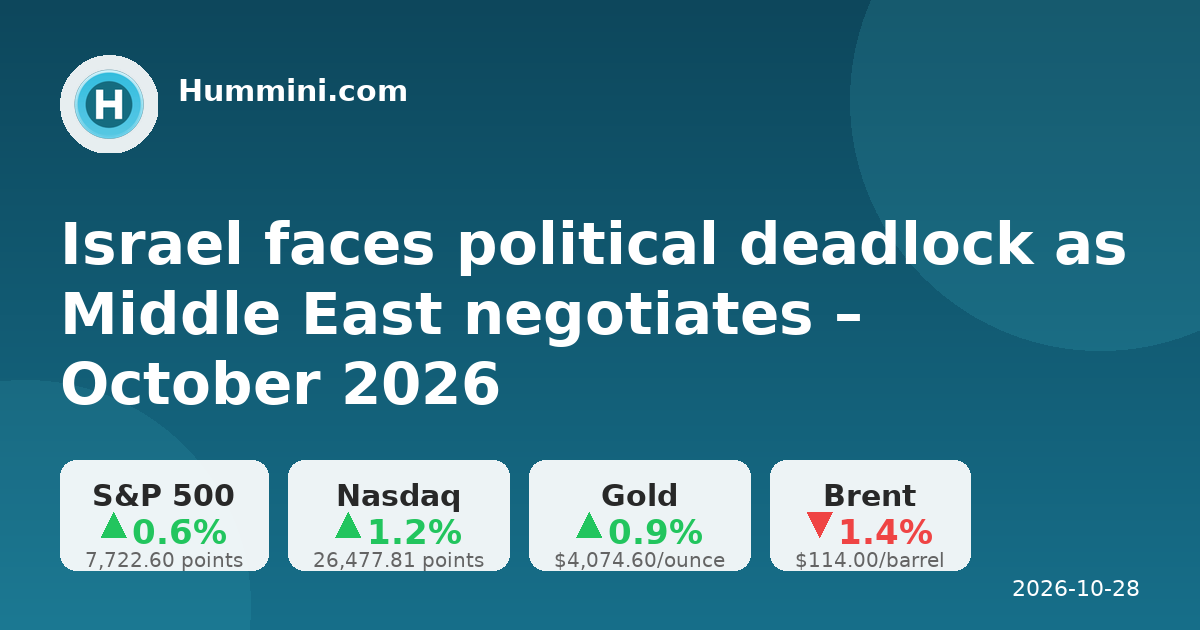
Israel faces political deadlock as Middle East negotiates – October 2026
khoảng 2 giờ trước
00WORLD TEMPERATURE
4/5. Israel enters political deadlock after Netanyahu loses parliamentary majority, while the Middle East faces an oil refinery strike alongside urgent security diplomacy in Tehran.
BRIEFING
Updated from 18:30 on October 27 to 05:00 on October 28 (Hanoi time), covering only new developments.
1. Prime Minister Benjamin Netanyahu's right-wing bloc drops to 50 seats following Knesset election closing, triggering political deadlock as voter turnout exceeds 74%.
2. Yemen's Houthis claim missile strike on Saudi Arabia's Ras Tanura oil refinery, as top defense envoys from Mecca Pact nations hold talks in Tehran.
3. A US federal appeals court rejects Justice Department efforts to block 20,000 mail-in ballots in California, while Donald Trump offers a one million dollar fraud bounty.
4. Defense ministers from five major European powers sign a declaration in Paris pledging greater defense autonomy ahead of future peace talks.
5. The French government unveils a four billion euro educational concession package, but student unions swiftly reject it and maintain campus blockades.
6. Poland's Prime Minister confirms trilateral Ukraine peace talks are slated for November 4 in Abu Dhabi, as the Oleshky humanitarian truce expands.
1. NETANYAHU BLOC DROPS TO 50 SEATS AS ISRAEL FACES DEADLOCK
Following the close of polling stations at 22:00 on October 27 (03:00 on October 28 Hanoi time), exit polls showed Prime Minister Benjamin Netanyahu's governing coalition suffering a severe setback, dropping to around 50 seats and falling well short of the 61-seat majority needed to form a government, according to Israel's Kan and Channel 12 networks. Nationwide voter turnout finished above 74%, marking the highest civic participation rate in Israeli elections since 1999.
Netanyahu's Likud remains the largest single party in the Knesset with 24 to 25 seats, but his right-wing and religious alliance shed between 14 and 18 seats compared to the outgoing parliament. On the opposing side, the anti-Netanyahu bloc led by former military chief Gadi Eisenkot alongside former prime minister Naftali Bennett is projected to secure 50 to 52 seats. This tight split elevates Arab-led parties, including Ra'am and the Joint List, into decisive kingmakers after winning a historic 17 to 18 seats fueled by unprecedented Arab voter turnout. Neither major Zionist bloc currently possesses a direct path to reaching the 61-vote threshold in the 120-member parliament.
Strategic significance: This outcome plunges Israeli politics into its most complex quandary in years, placing Netanyahu at severe risk of losing the premiership unless he fractures the opposition. However, Eisenkot's coalition faces an equally delicate dilemma: constructing a governing cabinet will require either formal cooperation or tacit voting support from Arab parties, a move that could trigger intense backlash among right-leaning members within his own alliance. If party leaders fail to forge concessions after President Isaac Herzog completes consultations, Israel will likely face another prolonged cycle of repeat elections, leaving governance and regional security policy paralyzed.
2. HOUTHIS STRIKE RAS TANURA REFINERY AS MECCA PACT MEETS IN TEHRAN
On the evening of October 27, Yemen's Houthi movement announced a ballistic missile and drone strike targeting the Ras Tanura refinery in eastern Saudi Arabia, the kingdom's primary oil processing facility, according to Houthi military spokesperson Yahya Saree. Regional sources and Bloomberg reported that emergency services swiftly contained a localized blaze near the port terminal, while the Saudi-led coalition confirmed the interception of multiple aerial threats.
The attack coincided with an unexpected diplomatic breakthrough unfolding in Tehran. A senior defense and intelligence delegation representing Mecca Pact nations—comprising Saudi Defense Minister Khalid bin Salman, Pakistan Army Chief Asim Munir, and Turkish intelligence chief Ibrahim Kalin—met directly with Iranian President Masoud Pezeshkian to negotiate a reduction in Houthi strikes and secure maritime traffic through the Strait of Hormuz. In parallel, Omani Foreign Minister Badr Albusaidi publicly urged six Gulf states alongside Iraq and Iran to sign a regional non-aggression pact, emphasizing that the region must cultivate self-reliance rather than lean on an American security umbrella.
Strategic significance: The strike against Ras Tanura demonstrates that Gulf energy infrastructure remains acutely vulnerable, yet Riyadh's willingness to engage Tehran directly alongside regional heavyweights signals a pragmatic shift. Regional Muslim powers are attempting to construct an independent de-escalation framework to protect petroleum supply lines and avert wider conflagration, reflecting declining faith in long-term American guarantees. Nevertheless, until Tehran exercises verifiable restraint over Houthi units on the ground, the risk of maritime disruption at Hormuz remains unlikely to dissipate quickly.
3. APPEALS COURT REJECTS BALLOT PURGE AS TRUMP OFFERS ONE MILLION REWARD
The 9th US Circuit Court of Appeals issued a 2-1 decision denying an emergency request by the Department of Justice to sequester approximately 20,000 mail-in ballots in California, according to court documents released early on October 28 Hanoi time. The panel acted after random audits revealed that most voters on the federal challenge list were native-born US citizens possessing full voting eligibility.
Responding to the legal setback, President Donald Trump stated during the day that he will only accept the results of next week's midterm elections if they are honest, according to Al Jazeera. Trump also unveiled a one million dollar cash reward for verifiable reports of election fraud resulting in arrest and conviction. Concurrently, the Justice Department's Civil Rights Division announced the dispatch of federal monitors to polling locations across Pennsylvania and Georgia, provoking sharp resistance from local election administrators in both battleground states.
Strategic significance: The appellate ruling confirms that federal efforts to purge voter registries before election day are encountering a sturdy judicial wall in Democratic-led states. However, Trump's bounty announcement and refusal to commit to an unconditional concession lay the psychological groundwork for contentious post-election challenges after November 3. This trajectory threatens to turn key battleground states into prolonged legal combat zones, thrusting the American political apparatus into protracted friction once polls close.
4. FIVE EUROPEAN NATO POWERS PLEDGE DEFENSE AUTONOMY AT PARIS SUMMIT
Defense ministers from Europe's five largest military powers—France, Germany, Britain, Italy, and Poland—signed a joint declaration in Paris on October 27 committing to accelerate collective defense autonomy, according to Liga News and the UK Ministry of Defence. The E5 ministerial meeting, attended by EU High Representative for Foreign Affairs Kaja Kallas, marked a significant coordinating step among the continent's primary military capitals.
The joint statement emphasized that Europe must proactively enhance combat readiness, boost capital spending, and integrate national defense industries to prevent vulnerability against geopolitical shifts. While affirming that the United States remains an indispensable NATO ally, the ministers stressed that Europe requires robust independent deterrence capabilities. The initiative comes as the European Union confronts a 70 billion euro funding gap in long-term military support for Ukraine amid sluggish regional economic growth. Simultaneously, diplomatic reporting from The Telegraph indicated that Russia plans to demand a NATO pullback to 1997 borders during future peace discussions, a condition European leaders immediately dismissed.
The E5 summit convened at a pivotal juncture as European capitals reassess defensive postures ahead of emergent Ukraine peace channels and the upcoming US midterm vote, which could reshape transatlantic defense assistance.
Strategic significance: The joint posture struck by five key European powers illustrates an enduring shift in the continent's strategic doctrine, driven by the realization that capitals can no longer depend entirely on American nuclear and fiscal coverage. However, the chasm between political rhetoric and actual military capacity remains vast, particularly as anchor economies like Germany and France confront severe fiscal headwinds. Without dedicated joint funding mechanisms, the E5's push for strategic autonomy will struggle to materialize into credible conventional deterrence in the near term.
5. FRANCE OFFERS FOUR BILLION CONCESSIONS BUT STUDENT UNIONS REJECT
Confronting persistent youth demonstrations, the French government announced an emergency four billion euro concession package providing local authorities funds for school repairs alongside commitments to phase out the Parcoursup university admissions portal by 2028, according to EdWeek and The Guardian. However, French student and secondary unions immediately rejected the measures as half-hearted compromises and urged demonstrators to maintain barricades across educational institutions.
The French Ministry of Education proposed preferential loans and strict caps on classroom sizes in an effort to defuse nationwide unrest underway since mid-September. Yet spokespersons for Les Lycéens and Renouveau Lycéen insisted that students and labor allies will sustain blockades at high schools and universities across Paris and regional centers until core demands on living costs and public funding are met. The youth mobilization continues to coordinate closely with major trade unions preparing for a general strike on November 5.
6. UKRAINE TALKS SET FOR NOVEMBER 4 AS OLESHKY TRUCE EXPANDS
Trilateral technical negotiations between Ukraine, Russia, and the United States have been scheduled for November 4 in Abu Dhabi, according to confirmations from Polish Prime Minister Donald Tusk and European diplomatic officials. Meanwhile, US First Lady Melania Trump announced that the localized humanitarian ceasefire established around the town of Oleshky in Kherson Oblast has expanded into adjacent frontline sectors to facilitate relief deliveries.
Military commands on both sides adhered to silence protocols on the ground, allowing humanitarian convoys to reach isolated civilian populations. Preparing the diplomatic groundwork for the Abu Dhabi talks, Finnish President Alexander Stubb and Norwegian Prime Minister Jonas Gahr Støre held direct phone discussions on October 27 with Russian President Vladimir Putin to gauge Kremlin parameters, coordinating closely with Kyiv and Western partners.
NEXT 48–72 HOURS
Israel's Central Elections Committee will complete official tabulation and publish comprehensive results within 48 hours, paving the way for President Isaac Herzog to designate a prime ministerial candidate. The US Federal Reserve will conclude its policy meeting and announce interest rate decisions early on October 29 Hanoi time, followed by rate verdicts from the European Central Bank and the Bank of England. Energy markets will monitor tanker traffic through the Strait of Hormuz and diplomatic echoes from Tehran following Mecca Pact security meetings. In France, labor and student unions will convene to finalize strategy for the November 5 general strike if negotiations with ministries stall. Global financial markets will also digest third-quarter financial earnings from tech giants Alphabet and Microsoft on October 29.
SOURCES
Event 1: Kan News – Exit polls show Knesset deadlock as Netanyahu bloc drops – https://www.kan.org.il/elections2026/exit-polls
Event 1: Channel 12 Israel – Coalition loses majority in record turnout election – https://www.mako.co.il/news-politics/2026-elections
Event 1: CNN – Netanyahu suffers blow as exit polls project deadlock in Israeli election – https://www.cnn.com/2026/10/27/middleeast/israel-election-exit-polls-netanyahu-deadlock/
Event 1: Arab News – Arab parties emerge as kingmakers after historic turnout in Israel – https://www.arabnews.com/node/israel-elections-arab-vote-kingmaker-2026
Event 2: Middle East Eye – Yemen Houthis claim missile strike on Saudi Ras Tanura oil refinery – https://www.middleeasteye.net/news/yemen-houthis-target-saudi-arabia-ras-tanura-refinery
Event 2: Bloomberg – Saudi Arabia contains localized fire near Ras Tanura terminal – https://www.bloomberg.com/news/articles/2026-10-27/saudi-ras-tanura-terminal-fire-contained
Event 2: Critical Threats Project – Mecca Pact defense delegation visits Tehran amid regional escalation – https://www.criticalthreats.org/analysis/mecca-pact-iran-diplomatic-talks-october-2026
Event 2: The Guardian – Oman proposes regional non-aggression pact to bypass US security umbrella – https://www.theguardian.com/world/2026/oct/27/oman-proposes-gulf-iran-security-pact
Event 3: The Guardian – US appeals court blocks DOJ attempt to purge 20000 California ballots – https://www.theguardian.com/us-news/2026/oct/27/ninth-circuit-rejects-doj-california-ballot-challenge
Event 3: Al Jazeera – Trump says he will accept midterm results only if elections are honest – https://www.aljazeera.com/news/2026/10/27/trump-midterm-election-integrity-challenge
Event 3: CBS News – Justice Department deploys federal election monitors to Pennsylvania and Georgia – https://www.cbsnews.com/news/doj-civil-rights-monitors-midterm-polling-sites-2026/
Event 4: Liga News – E5 defense ministers meet in Paris to push for European defense autonomy – https://news.liga.net/en/politics/news/e5-defense-ministers-paris-summit-declaration-2026
Event 4: UK Ministry of Defence – Joint Statement on European Defence Co-operation at Paris Summit – https://www.gov.uk/government/news/e5-defence-ministers-paris-statement-oct-2026
Event 4: The Telegraph – Russia to demand NATO withdrawal to 1997 borders in upcoming peace talks – https://www.telegraph.co.uk/world-news/2026/10/27/russia-nato-1997-borders-peace-negotiations/
Event 5: EdWeek – French government announces 4 billion euro package as student protests continue – https://www.edweek.org/policy-politics/french-school-protests-concessions-rejected-2026/10
Event 5: The Guardian – French student unions reject government concessions, vow to maintain barricades – https://www.theguardian.com/world/2026/oct/27/french-students-reject-reform-package-protests
Event 6: RBC Ukraine – Trilateral peace talks in Abu Dhabi tentatively scheduled for November 4 – https://www.rbc.ua/eng/news/abu-dhabi-trilateral-negotiations-november-2026.html
Event 6: The Independent – Oleshky humanitarian ceasefire expands in southern Kherson – https://www.independent.co.uk/news/world/europe/ukraine-oleshky-ceasefire-expansion-kherson-2026.html
Event 6: CTV News – Nordic leaders speak with Putin on framework for Ukraine peace – https://www.ctvnews.ca/world/nordic-leaders-putin-call-ukraine-peace-framework-2026
0 comments
Ads
Related Posts
Ads