Ads
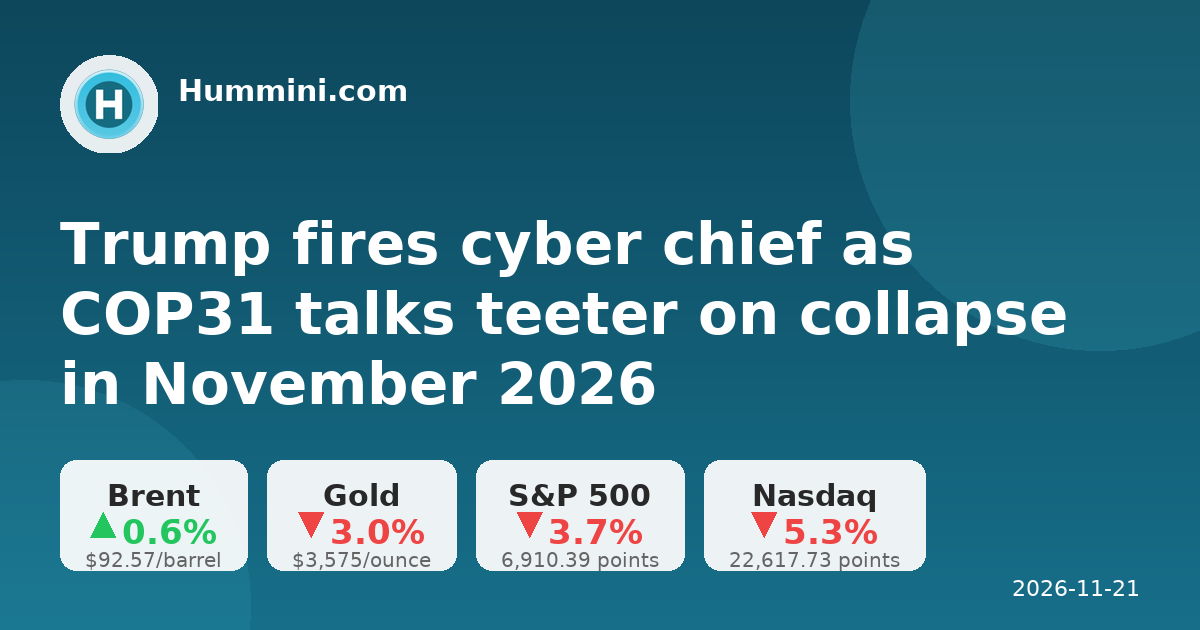
Trump fires cyber chief as COP31 talks teeter on collapse in November 2026
6 ngày trước
00WORLD TEMPERATURE
3.5/5. The United States reshuffles cybersecurity leadership after infrastructure failures while global climate negotiations edge toward collapse.
BRIEFING
Updated from 05:00 to 12:00 on November 21, 2026 (Hanoi time), covering new events and developments only.
1. President Donald Trump ousted National Cyber Director Sean Cairncross following Microsoft and FAA outages that disrupted 18,000 flights, naming the Pentagon CIO as acting chief.
2. Trump called for former Nvidia CEO Jensen Huang to be given a second chance while threatening steep tariffs on American companies building AI data centers abroad.
3. COP31 climate negotiations in Antalya plunged deeper into crisis as an Australian draft dropped all mentions of fossil fuels, drawing veto threats from island nations and Panama.
4. A magnitude 6.7 earthquake struck the central Peruvian Andes and shook the capital city of Lima, sending residents and lawmakers fleeing into the streets.
5. Russian Chargé d'Affaires Karen Malayan reiterated warnings for Western diplomats to leave Kyiv following air strikes that damaged European diplomatic offices.
6. Chinese Premier Li Qiang and Australian Prime Minister Anthony Albanese pledged to minimize bilateral trade disruptions during a CEO roundtable in Beijing.
1. TRUMP OUSTS NATIONAL CYBER DIRECTOR FOLLOWING MASSIVE FLIGHT AND TECH OUTAGES
U.S. President Donald Trump ousted National Cyber Director Sean Cairncross on November 20 following a series of severe technology disruptions that paralyzed civil aviation and digital services nationwide, according to Reuters. Trump tapped Department of Defense Chief Information Officer Kirsten Davies to take over as acting director of the agency.
The sudden dismissal came after a contractor's router upgrade error in Arkansas forced the Federal Aviation Administration to issue a nationwide ground stop, disrupting more than 18,000 flights right ahead of the Thanksgiving holiday travel rush. Concurrently, a global Microsoft cloud service outage crippled Teams and Outlook worldwide, while technical failures also hit JPMorgan Chase online banking and the National Security Agency's classified internal network NSANet.
Speaking at the White House, Trump asserted bluntly that Cairncross was "not good enough" for the role. White House Chief of Staff Stephen Miller strongly pushed for the departure, arguing that Cairncross lacked the deep technical credentials required to direct national cyber defense. Although Director of National Intelligence Jay Clayton and Secretary of State Marco Rubio publicly stressed that the disruptions stemmed from routine maintenance and software bugs rather than coordinated foreign cyberattacks, the administration acted swiftly to quell backlash from airlines and corporate leaders.
Congress established the Office of the National Cyber Director in 2021 to coordinate cybersecurity policy across federal agencies, yet the worst air travel gridlock since 2023 quickly turned the leadership role into a political flashpoint.
Strategic significance: Placing a Pentagon technology chief in charge signals the White House's intent to instill strict military discipline into civilian digital infrastructure oversight. While this shift is likely to usher in stringent federal compliance mandates for private contractors, it risks heightening regulatory friction between Washington and Silicon Valley tech giants managing critical cloud networks.
2. TRUMP DEFENDS JENSEN HUANG AND THREATENS STEEP OVERSEAS DATA CENTER TARIFFS
During a White House press briefing on November 20, President Donald Trump unexpectedly came to the defense of former Nvidia CEO Jensen Huang while threatening severe penalties against American tech firms building artificial intelligence data centers abroad, according to The Washington Post. The remarks mark an extraordinary executive intervention following Huang's resignation and the launch of a House Judiciary Committee oversight investigation into Nvidia.
Trump praised Huang as a brilliant mind and urged Nvidia's board to accept an apology and grant the former executive a "second chance" to return to leadership. Turning to computational infrastructure, Trump warned that his administration would impose a "tremendous tax" on any domestic company attempting to construct data centers outside the country. Asserting that America cannot afford to let digital capacity migrate abroad because "China will take all of them," Trump acknowledged that he had not vetted the tariff threat with his staff beforehand.
Strategic significance: Trump's tariff ultimatum places cloud giants like Microsoft, Amazon, and Alphabet in an acute dilemma after committing tens of billions of dollars to data center expansions across Europe and the Middle East. If Washington translates this rhetoric into binding tax penalties, global computing costs will spike sharply, impeding cross-border AI deployment and potentially incentivizing international clients to accelerate their shift toward alternative, non-American semiconductor ecosystems.
3. AUSTRALIAN DRAFT OMITS FOSSIL FUEL LANGUAGE TRIGGERING COP31 VETO THREATS
Negotiations at the UN Climate Change Conference COP31 in Antalya spilled into overtime on Saturday after a revised draft agreement spearheaded by co-host Australia removed all explicit references to phasing out fossil fuels, according to CGTN. The complete omission of coal, oil, and gas from the cover decision immediately triggered furious protests from the European Union and climate-vulnerable developing nations.
Rather than committing to binding emissions cutbacks, the text shepherded by Australian Climate Minister Chris Bowen heavily emphasized carbon capture, utilization, and storage alongside a voluntary 35-by-35 electrification initiative. Pacific island delegates from nations including Vanuatu slammed the compromise as the worst draft in summit history, decrying it as a gift to the fossil fuel lobby. Panama's Environment Minister Juan Carlos Navarro publicly threatened to veto the entire summit outcome unless the final text sets explicit caps on oil production.
Strategic significance: The Antalya deadlock underscores an irreconcilable divide between frontline climate nations and major resource exporters like Australia attempting to protect mineral revenues. Unless COP31 President Murat Kurum can broker a third compromise text within the next 24 hours, the summit risks becoming the first UN climate conference since the Paris Agreement to collapse without adopting a consensus declaration.
4. MAGNITUDE 6.7 EARTHQUAKE STRIKES PERUVIAN ANDES SHAKING BUILDINGS IN LIMA
A magnitude 6.7 earthquake struck the central Peruvian Andes on the evening of November 20 local time, rattling buildings and sending panicked residents fleeing into the streets of Lima, according to the U.S. Geological Survey. The Geophysical Institute of Peru initially recorded the tremor at magnitude 6.9 before revising its assessment.
The earthquake's epicenter was located approximately 21 kilometers north of the town of Junín at a focal depth of 108 kilometers. The considerable depth substantially buffered surface shaking, preventing catastrophic destruction across central provinces such as Junín, Pasco, and Huánuco, as well as the coastal capital of Lima hundreds of kilometers away. Lawmakers and staff at Peru's Congress in Lima were forced to halt proceedings and evacuate the legislative palace as the structure swayed violently.
The U.S. National Tsunami Warning Center confirmed that the seismic event posed no tsunami threat to Pacific coastlines. Hernando Tavera, head of the Geophysical Institute of Peru, stated that authorities reported only localized rockfalls along Andean roads, with no immediate casualties or structural collapses documented.
Peru sits atop the Pacific Ring of Fire, where the collision between the Nazca and South American tectonic plates regularly generates hundreds of earthquakes annually across the Andean nation.
5. RUSSIA REITERATES WARNING FOR WESTERN DIPLOMATS TO EVACUATE KYIV
Russian Chargé d'Affaires to the European Union Karen Malayan on November 21 reiterated Moscow's warning for Western diplomats and foreign citizens to evacuate Kyiv, according to Anadolu Agency. The stern warning followed a formal summons issued by the European External Action Service in Brussels protesting air strikes that damaged diplomatic premises.
The diplomatic friction escalated after intensive Russian missile and drone barrages against Ukrainian energy hubs caused structural damage to the EU diplomatic mission offices as well as the Austrian and Dutch embassies in Kyiv. Speaking following the summons, Malayan rejected allegations that Russian forces deliberately targeted foreign missions, maintaining that Moscow exclusively targets military logistics in retaliation for strikes against Russian civilian infrastructure such as the Crimean Bridge.
The Russian envoy argued that foreign personnel remaining in Kyiv were exposing themselves to extreme perils as military operations intensify. EU foreign policy officials strongly condemned the evacuation demands, characterizing the stance as an unacceptable attempt to intimidate international envoys and undermine protections enshrined under the Vienna Convention.
Safety concerns for international missions in Kyiv have intensified as freezing temperatures arrive and Russian strikes force Ukraine's state grid operator to implement around-the-clock emergency power rationing nationwide.
Strategic significance: Moscow's persistent calls for foreign diplomats to leave Kyiv serve as psychological pressure intended to prompt European governments to scale back their physical presence in the Ukrainian capital. Any diplomatic withdrawal westward would hand Russia a symbolic victory by diminishing tangible Western engagement at Ukraine's political center during critical winter operations.
6. CHINA AND AUSTRALIA PLEDGE TO SAFEGUARD SUPPLY CHAINS AT BEIJING SUMMIT
Chinese Premier Li Qiang and Australian Prime Minister Anthony Albanese attended the 9th China-Australia CEO Roundtable in Beijing on November 21, pledging to deepen bilateral economic ties and minimize supply chain disruptions, according to Xinhua. The joint appearance highlighted efforts to stabilize commercial ties ahead of the 55th anniversary of diplomatic relations next year.
Addressing corporate leaders from both nations, Premier Li emphasized that the Chinese and Australian economies are deeply complementary, urging Canberra to foster an open and non-discriminatory environment for Chinese enterprises. In response, Prime Minister Albanese underscored that China remains Australia's foremost trading partner, proposing expanded collaboration in emerging frontiers including artificial intelligence, modern agriculture, and the clean energy transition.
Despite the constructive tone struck by both leaders, trade analysts observed lingering frictions over Australia's rigorous foreign investment vetting regarding critical minerals and regulatory scrutiny over sensitive technology partnerships.
Bilateral commerce between the two Asia-Pacific economies has steadily recovered following Beijing's phased removal of trade restrictions on Australian coal, barley, and wine implemented during earlier diplomatic disputes.
NEXT 48–72 HOURS
The COP31 climate summit in Antalya enters its final overtime window to either release a third compromise draft or declare an official impasse. In Washington, Acting National Cyber Director Kirsten Davies will hold initial consultations with technology executives and the Federal Aviation Administration to review network vulnerabilities. The U.S. House Judiciary Committee is expected to schedule hearings with Nvidia leadership, while global financial markets brace for holiday-shortened trading ahead of Thanksgiving with investors closely watching tech sector volatility.
SOURCES
Ouster of U.S. National Cyber Director:
Reuters – Trump fires cyber director Cairncross after flight and tech outages – https://www.reuters.com
Japan Times – White House replaces cyber chief with Pentagon CIO following FAA ground stop – https://www.japantimes.co.jp
The Guardian – Tech disruption prompts Trump to oust US cybersecurity director – https://www.theguardian.com
Trump remarks on Nvidia and data center tariffs:
Washington Post – Trump defends Jensen Huang and threatens tariffs on overseas AI data centers – https://www.washingtonpost.com
The Hindu – Trump calls for second chance for Huang while proposing data infrastructure tax – https://www.thehindu.com
Los Angeles Times – White House signals crackdown on foreign tech facilities – https://www.latimes.com
Deadlock at COP31 climate summit:
CGTN – Antalya climate summit extends into overtime as draft text sparks outrage – https://www.cgtn.com
The Guardian – Island nations threaten COP31 veto over omission of fossil fuel phase-out – https://www.theguardian.com
Al Jazeera – Turkish presidency struggles for consensus as Australia removes fossil fuel text – https://www.aljazeera.com
Earthquake in central Peru:
USGS – Magnitude 6.7 earthquake strikes 21 km north of Junin Peru – https://www.usgs.gov
Washington Post – Strong Andes earthquake felt across Lima with no initial casualties – https://www.washingtonpost.com
Anadolu Agency – Tremor shakes central Peru triggering evacuations in capital – https://www.aa.com.tr
Russia warning to Western envoys in Kyiv:
Anadolu Agency – Russian envoy reiterates call for Western diplomats to leave Kyiv – https://www.aa.com.tr
Lao Dong – Russian EU charge reiterates diplomatic guidance following air strikes – https://laodong.vn
Dan Tri – Russia denies deliberate strikes on foreign missions in Kyiv – https://dantri.com.vn
China-Australia CEO Roundtable in Beijing:
Xinhua – Chinese premier and Australian prime minister address 9th CEO roundtable – https://www.xinhuanet.com
Gov.cn – Li Qiang stresses supply chain stability in meeting with Albanese – https://www.gov.cn
The Australian – Albanese highlights trade ties at business gathering in Beijing – https://www.theaustralian.com.au
0 comments
Ads
Related Posts
Ads