Ads
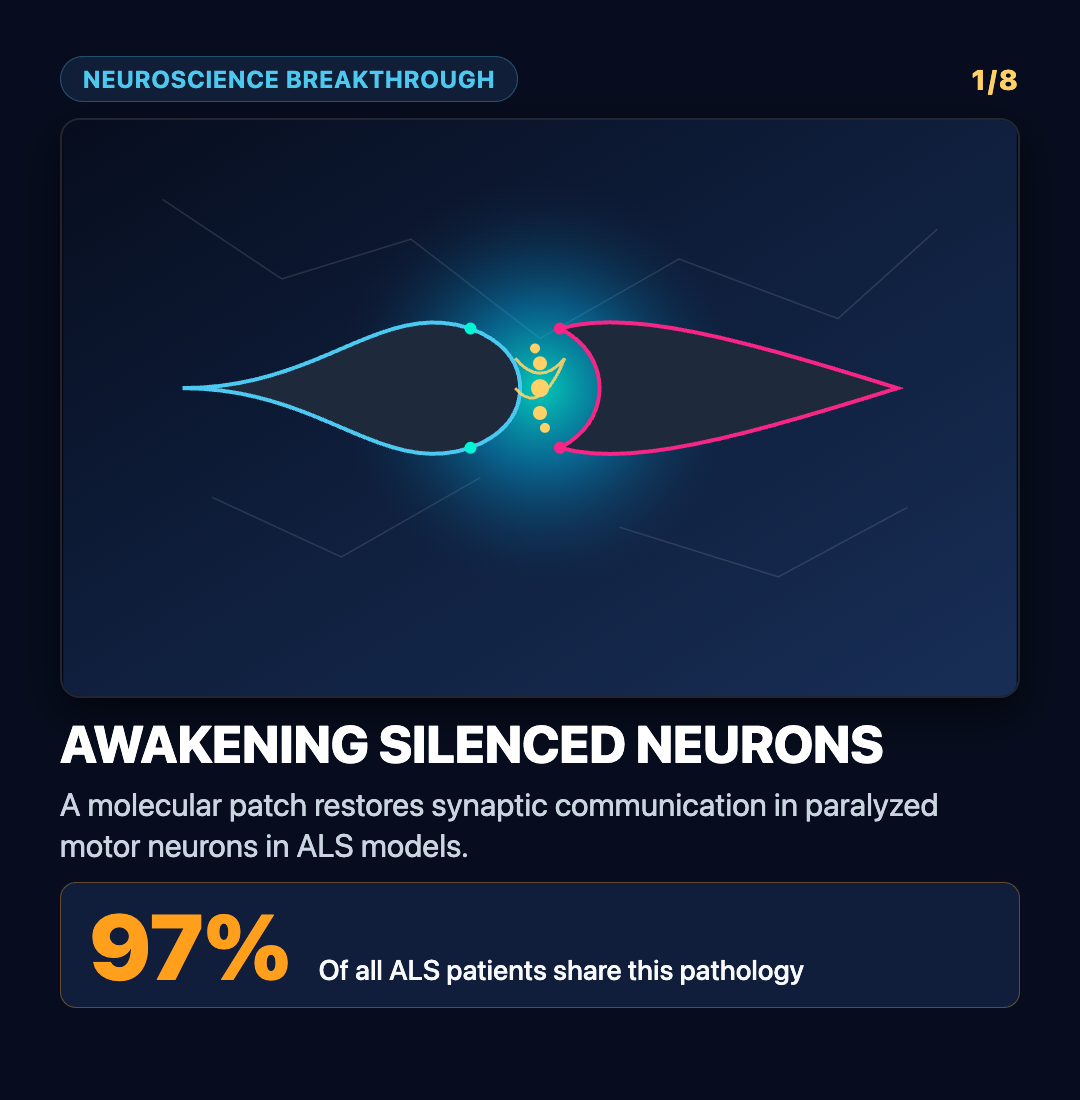
Molecular patch restores synaptic communication in motor neuron disease
khoảng 23 giờ trước
00Imagine a city neighborhood where the lights suddenly go completely dark. Instead of fallen power transmission poles across town, the disruption traces back to a single tiny circuit breaker jammed inside the central substation. On November 11, 2026, in the prestigious scientific journal Nature, a research team led by Professor Pietro Fratta at University College London Queen Square Institute of Neurology and the UK Dementia Research Institute reported a pivotal breakthrough for amyotrophic lateral sclerosis and frontotemporal dementia.
WHAT WAS THE ORIGINAL PROBLEM BEHIND THIS DISEASE?
The human motor nervous system operates like a massive postal distribution network, where billions of neurons continuously relay letters and parcels containing neurotransmitter chemicals across microscopic junction gaps known as synapses. In patients battling amyotrophic lateral sclerosis or frontotemporal dementia, this network deteriorates, causing progressive muscle wasting, paralysis, and loss of speech and mobility. For decades, scientists have identified a notorious protein called TDP-43 as a central culprit. Under healthy conditions, this protein acts as a meticulous proofreader inside the cell nucleus, trimming and stitching genetic instructions before the cellular machinery builds essential proteins. However, in ninety-seven percent of amyotrophic lateral sclerosis cases, this proofreader vanishes from the nucleus, accumulating into toxic clumps in the outer cytoplasm.
Note – Amyotrophic lateral sclerosis: A rapidly progressing neurodegenerative disorder that destroys motor neurons controlling voluntary muscle movement, notably experienced by physicist Stephen Hawking.
Note – TDP-43 protein: An essential nuclear protein functioning like a proofreading editor that cuts and splices genetic messages to ensure healthy cellular protein production.
WHAT DID THE SCIENTISTS DISCOVER THAT CHALLENGES OLD BELIEFS?
For years, medicine assumed that once motor symptoms emerge and neural signals fade, the affected motor neurons are already irreversibly destroyed. The new study in Nature upends this pessimistic dogma. The researchers demonstrated that before neurons actually perish, they enter an extended state of pre-degenerative silence. Structurally, the nerve cells remain fully intact and alive, but their communication gates at the synapse shut down. The investigation revealed that when TDP-43 is depleted from the nucleus, the cellular assembly line erroneously inserts a bogus sequence known as a cryptic exon into the messenger RNA of another critical protein called UNC13A. Cellular quality control mechanisms promptly detect this corrupted instruction and destroy it, leading to a profound deficiency of UNC13A protein. Deprived of this protein, synaptic vesicles carrying neurotransmitters cannot dock at the cell membrane to fire signals across the gap.
Note – Frontotemporal dementia: A devastating neurodegenerative condition affecting the frontal and temporal brain lobes, leading to marked declines in language, personality, and social cognition.
Note – Synapse: A microscopic junction between neighboring nerve cells acting as a communication gateway where electrical impulses trigger chemical releases to transmit signals.
Note – Cryptic exon: A flawed snippet of genetic code that is normally excised during RNA processing, but when erroneously included, destroys the protein blueprint.
HOW DID SCIENTISTS SECURE CONCLUSIVE EXPERIMENTAL EVIDENCE?
To rigorously test this mechanism, the research team at University College London collaborated with scientists at King's College London and the Francis Crick Institute, performing experiments on living human motor neurons and cortical neurons differentiated from induced pluripotent stem cells. They verified that depleting nuclear TDP-43 induced a near-total loss of UNC13A protein, which crashed synaptic transmission frequency to near zero.
To reverse the failure, the investigators designed synthetic molecular splints called antisense oligonucleotides. These tiny molecular patches adhere specifically to the cryptic splice site on the nascent RNA message like a piece of smart adhesive tape. By concealing the flawed splice site from the cellular machinery, the molecular patch forces the cell to bypass the junk code and generate full-length, functional UNC13A protein. Electrophysiological recordings confirmed that neurotransmitter vesicles promptly resumed docking at the synapse membrane, restoring spontaneous and evoked neurotransmitter release as well as synchronous network firing across human neural circuits. The study underwent rigorous peer review prior to formal publication in Nature.
Note – Antisense oligonucleotide: A laboratory-engineered short molecular strand tailored to bind precise genetic sequences, masking defects to restore normal cellular protein fabrication.
WHAT DOES THIS BREAKTHROUGH MEAN FOR HUMANITY?
This research delivers compelling evidence that restoring function to silenced, comatose nerve cells is feasible, providing a tangible molecular target rather than merely managing terminal symptoms. The beneficiaries encompass millions of individuals affected by fatal neurodegenerative disorders worldwide, as ninety-seven percent of amyotrophic lateral sclerosis patients and approximately half of frontotemporal dementia cases share this exact TDP-43 breakdown.
Nevertheless, the distance from cell culture dishes to an approved pharmacy medicine spans several years of dedicated development. The study represents early-stage laboratory experimentation in human cells and animal models. Scientists must now formulate delivery vehicles capable of efficiently crossing the blood-brain barrier, maintain adequate molecular durability in the body, and ensure no unintended adverse immune reactions occur. In forthcoming steps, the researchers plan to refine the antisense oligonucleotide chemistry and advance toward pre-clinical safety evaluations in mammalian models before commencing human clinical trials. These findings reflect basic medical research and do not represent immediate clinical treatment advice.
SOURCES
Nature – UNC13A splice correction rescues synaptic dysfunction induced by TDP-43 loss – https://doi.org/10.1038/s41586-026-11256-2
UK Dementia Research Institute – Splicing rescue restores motor neuron synapses in ALS models – https://ukdri.ac.uk/news-and-events/unc13a-synapse-restoration
King's College London – Restoring neural communication in motor neuron disease – https://www.kcl.ac.uk/news/2026/restoring-neural-communication-als
0 comments
Ads
Related Posts
Ads