Ads
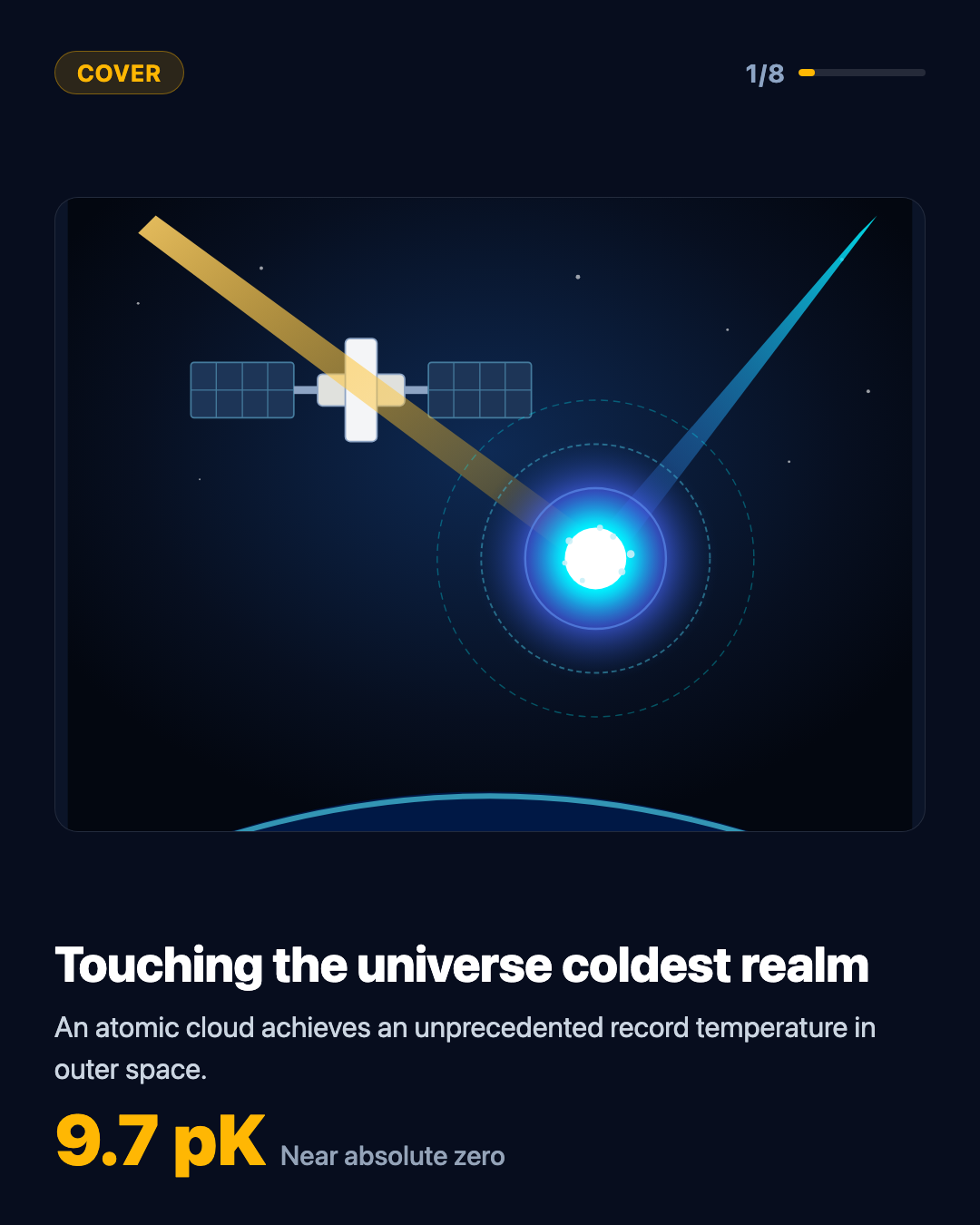
Chilling an atomic cloud near absolute zero in space
7 ngày trước
00AN UNPRECEDENTED CHILL IN ORBIT
Imagine standing outdoors on a bitterly freezing winter day, shivering with every bone in your body. Yet no matter how severe cold feels on Earth, it pales in comparison to the vast emptiness of outer space. Astonishingly, right amid that cosmic void, human ingenuity has just created a pocket of gas colder than deep space by more than one hundred billion times.
On November 5, 2026, a research team led by Peking University and the Shanghai Institute of Optics and Fine Mechanics announced in the journal Science that they had successfully cooled an atomic gas cloud down to 9.7 picokelvin aboard the Tiangong space station.
WHAT REALLY IS TEMPERATURE AND WHY CHASE EXTREME COLD?
In everyday terms, we often think of cold as the simple absence of heat. But to physicists, temperature is nothing more than a speedometer tracking how violently constituent particles jiggle around. Picture a container packed with rolling marbles. When hot, those marbles shoot about frantically, slamming against the walls. As you cool the container, the marbles slow down, step by step, and if all kinetic energy could be extracted, they would grind to a near-total standstill at a fundamental boundary called absolute zero.
Note – Absolute zero: The lowest theoretical temperature in the universe, equivalent to minus 273.15 degrees Celsius, where all thermal motion of particles grinds to a near-complete standstill like an engine shut down with wheels locked.
When matter is steered exceptionally close to this absolute stop, a marvelous transformation unfolds. Atoms no longer bounce around as unruly individuals. Instead, they lock in step, blending into a solitary giant quantum wave, much like thousands of musicians in an orchestra uniting on one flawless note.
Note – Bose-Einstein condensate: An exotic state of matter formed when ultracold atoms merge into a single collective quantum wave, much like thousands of individual water droplets blending into one uniform gelatin block.
WHAT GRAVITATIONAL HURDLE FELL APART IN SPACE?
For decades, terrestrial physicists have strived to chill clouds of quantum gas to interrogate the rules of the subatomic universe.
Note – Quantum gas: A gas chilled so close to absolute zero that the bizarre laws of quantum mechanics dominate its behavior, replacing ordinary billiard-ball collisions with wave-like patterns.
However, every laboratory bound to Earth confronts an invisible yet relentless adversary in terrestrial gravity. No matter how delicately you chill a cluster of atoms, Earth's downward pull drags them toward the floor. In less than half a second, the fragile atomic cloud smashes into the chamber bottom and scatters. To prolong observation, scientists have dropped entire apparatuses down tall drop towers, yet that granted barely two extra seconds before impact.
That dynamic completely reversed when researchers moved the apparatus onto an orbital space station. In microgravity, atoms no longer crash into the container base. Consequently, the rubidium atomic gas cloud drifted freely and expanded smoothly for 7.0 seconds while staying sharply resolvable on imaging sensors. Those seven seconds transformed what was once a fleeting blink into a generous window to witness delicate quantum choreography.
HOW DID SCIENTISTS CAPTURE THIS RECORD COLD?
Achieving the record temperature of 9.7 picokelvin demanded a sophisticated combination of optical and mechanical techniques within the Cold Atom Physics Rack aboard the Mengtian laboratory module.
Note – Picokelvin: An extremely tiny unit of temperature equal to one trillionth of a Kelvin, comparable to slicing a single millimeter into a million parts and then dividing that sliver into a million pieces again.
A reading of 9.7 picokelvin means the temperature hovered less than ten trillionths of a degree above absolute zero. This is more than one hundred billion times colder than the background chill of deep space, making this tiny cloud the coldest spot recorded in the known universe.
First, scientists gathered approximately 20,000 rubidium-87 atoms into a trap woven purely from crossed laser beams. This light cage functioned like an invisible pair of chopsticks, suspending particles in a high-vacuum chamber without letting them touch any physical surface.
Note – Optical dipole trap: A technique using intersecting laser beams to hold and guide floating atoms in a vacuum chamber without any physical container walls touching them.
Once confined, the atoms were chilled using evaporative cooling. This process mirrors how a steaming bowl of soup cools down when gently blown upon: the most energetic, fastest water molecules escape first as steam, leaving behind a cooler soup broth. By lowering the trap barrier, researchers allowed the hottest rubidium atoms to fly away, retaining only the sluggish, coldest particles at the bottom.
Note – Evaporative cooling: A cooling method that lowers overall temperature by allowing the fastest and hottest particles to escape, just like steam rising from a cup of coffee cools down the remaining liquid.
Next, rather than relying on magnetic coils prone to electrical noise on a spacecraft, the team expanded the optical trap gently. In weightlessness, the 20,000 rubidium atoms expanded smoothly, shedding nearly all remaining kinetic motion and plunging to 9.7 picokelvin. Experimental data matched quantum theoretical models consistently across multiple runs and passed rigorous peer review prior to publication in Science.
WHAT DOES THIS SUPREME STILLNESS OFFER HUMANITY?
Suspending an ultra-cold quantum gas for seven undisturbed seconds in orbit is far more than a numerical milestone. It grants humanity a measuring tool of unprecedented finesse. When atoms stand virtually motionless, they serve as the ultimate rulers to register the subtlest fluctuations in their environment.
The most direct application lies in developing next-generation spaceborne atom interferometers.
Note – Atom interferometer: An ultra-sensitive measuring device that exploits the wave nature of atoms to gauge gravity, rotation, or magnetic fields far more precisely than traditional optical sensors.
Such quantum sensors could map Earth's gravitational variations from orbit with unmatched resolution. Highly granular gravity maps would enable geologists to locate hidden subterranean water aquifers beneath arid deserts, monitor the melting of polar ice caps driven by climate change, or identify subtle crustal shifts preceding earthquakes.
On fundamental physics, the platform enables testing Albert Einstein's general relativity under extreme scrutiny. Do diverse quantum states truly fall with identical acceleration in a gravitational field? An ultra-still atomic cloud in space also opens novel avenues for hunting ultralight dark matter candidates and detecting low-frequency gravitational waves from primordial cosmic mergers.
Nevertheless, the distance from an orbital laboratory to routine daily life remains significant. This work represents early-stage basic research. The experimental apparatus presently occupies an entire multi-hundred-kilogram equipment rack aboard the Mengtian module, requiring delicate remote orchestration. Miniaturizing such hardware into rugged, energy-efficient commercial packages or self-contained satellites will take years of engineering development.
Looking ahead, the team aims to refine their laser systems to extend free observation past ten seconds and experiment with co-trapping two distinct atomic species, ushering in a new era for precision quantum metrology in space.
SOURCES
Science – Quantum gases below 10 picokelvin in space – https://doi.org/10.1126/science.aea5324
Chinese Academy of Sciences – Ultracold quantum gases achieved aboard China Space Station – https://english.cas.cn/newsroom/research_news/phys/
LiveScience – Coldest temperature in space achieved aboard Tiangong station – https://www.livescience.com/physics-mathematics/quantum-physics/coldest-temperature-in-space-tiangong
0 comments
Ads
Related Posts
Ads