Ads
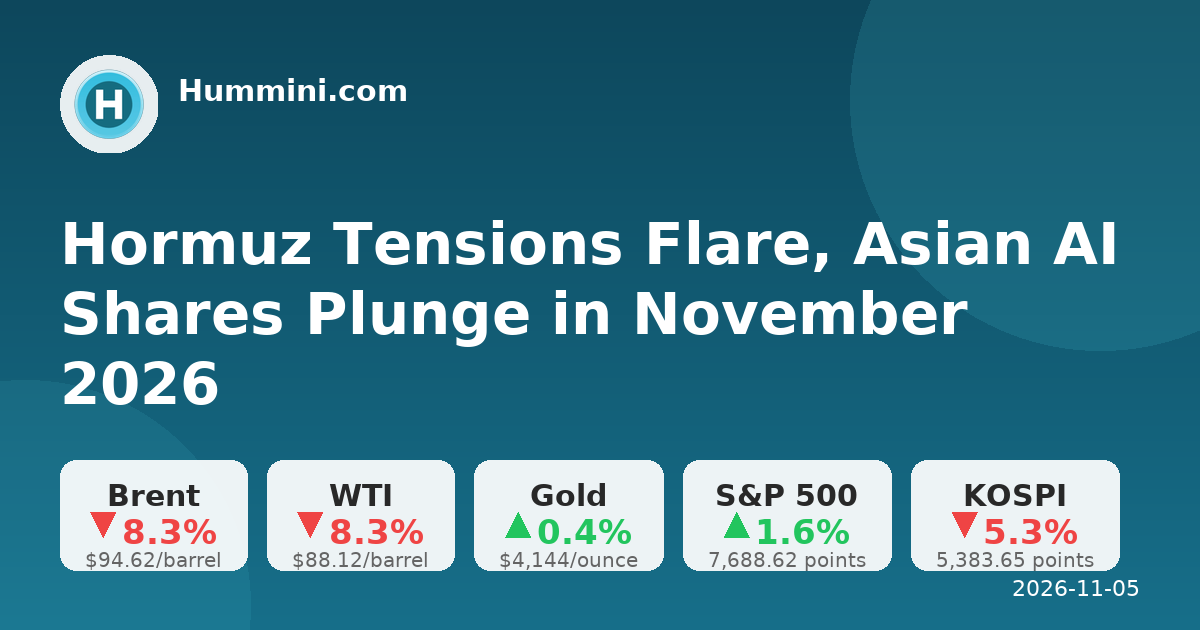
Hormuz Tensions Flare, Asian AI Shares Plunge in November 2026
khoảng 1 giờ trước
00WORLD TEMPERATURE
3.9/5. Resurgent maritime perils in the Strait of Hormuz alongside widespread European aviation bomb alerts heightened global security tensions.
BRIEFING
Updated from 12:00 to 19:00 on November 5, 2026 (Hanoi time), covering only new developments and updates.
1. Iran announced two oil tankers and a tugboat caught fire in the Strait of Hormuz after entering unauthorized shipping passages.
2. Saudi air defense forces successfully intercepted a Houthi ballistic missile targeting Medina province near Yanbu oil port.
3. Asian AI and tech stocks tumbled sharply, sending South Korea's KOSPI down 5.28 percent and triggering automated circuit breakers.
4. French Rafale fighter jets escorted an Aer Lingus airliner carrying 157 people to Évreux Air Base following an in-flight bomb alert.
5. NATO unveiled its Theory of Victory doctrine authorizing conventional deep precision strikes inside Russia to deter aggression.
6. Maersk raised its full-year 2026 profit guidance to 14.5 billion dollars on robust cargo demand for AI infrastructure.
7. Nationwide general strikes across France peaked with 700,000 demonstrators, severely paralyzing regional passenger rail networks.
8. Preliminary ballot counts covering nearly 30 percent in South Africa showed the ruling ANC falling to 31.7 percent.
1. OIL TANKERS CATCH FIRE IN HORMUZ, SAUDI INTERCEPTS MEDINA MISSILE
Two commercial oil tankers and an assisting tugboat caught fire while attempting to traverse unauthorized passages through the Strait of Hormuz on November 5, according to Iranian state news agency IRNA and Al Jazeera. Concurrently, the Saudi-led coalition confirmed that its air defenses successfully intercepted a ballistic missile launched by Yemen's Houthi movement toward the Medina region.
According to the Iranian military, a large crude carrier struck a naval mine south of the strait, while a supertanker caught fire near the eastern exit with flames spreading to an assisting tugboat. Iranian authorities alleged the vessels had deliberately disabled tracking transponders, while claiming electronic warfare units neutralized two U.S.-manufactured LUCAS attack drones. Along the Red Sea coast, coalition spokesman Colonel Turki al-Malki confirmed that fragments of the Houthi missile were neutralized mid-air without inflicting casualties, following precautionary civil defense alerts near Yanbu port.
The Strait of Hormuz and the southern Red Sea remain the world's most critical maritime corridors, channeling nearly one-third of seaborne oil supplies. The dual incidents unfolded just as global energy markets were seeking post-midterm diplomatic de-escalation in the Persian Gulf.
Strategic significance: Simultaneous maritime fires and missile attacks across both flanks of the Arabian Peninsula demonstrate that Tehran and its regional network retain the capability to choke critical shipping routes at will. This calculated display of deterrence warns Western capitals that domestic political shifts in Washington will not automatically mitigate operational security risks to Gulf energy flows.
2. AI TECH SHARES DUMPED AS KOSPI TUMBLES 5.3 PERCENT TRIGGERING SIDECAR
A fierce sell-off in semiconductor and artificial intelligence equities battered Asian financial exchanges on November 5, sending South Korea's KOSPI tumbling 5.28 percent to 5,383.65 points, according to Yonhap News Agency. In Tokyo, the Nikkei 225 similarly lost 1.79 percent to finish at 61,077.90 points as major semiconductor suppliers faced heavy liquidations.
The sharp decline on the Seoul exchange triggered automated sidecar trading curbs, temporarily halting program sell orders for five minutes. Memory chip manufacturers absorbed severe losses: SK Hynix plunged 9.45 percent, while Samsung Electronics sank more than 7.5 percent. In Tokyo, chip equipment makers including Tokyo Electron, Advantest, and tech investor SoftBank Group suffered steep pullbacks between 6 and 7 percent. The sell-off was catalyzed by political shifts following U.S. midterm elections, as investors grew concerned that a Democratic-controlled Congress would enforce stricter environmental reviews and utility constraints on power-hungry AI data centers.
East Asian manufacturing economies provide vital hardware components powering the global AI buildout, having benefited substantially from massive American capital expenditure cycles over the past year.
Strategic significance: Heavy reliance on American capital expenditure cycles leaves East Asian hardware producers uniquely vulnerable to policy shifts in Washington. This abrupt market pullback reveals that international investors are beginning to re-evaluate AI commercialization timelines, prioritizing capital preservation amid concerns that regulatory hurdles could slow upcoming infrastructure projects.
3. FRENCH JETS INTERCEPT AER LINGUS AIRLINER AMID SPREADING BOMB HOAXES
An Aer Lingus Airbus A320 commercial flight was forced to make an emergency landing at a military air base in western France under French fighter escort on November 5 following a bomb threat, according to Reuters and The Washington Post. All 151 passengers and six crew members were safely evacuated after the aircraft touched down.
Flight EI402 was traveling from Dublin to Rome when the crew squawked emergency transponder code 7700 after receiving an alert relayed by Italian security authorities. The French Air and Space Force scrambled Dassault Rafale fighter jets to intercept the airliner, guiding it safely onto the runway at Évreux-Fauville Air Base 105 in Normandy for bomb disposal inspections. The emergency diversion represented the most severe episode in a coordinated wave of more than a dozen false bomb threats targeting European carriers including Ryanair, Wizz Air, LOT, and Finnair throughout the day.
European transport and energy infrastructure networks have faced escalating gray-zone interference in recent months designed to disrupt civilian operations.
Strategic significance: Coordinated bomb threats directed at commercial aviation serve as a deliberate form of psychological disruption engineered to drain NATO civil defense and air policing capabilities. The cascading effect of these alerts extends far beyond flight delays, imposing substantial operational costs on airlines while stress-testing allied air defense readiness across shared European airspace.
4. NATO UNVEILS THEORY OF VICTORY DOCTRINE FEATURING DEEP STRIKES IN RUSSIA
NATO's Supreme Allied Commander Europe formally unveiled a landmark defense framework dubbed the Theory of Victory on November 5, outlining conventional deep precision strikes inside Russian territory to defeat potential aggression, according to Kyiv Post and Pravda. The new doctrine marks a fundamental evolution from conventional static border defense postures.
General Alexus Grynkewich emphasized that NATO forces will employ an active denial strategy focused on degrading command hubs, supply depots, and defense-industrial facilities located deep within hostile territory. Allied planners clarified that these deep strikes will rely exclusively on conventional precision munitions and cost-effective uncrewed attack systems, maintaining established nuclear thresholds. In tandem with the strategic revision, Britain and Germany achieved significant progress on a joint deep precision missile project exceeding 2,000 kilometers in range, while Sweden confirmed participation in financing deep strike capabilities for the alliance's eastern flank.
Following the outbreak of conflict in Eastern Europe, NATO initially reinforced frontier defenses across the Baltic states and Poland. However, contemporary combat lessons demonstrate that purely forward deployments remain susceptible to sustained enemy firepower without rear-area disruption.
Strategic significance: Publicly adopting a deep strike posture signals NATO's determination to reclaim conventional deterrence by making clear that military incursions will trigger immediate punishment against logistics infrastructure rather than localized border skirmishes. Nonetheless, explicitly targeting facilities within sovereign Russian territory elevates the risk of rapid conventional escalation if operational miscalculations occur.
5. MAERSK LIFTS FULL YEAR GUIDANCE ON AI BOOM AND PROTRACTED PORT BOTTLENECKS
A.P. Moller-Maersk upgraded its full-year 2026 underlying profit forecast for the third consecutive time on November 5, raising expected EBITDA to between 14.0 and 14.5 billion dollars on surging technology hardware shipments and maritime disruptions, according to Bloomberg and CNBC. Despite the upbeat forecast, company shares declined 11 percent as third-quarter earnings came in slightly below elevated financial estimates.
Maersk Chief Executive Vincent Clerc observed that global cargo flows are increasingly driven by extensive capital spending on artificial intelligence data centers and renewable power equipment. Compounding this freight demand, severe port congestion across East Asia caused by tropical storms and the continued closure of commercial transit through the Strait of Hormuz held average vessel wait times at 16.6 hours, pushing spot freight rates up 46 percent quarter-on-quarter. Although third-quarter EBITDA surged 75 percent year-on-year to 4.7 billion dollars, investors took profits amid concerns over prolonged detour expenses around conflict zones.
Container shipping moves more than 80 percent of global merchandise trade, serving as a primary pulse of worldwide commerce during ongoing geopolitical disruptions.
Strategic significance: Maersk's commercial trajectory underscores how the convergence of geopolitical choke points and technological buildouts is sustaining elevated logistics costs. Rather than easing as central banks had projected, persistently high freight rates continue to inject core inflationary pressure into major consumer economies.
6. FRANCE CRIPPLED AS UP TO 700,000 WORKERS JOIN NATIONWIDE STRIKES
France's nationwide general strike expanded significantly beyond early projections on the afternoon of November 5, with labor unions reporting between 500,000 and 700,000 demonstrators marching across nearly 185 cities and towns, according to Le Monde and The Guardian. The French Interior Ministry deployed an extensive security force of nearly 70,000 police officers and gendarmes nationwide to maintain order as public sector employees protested soaring living costs and austerity policies.
In Paris, the Paris Administrative Court rejected plans for marches near sensitive government sites like the Élysée Palace, directing protesters along a route from Place de la République to Place de la Nation. Commuter rail networks across the Paris region suffered severe cuts, with the RER D running at one-third capacity and lines such as the RER C operating at roughly half their normal frequency.
Strategic significance: The exceptional turnout highlights deepening social polarization within France as working-class voters voice mounting exhaustion with fiscal restraint. Intensifying street mobilization will complicate government efforts to enact public budget cuts, raising the prospect that domestic unrest could inspire similar labor disruptions across neighboring Western European economies.
7. SOUTH AFRICA VOTE REACHES ONE THIRD MARK AS ANC SINKS TO 31.7 PERCENT
Updated municipal election counts released on the evening of November 5 by the Electoral Commission of South Africa showed the ruling African National Congress sliding to 31.7 percent as tabulations neared 30 percent of voting districts, according to SABC News and Reuters. This tally represents a historic low compared to the 45.6 percent the party secured in 2021, reflecting widespread voter exasperation over chronic power blackouts and municipal graft.
The official opposition Democratic Alliance is running a close second with 28 to 30 percent of the national vote, taking decisive leads across several key urban councils in Gauteng and the Western Cape. Former President Jacob Zuma's MK Party held third place with 7 to 9 percent, while the Economic Freedom Fighters gathered roughly 5.6 percent. Election authorities noted that counting remains underway and verified results for all 257 municipal councils are scheduled to be finalized by November 8.
Strategic significance: The ruling party's deepening erosion in major urban centers pushes South Africa into an era of widespread hung councils. Fragmented local politics will require complex coalition negotiations, threatening administrative deadlock and delaying municipal infrastructure development across the continent's most industrial economy.
NEXT 48–72 HOURS
The Electoral Commission of South Africa will advance vote tabulations to finalize official seat allocations for 257 councils ahead of the November 8 deadline. In Paris, government officials and union leaders will evaluate strike turnout to chart subsequent fiscal negotiations. Internationally, maritime operators and allied naval forces will monitor tanker security in the Strait of Hormuz following recent fires, while Wall Street prepares for its next session to gauge the spillover of Asian technology sell-offs.
SOURCES
Strait of Hormuz tanker fires and Saudi air defense interception:
IRNA – IRGC reports fires on tankers navigating unauthorized routes in Strait of Hormuz – https://en.irna.ir
Al Jazeera – Ballistic missile targeting Medina intercepted by Saudi air defense – https://www.aljazeera.com
OilPrice – Tankers catch fire in Hormuz as maritime security alerts surge – https://oilprice.com
Middle East Eye – Drone interception and missile strikes shake Gulf waterways – https://www.middleeasteye.net
Asian technology and artificial intelligence equity sell-off:
Yonhap – KOSPI plunges over 5 percent as AI stock selloff triggers sidecar – https://en.yna.co.kr
Nikkei Asia – Tokyo Electron and Advantest slide as tech rout hits Nikkei 225 – https://asia.nikkei.com
Bloomberg – Asian chipmakers tumble on fears of US data center regulation – https://www.bloomberg.com
Aer Lingus flight diversion and European aviation bomb threats:
The Washington Post – Aer Lingus flight diverted to French airbase following bomb threat – https://www.washingtonpost.com
Reuters – French Rafale fighter jets escort passenger airliner amid Europe flight alerts – https://www.reuters.com
The Guardian – Coordinated hoax bomb threats disrupt European air travel networks – https://www.theguardian.com
NATO Theory of Victory military doctrine announcement:
Kyiv Post – SACEUR unveils Theory of Victory doctrine featuring deep precision strikes – https://www.kyivpost.com
Pravda – NATO eastern flank deterrence shifts to deep strikes against enemy logistics – https://www.pravda.com.ua
Defence Industry Europe – Germany and UK accelerate long range deep strike cruise missile project – https://defence-industry.eu
Maersk guidance upgrade and supply chain bottlenecks:
Bloomberg – Maersk upgrades 2026 profit outlook on AI infrastructure cargo boom – https://www.bloomberg.com
CNBC – Shipping giant Maersk lifts full year earnings guidance despite Q3 share drop – https://www.cnbc.com
Euronext – AP Moller Maersk Copenhagen trading summary and guidance upgrade – https://www.euronext.com
France nationwide general strike and Paris demonstrations:
Le Monde – Massive nationwide strikes draw hundreds of thousands across France – https://www.lemonde.fr
The Guardian – France faces widespread transport shutdown as 700,000 march – https://www.theguardian.com
Sortir a Paris – Paris administrative court mandates République to Nation protest route – https://www.sortiraparis.com
South Africa local government election vote tabulations:
SABC News – IEC reports ANC slipping to 31 percent as local vote counting continues – https://www.sabcnews.com
Reuters – South Africa municipal election tallies point to hung councils in major metros – https://www.reuters.com
Daily Maverick – Democratic Alliance surges in Gauteng as ANC local hegemony crumbles – https://www.dailymaverick.co.za
Global financial and commodity market benchmarks:
Trading Economics – Global commodities and stock market benchmarks dashboard – https://tradingeconomics.com
Investing.com – Crude oil plunges as Wall Street and Asian equities diverge – https://www.investing.com
State Bank of Vietnam – Daily foreign exchange rates and financial market indicators – https://www.sbv.gov.vn
0 comments
Ads
Related Posts
Ads