Ads
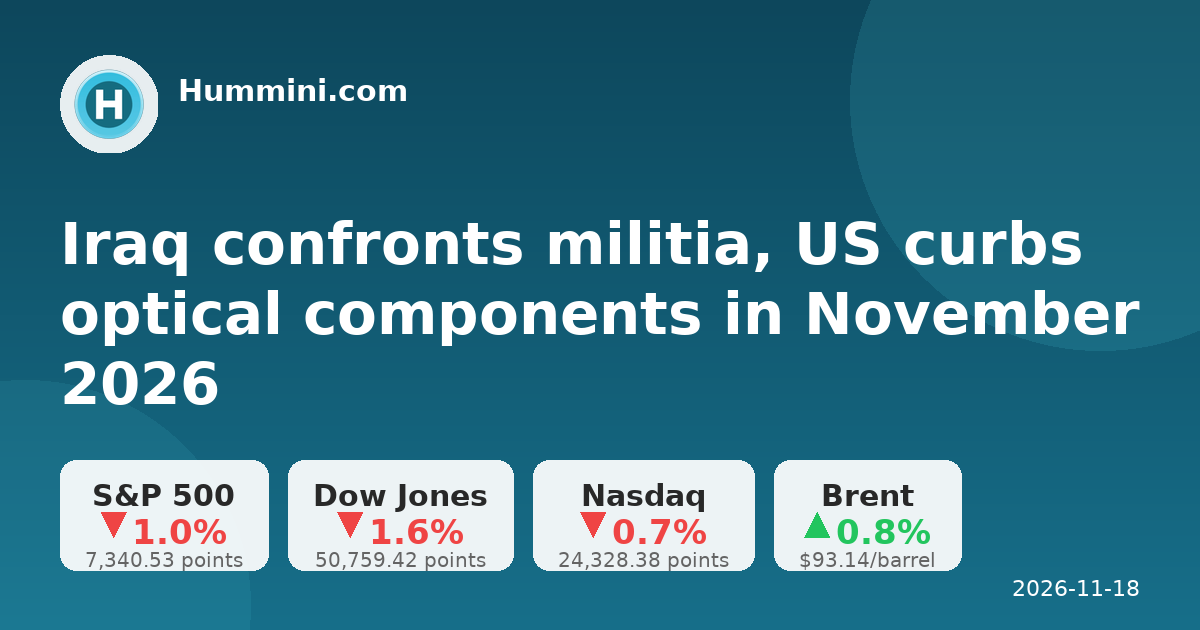
Iraq confronts militia, US curbs optical components in November 2026
2 ngày trước
00WORLD TEMPERATURE
3.8/5. An armed standoff looms in Iraq between state troops and pro-Iran militia, while US-China tech frictions and Franco-Iranian cyber diplomacy heat up simultaneously.
BRIEFING
Updated from 19:00 on November 17 to 05:00 on November 18, 2026 (Hanoi time), covering only new events and developments.
1. Iraq's Prime Minister issued an ultimatum demanding the Kataib Hezbollah militia vacate Jurf al-Sakhar by November 20 after satellite surveillance revealed large-scale oil theft.
2. The US administration is advancing import restrictions on new Chinese optical transceivers for AI data centers, overriding warnings from domestic tech giants of a ten-year supply disruption.
3. Canada and China unveiled an expanded 400-million-CAD tariff relief agreement at the APEC summit in Shenzhen to mitigate exposure to prospective US protectionist tariffs.
4. France formally summoned Iran's ambassador after cybersecurity investigators concluded an IRGC unit attacked refrigeration systems across 700 supermarkets and regional blood banks.
5. Germany agreed to back Spain's Pablo Hernández de Cos for European Central Bank President in exchange for securing the chief economist post for a German scholar.
6. Japan proposed creating an Asia Oil Security Task Force and offered unused domestic crude tanks to Southeast Asian nations amid heightened shipping risks in the Strait of Hormuz.
7. Alibaba became the sole global tech titan to endorse the UN Antalya AI Pledge at COP31, while major American technology corporations declined to sign on.
1. IRAQ ISSUES ULTIMATUM TO KATAIB HEZBOLLAH MILITIA
Iraqi Prime Minister Ali al-Zaidi ordered security forces to prepare to enter Jurf al-Sakhar south of Baghdad, setting a November 20 deadline for the Iran-backed Kataib Hezbollah militia to vacate the stronghold, according to The Washington Post.
The ultimatum followed intelligence satellite imagery documenting systematic oil siphoning and pipeline tampering across the district. Kataib Hezbollah rejected the allegations and warned it would confront government troops if they entered the area. Military tanks, armored vehicles, and heavily armed militia units deployed to the outskirts, creating a tense perimeter standoff. Fearing intra-Shiite armed clashes, General Esmail Qaani, commander of the IRGC Quds Force, flew urgently to Baghdad overnight to mediate with Prime Minister al-Zaidi. Local security officials proposed allowing Interior Ministry energy police to guard the pipelines as an off-ramp to avert direct combat.
Jurf al-Sakhar occupies a critical southern approach to Baghdad and has operated as an autonomous, closed enclave under Kataib Hezbollah control since the group expelled Islamic State militants in 2014.
Strategic significance: The decisive posture of Prime Minister al-Zaidi represents Baghdad's boldest push to assert state authority over entrenched paramilitary factions. However, if Iranian mediation falters, an armed clash between the regular army and militia forces risks plunging Iraq into intense domestic turmoil precisely when regional Persian Gulf stability is already frayed.
2. US MOVES TO RESTRICT CHINESE OPTICAL MODULES FOR AI
The US administration is advancing plans to prohibit imports of new Chinese optical transceivers used in AI data centers, setting aside intense lobbying from domestic tech giants, according to Reuters.
The proposed Federal Communications Commission measure aims to prevent cyber espionage backdoors and firmware tampering in critical network gear. Chinese manufacturers supply approximately two-thirds of the global optical transceiver market, producing modules that convert electrical signals into light pulses for high-speed server interconnects. A tech coalition including Amazon, Google, Meta, Microsoft, Cisco, and CoreWeave mounted fierce resistance, warning that alternative suppliers lack adequate manufacturing scale and that full compliance could take up to a decade. Executives also cautioned that Beijing could retaliate by choking off supplies of indium phosphide, a compound semiconductor material essential for optical sensor manufacturing.
The restriction deepens Washington's technology curbs following Commerce Department rules barring foreign data centers from leasing advanced AI computing capacity to Chinese entities.
Strategic significance: Broadening national security restrictions from logic chips to transmission hardware demonstrates Washington's willingness to absorb higher capital expenditure and slower data center rollouts to sever supply dependencies on Beijing. Should China respond with export restrictions on rare compound materials, the global race for AI computing power faces renewed cost inflation and hardware bottlenecks.
3. CANADA AND CHINA EXPAND BILATERAL TARIFF RELIEF PACT
Canadian Prime Minister Mark Carney and Chinese President Xi Jinping announced an expanded bilateral tariff relief agreement covering roughly 400 million Canadian dollars on the sidelines of the APEC summit in Shenzhen, according to CBC News.
Beijing agreed to suspend retaliatory tariffs on 116 million CAD in frozen pork cuts from January 2027 through 2028, while reducing duties on 285 million CAD in seafood exports including cold-water shrimp, geoduck clams, and Greenland halibut. In return, Ottawa extended existing tariff remissions on Chinese steel and aluminum through December 2028 and added 32 industrial metal tariff codes to the duty-free list. China's Finance Ministry also confirmed plans to revive a bilateral currency swap agreement that had been dormant for nine years and establish frameworks for qualified Canadian institutions to issue panda bonds in Chinese domestic debt markets.
The breakthrough builds on diplomatic rapprochement following years of frozen relations, as US trading partners maneuver to shield their economies from anticipated broad-based tariffs under the incoming administration of President Donald Trump.
Strategic significance: The agreement reflects a pragmatic pivot by Prime Minister Mark Carney to secure agricultural and marine export markets and buffer the Canadian economy against volatile trade shocks from Washington. Nonetheless, deepening commercial and monetary integration with Beijing is poised to draw sharp scrutiny and policy resistance from congressional lawmakers and security officials in the United States.
4. FRANCE SUMMONS IRANIAN AMBASSADOR OVER SUPERMARKET CYBERATTACK
The French Foreign Ministry summoned the Iranian ambassador in Paris after investigators concluded an IRGC cyber warfare unit orchestrated sabotage attacks targeting refrigeration systems across 700 supermarkets, according to The Guardian.
National cybersecurity agency ANSSI and the Paris prosecutor's office traced the intrusions to the Shahid Kaveh hacking unit within the Islamic Revolutionary Guard Corps. The group manipulated digital thermostats across major retail chains, including Carrefour, Intermarché, and E. Leclerc. The hacks forced refrigeration temperatures above 50 degrees Celsius, spoiling massive quantities of perishable food, igniting localized equipment fires, and probing regional blood bank storage. Foreign Minister Jean-Noël Barrot condemned the campaign as unprecedented aggression on French territory, noting that prosecutors have requested international arrest warrants for unit commanders and that Paris will advocate for coordinated European Union sanctions. Iran consistently denies involvement in overseas cyber operations.
The incident marks a concerning expansion of state-sponsored cyber warfare directly targeting civilian food supply chains and medical refrigeration infrastructure in Europe amid ongoing Middle Eastern hostilities.
Strategic significance: Paris's public attribution and diplomatic summons establish a firm European red line against cyber sabotage targeting core civilian logistics. With France explicitly reserving the right to deliver proportional cyber responses, the episode creates a dangerous new channel for Western-Iranian confrontation beyond conventional Middle Eastern theaters.
5. GERMANY BACKS DE COS FOR EUROPEAN CENTRAL BANK PRESIDENCY
The German government decided to endorse former Bank of Spain Governor Pablo Hernández de Cos to succeed Christine Lagarde as European Central Bank President in February 2027, according to Reuters sources.
Support from Berlin, combined with France's endorsement, positions de Cos, who currently leads the Bank for International Settlements, as the commanding favorite and sidelines Dutch Central Bank Chief Klaas Knot. In exchange for conceding the presidency to a southern European policymaker, the German Finance Ministry secured an understanding that Princeton University economics professor Markus Brunnermeier will assume the chief economist role on the executive board. The power-sharing arrangement maintains the institutional and ideological equilibrium between northern fiscal conservatives and southern member states on the six-member leadership panel.
Christine Lagarde is scheduled to conclude her tenure early on February 7, 2027, initiating a comprehensive reshuffle of the euro area's apex monetary authority.
Strategic significance: Early consensus between Berlin and Paris shields the eurozone from destabilizing leadership vacancies at a time of sluggish regional output and external trade friction. With de Cos managing consensus and a German economist drafting policy initiatives, the ECB is likely to maintain a balanced, data-dependent interest rate path that preserves price stability while containing sovereign bond spreads across southern Europe.
6. JAPAN PROPOSES ASIA OIL SECURITY TASK FORCE AT ASEAN
Japanese Prime Minister Sanae Takaichi proposed establishing an Asia Oil Security Task Force on the sidelines of the ASEAN Summit in Manila, according to Philstar.
The planned mechanism functions as an Asian counterpart to the International Energy Agency, tasked with coordinating regional stockpiling frameworks, establishing emergency release protocols, and managing oil sharing during supply emergencies. To assist resource-constrained Southeast Asian partners without requiring costly storage construction, Japan offered to open unused domestic storage tanks to host strategic reserves for regional neighbors, synchronizing with a joint reserve scheme led by the Philippines. Prime Minister Takaichi also unveiled the POWERR Gulf Initiative to facilitate direct crisis coordination between Persian Gulf producers and Asian consuming nations.
The initiative responds to tanker mining incidents and escalating closure risks along the Strait of Hormuz that directly imperil crude shipments bound for Asian refineries.
Strategic significance: Tokyo's proposal reinforces Japan's leadership in constructing regional energy resilience, addressing cooperative gaps left by existing Asian multilateral frameworks. By pooling reserve infrastructure, Japan expands its diplomatic footprint in Southeast Asia while establishing a necessary buffer for regional manufacturing value chains against volatile Middle Eastern disruptions.
7. ALIBABA IS SOLE TECH GIANT TO SIGN COP31 CLIMATE AI PLEDGE
Chinese technology conglomerate Alibaba became the only global tech titan to endorse the Antalya AI Climate Action Pledge at the COP31 summit in Turkey, according to the International Telecommunication Union.
Spearheaded by the Turkish COP31 Presidency and the International Telecommunication Union, the voluntary framework establishes benchmarks across four pillars: powering AI data centers with clean energy, engineering energy-efficient and water-efficient hardware, delivering transparent greenhouse gas accounting, and transferring green tech to developing nations. The initial launch drew approximately 90 endorsements from governments and civil society organizations. However, major American technology giants including Google, Microsoft, Meta, Amazon, and Nvidia declined to sign, drawing criticism from climate advocacy groups over emission accountability as artificial intelligence power demand surges globally.
The friction over computational power consumption unfolds as COP31 ministerial negotiations remain entangled in bitter disputes over adaptation financing and sovereign debt relief.
NEXT 48–72 HOURS
A trilateral summit between the United States, China, and Russia is scheduled for November 19 in Shenzhen alongside APEC leaders meetings, where Donald Trump, Xi Jinping, and Vladimir Putin are set to discuss nuclear arms control and regional security frameworks.
The deadline set by Iraqi Prime Minister Ali al-Zaidi for Kataib Hezbollah to hand over Jurf al-Sakhar expires on November 20, representing a decisive flashpoint for potential armed confrontation.
Ministerial negotiations at the COP31 climate summit in Antalya, Turkey, enter their final phase to reach consensus on adaptation finance targets before the scheduled November 20 conclusion.
Nvidia will release quarterly financial earnings on November 18, providing a vital gauge for global semiconductor investment sentiment and Wall Street indices following recent pullbacks.
SOURCES
1. IRAQ ISSUES ULTIMATUM TO KATAIB HEZBOLLAH MILITIA
The Washington Post – Iraq forces prepare standoff with Kataib Hezbollah in Jurf al-Sakhar – https://www.washingtonpost.com/world/2026/11/17/iraq-jurf-al-sakhar-kataib-hezbollah-standoff/
Arab News – Iraqi government sets deadline for militia withdrawal over oil smuggling – https://www.arabnews.com/node/2621182/middle-east
2. US MOVES TO RESTRICT CHINESE OPTICAL MODULES FOR AI
Reuters – US advances curbs on Chinese optical transceivers for AI data centers despite tech pushback – https://www.reuters.com/technology/us-curbs-china-optical-transceivers-ai-data-centers-2026-11-17/
The Defiant – Big Tech pushes back against FCC optical transceiver curbs – https://thedefiant.io/news/tech/optical-transceivers-fcc-ai-data-centers
3. CANADA AND CHINA EXPAND BILATERAL TARIFF RELIEF PACT
CBC News – Canada and China expand tariff relief pact on sidelines of APEC summit – https://www.cbc.ca/news/politics/canada-china-tariff-relief-apec-shenzhen-1.7482910
South China Morning Post – Carney and Xi agree on expanded trade concessions and currency swap – https://www.scmp.com/news/china/diplomacy/article/3289104/carney-xi-trade-deal-apec
4. FRANCE SUMMONS IRANIAN AMBASSADOR OVER SUPERMARKET CYBERATTACK
The Guardian – France summons Iranian envoy over cyberattacks on 700 supermarkets – https://www.theguardian.com/world/2026/nov/17/france-summons-iran-ambassador-cyberattack-supermarkets-irgc
Al Jazeera – France accuses IRGC cyber unit of targeting commercial refrigeration – https://www.aljazeera.com/news/2026/11/17/france-iran-cyber-supermarkets-irgc
5. GERMANY BACKS DE COS FOR EUROPEAN CENTRAL BANK PRESIDENCY
Reuters – Germany backs Spain's de Cos for ECB president in package deal with Berlin economist – https://www.reuters.com/markets/europe/germany-backs-de-cos-ecb-presidency-brunnermeier-2026-11-17/
Euronext – European capitals near agreement on ECB leadership succession – https://www.euronext.com/en/news/ecb-presidency-race-de-cos
6. JAPAN PROPOSES ASIA OIL SECURITY TASK FORCE AT ASEAN
Philstar – Japan proposes Asia Oil Security Task Force and shared reserves at ASEAN – https://www.philstar.com/business/2026/11/17/2398412/japan-proposes-asia-oil-security-task-force
The Daily Star – PM Takaichi offers Japanese storage tanks for Asian emergency oil pool – https://www.thedailystar.net/business/energy-power/news/japan-oil-storage-asia-3759102
7. ALIBABA IS SOLE TECH GIANT TO SIGN COP31 CLIMATE AI PLEDGE
Climate Home News – Alibaba signs UN Antalya AI climate pledge as US tech giants stay away – https://www.climatechangenews.com/2026/11/17/antalya-ai-pledge-cop31-alibaba/
International Telecommunication Union – COP31 launches Antalya AI Climate Action Pledge – https://www.itu.int/en/mediacentre/Pages/2026-11-16-cop31-ai-pledge.aspx
FINANCIAL MARKETS
Morningstar – S&P 500 closes lower Tuesday amid tech pullback – https://www.morningstar.com/markets/sp500-close-2026-11-17
The Star – Brent crude settles higher at $93.14 on geopolitical risk – https://www.thestar.com.my/business/market-watch/2026/11/17/oil-brent-settles-higher
0 comments
Ads
Related Posts
Ads