Ads
Quantum physics anchors cybersecurity to exact coordinates in physical space
6 ngày trước
00WHEN PHYSICAL COORDINATES BECOME AN UNBREAKABLE KEY
Imagine waking up to discover your bank account has been completely emptied simply because an attacker stole your password. In the digital universe, whoever possesses the correct cryptographic key is treated as you, even if they are lurking on the opposite side of the planet.
On November 18, 2026, scientists at the National Institute of Standards and Technology (NIST), along with international collaborators, published a landmark breakthrough in the journal Nature that fundamentally changes digital security: for the first time, they successfully demonstrated a method to verify the absolute physical coordinates of a device using quantum mechanics, even when that device is entirely untrusted.
Note – Quantum Position Verification: A method leveraging the laws of quantum physics to verify whether a person or device is genuinely present at a declared spatial coordinate, preventing remote impersonation.
WHY CURRENT DIGITAL SECURITY CAN BE FOOLED FROM AFAR
Modern digital security relies on three pillars: what you know like a password, what you have like a token card, or who you are like a fingerprint. Yet all of this information is ultimately converted into streams of binary bits. As digital signals travel across fiber optic cables or radio frequencies, adversaries can intercept, duplicate, or relay them to a remote server in milliseconds. Even global positioning satellite signals can be spoofed using transmitters on the ground. Cybersecurity experts call this a relay attack, where an imposter acts as a stealthy middleman, shuttling legitimate authorization to a bank without either party realizing the deception.
Note – Relay attack: A cyberattack where an adversary intercepts valid authentication credentials and relays them to a target server to impersonate the user without breaking encryption algorithms.
Note – Quantum entanglement: A phenomenon where two particles are so deeply interconnected that measuring the physical state of one instantly dictates the state of the other, regardless of distance.
THE BREAKTHROUGH OF UNTRUSTED DEVICES
For years, theoretical physicists envisioned using quantum particles of light alongside the speed of light to lock in a sender location. However, earlier schemes suffered from a crippling vulnerability: they required absolute faith in the user hardware. If the device carried a manufacturer backdoor, or if colluding attackers coordinated using pre-shared entangled quantum bits, they could easily trick the system. The breakthrough achieved by NIST is demonstrating a device-independent protocol. Even if your computer was built by a malicious adversary or rigged with spyware, the fundamental laws of nature still prove your location is genuine.
Note – Quantum no-cloning theorem: A fundamental principle of physics stating that it is impossible to create an identical copy of an arbitrary unknown quantum state without disturbing it.
Note – Device-independent: A cryptographic framework whose security is mathematically proven through physical laws, independent of whether internal hardware components are compromised or faulty.
EXPERIMENTAL PROOF OVER A 195-METER TESTBED
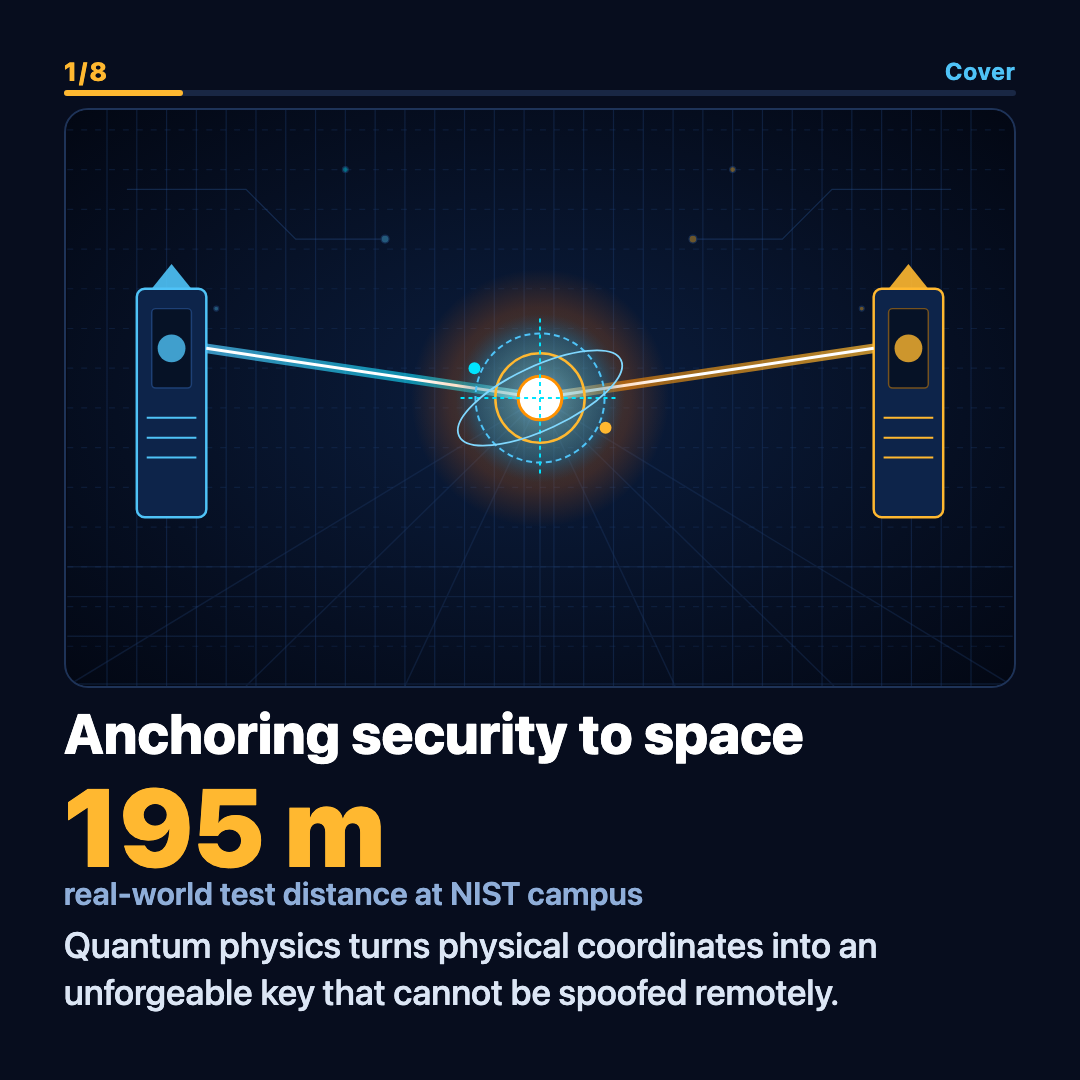
To validate this concept in the real world, the research team constructed a 195-meter quantum testbed across the NIST campus in Boulder, Colorado. Two trusted verifier stations were positioned at opposite ends of research corridors, synchronized through fiber optic and timing cables. The device claiming the location was situated between them.
At the start of each trial, one verifier generated an entangled photon pair, retaining one photon while transmitting the other toward the user. Simultaneously, both stations broadcast random numeric challenges precisely timed to arrive at the user coordinates at the exact same nanosecond. The user had to measure the polarization of the photon and return the answer immediately. The speed of light in vacuum served as the supreme arbiter: if an imposter stood just meters away, their reply arrived late. By successfully conducting a loophole-free photonic Bell test, the team achieved a localization volume 4.5 times tighter than the best possible classical protocols, closing all avenues for deceit.
Note – Loophole-free Bell test: A rigorous experimental physics test that confirms quantum entanglement correlations are genuine without technical loopholes or covert communication between measuring devices.
A PHYSICAL SHIELD TO PROTECT FUTURE CRITICAL INFRASTRUCTURE
This breakthrough heralds a new era where cybersecurity no longer relies solely on abstract lines of code, but is anchored directly into the geometry of spacetime. Its foremost value lies in shielding vital systems against remote attacks. A multi-million-dollar wire transfer, a grid switching operation, or defense launch authorization can be strictly restricted so that it only executes if the operator is physically sitting inside a fortified control room. Any remote hacking attempt is rendered physically impossible by the cosmic speed limit of light.
Nevertheless, translating this lab demonstration into daily life remains a long-term endeavor. Scientists emphasize that this technology is still in basic research and will likely take at least a decade to reach commercial maturity. Key technical hurdles include optical signal loss across long distances and the need for scalable quantum repeaters. The next milestone for researchers will be expanding the experimental baseline from hundreds of meters to tens of kilometers across metropolitan fiber networks.
SOURCES
Nature – Quantum position verification with remote untrusted devices – https://doi.org/10.1038/s41586-026-11247-3
NIST – NIST Physicists Demonstrate Quantum Location Verification – https://www.nist.gov
arXiv – Quantum position verification with remote untrusted devices – https://arxiv.org/abs/2603.11247
0 comments
Ads
Related Posts
Ads