Ads
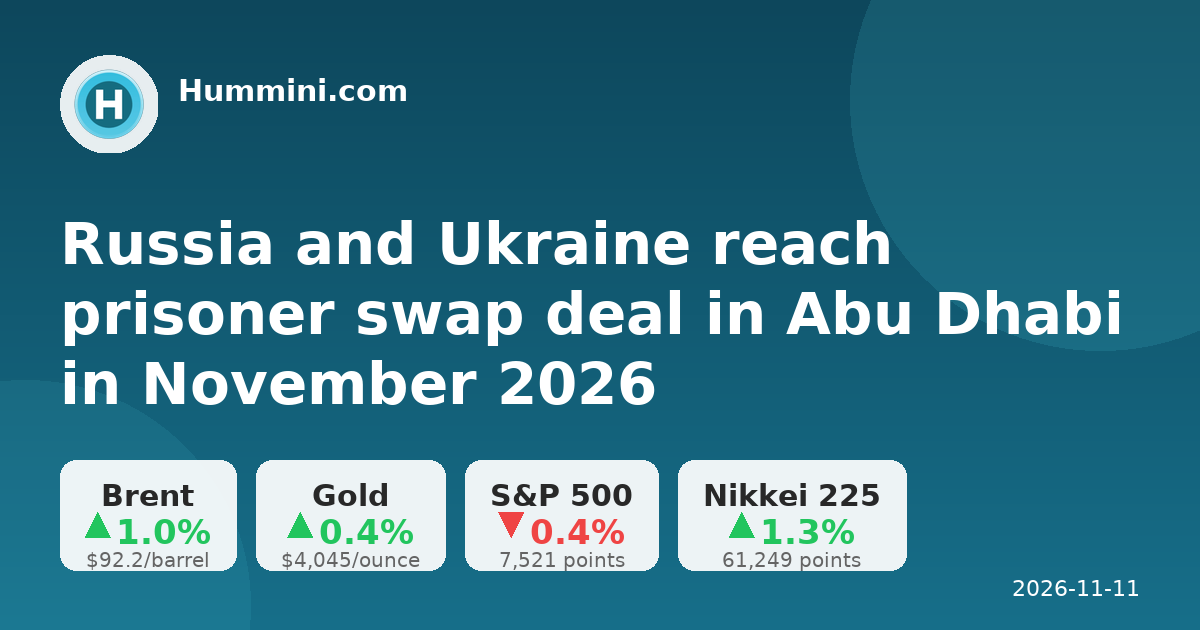
Russia and Ukraine reach prisoner swap deal in Abu Dhabi in November 2026
9 ngày trước
00WORLD TEMPERATURE
3.5/5. The prisoner swap deal between Russia and Ukraine offers rare humanitarian progress, yet underlying global frictions remain acute as senior U.S. cabinet members relocate to military installations and disputes deepen over international trade and international judicial institutions.
BRIEFING
Updated from 12:11 to 19:00 on November 11, 2026 (Hanoi time), covering exclusively breaking news and significant developments.
1. Russia and Ukraine concluded trilateral Abu Dhabi talks by sealing a landmark large-scale prisoner of war exchange.
2. The United Nations Human Rights Council postponed its review of the United States to 2027 following an official boycott by Washington.
3. Israel's newly sworn-in opposition bloc tabled three sweeping bills to curb caretaker Prime Minister Benjamin Netanyahu's political power.
4. U.S. Treasury Secretary Scott Bessent moved into a secure military facility following credible assassination threats traced to Iran.
5. Japan is considering advancing its 2027 budget contributions to the International Criminal Court to buffer it against anticipated U.S. sanctions.
6. The EU Chamber of Commerce warned European manufacturers face an existential risk of being outcompeted by Chinese rivals by 2030.
7. Brent crude oil prices ticked upward to $92.2 per barrel amid persistent geopolitical risks across the Middle East.
1. RUSSIA AND UKRAINE CLINCH MAJOR PRISONER SWAP DEAL AS ABU DHABI TALKS CONCLUDE
On the afternoon of November 11, trilateral security negotiations in Abu Dhabi officially concluded with an initial breakthrough agreement on a large-scale prisoner of war exchange between Russia and Ukraine, according to senior Russian aide Vladimir Medinsky and U.S. special envoy Jared Kushner.
Following two full days of closed-door deliberations, Medinsky told reporters that Moscow and Kyiv had established mutual understanding on key humanitarian issues and authorized the implementation of a major prisoner release. Kushner characterized the breakthrough as the largest humanitarian release of prisoners since the war escalated, adding that final numbers and transport logistics are being coordinated. Negotiators acknowledged, however, that substantial divisions remain unbridged regarding the broader European security blueprint tabled by the U.S. delegation, while Russian officials maintained skepticism toward direct European Union involvement in subsequent talks.
Strategic significance: The prisoner exchange gives American mediators a concrete deliverable to keep diplomatic channels alive, yet the absence of consensus on core territorial and security guarantees underscores that a comprehensive settlement remains distant. Upcoming visits by U.S. envoys to Moscow and European capitals will likely test how far each capital is genuinely willing to compromise.
2. UN HUMAN RIGHTS COUNCIL DELAYS US REVIEW AFTER TRUMP ADMINISTRATION BOYCOTT
On November 10 in Geneva, the United Nations Human Rights Council voted by consensus to delay its Universal Periodic Review of the United States to January 2027 after the Trump administration boycotted the session, leaving its seats empty, according to the Associated Press.
The boycott marks the first instance in the council's nearly 20-year history in which a member state completely refused to undergo the mandatory peer review required for all 193 UN members. Confronted with vacant American seats, the 47-nation council elected to grant a two-month postponement to encourage Washington to reengage. The U.S. State Department defended its absence, describing the council as an irredeemable forum that promotes anti-American positions. The decision drew sharp condemnation from global human rights monitors and lawmakers, who cautioned that allowing Washington to bypass scrutiny creates a damaging precedent for other states seeking to evade international accountability.
Washington previously withdrew from the Human Rights Council in February 2025 during President Donald Trump's second term, and this marks the second consecutive year the United States has deferred its mandatory evaluation, which was initially scheduled for November 2025.
Strategic significance: Washington's public boycott underscores an unapologetic skepticism toward multilateral oversight, prioritizing bilateral leverage and absolute sovereignty above international bodies. Relations between the United States and the United Nations are likely to fracture further, weakening the binding moral and legal force of global human rights frameworks.
3. ISRAELI OPPOSITION LAUNCHES LEGISLATIVE OFFENSIVE TO BLOCK NETANYAHU COMEBACK
On November 11, immediately after the swearing-in of the 26th Knesset, the Israeli parliamentary opposition led by former military chief Gadi Eisenkot mobilized its majority to introduce three aggressive legislative measures intended to terminate caretaker Prime Minister Benjamin Netanyahu's political career, according to The Guardian.
The legislative package includes three decisive measures: creating an independent state commission of inquiry into intelligence failures surrounding October 7, 2023, capping prime ministerial service at eight years to bar Netanyahu from office, and repealing the judicial overhaul passed by the previous government. The opposition also advanced moves to replace parliamentary Speaker Amir Ohana, a key Netanyahu confidant. During a combative opening session, Netanyahu struck back by accusing Arab opposition parties of being terror supporters, prompting Eisenkot to condemn the remarks as definitive proof that Netanyahu is unsuited to govern.
The legislative showdown follows a deadlocked October 2026 general election where neither coalition captured an outright majority, prompting President Isaac Herzog to grant Eisenkot a 28-day mandate to assemble a ruling coalition.
Strategic significance: This pre-emptive legislative strike indicates that the anti-Netanyahu coalition is moving to dismantle his political apparatus before coalition negotiations even conclude. Should Eisenkot fail to assemble a stable 61-seat majority within the constitutional timeframe, the mandate would revert to Netanyahu, potentially steering Israel into an unprecedented constitutional impasse.
4. US TREASURY SECRETARY MOVES TO MILITARY BASE OVER IRAN THREATS
U.S. Treasury Secretary Scott Bessent has vacated his Washington home to live inside a heavily fortified military installation following severe assassination threats linked to Iran, according to The New York Times on November 11.
U.S. intelligence reports confirmed that Iranian assassination plots targeting senior American figures have entered an advanced phase, with Bessent identified as a top-tier target because he spearheads crushing economic sanctions and financial enforcement measures against Tehran. Bessent follows White House Chief of Staff Stephen Miller and Secretary of State Marco Rubio into protected military housing. A Treasury Department spokesperson stated that Bessent will not be deterred by Iranian threats and affirmed that the maximum pressure sanctions campaign will accelerate.
Tensions between Washington and Tehran have escalated through 2026 as the United States tightened punitive financial measures against Iranian oil exports and banking channels, while Tehran faced accusations of directing assassination networks and cyber assaults against Western officials.
Strategic significance: The physical relocation of top economic and foreign policy cabinet officials to fortified military installations illustrates that contemporary geopolitical confrontations now directly imperil policymakers well beyond conventional battlefields. This escalation will almost certainly prompt Washington to execute stiffer punitive financial penalties and defensive military deployments aimed at Iranian networks.
5. JAPAN WEIGHS EARLY ICC FUNDING TO COUNTER THREAT OF US SANCTIONS
The Japanese government is evaluating an early transfer of its 2027 statutory financial contributions to the International Criminal Court to protect the tribunal from operational paralysis caused by looming U.S. sanctions, according to diplomatic sources in Tokyo on November 11.
The move comes as the U.S. Congress and executive branch prepare punitive financial measures against the ICC and its newly appointed Japanese president, Judge Tomoko Akane. Japan serves as the largest financial contributor to the court's core operational budget. Disbursing funds ahead of scheduled Washington sanctions would insulate the tribunal's active judicial operations from having international banking channels severed.
Frictions between Washington and the ICC intensified sharply after the court issued arrest warrants for senior leaders allied with the United States, sparking intense pushback from conservative U.S. lawmakers seeking to defund and isolate the institution.
Strategic significance: An advance disbursement places Tokyo in a delicate diplomatic position, balancing its indispensable security alliance with Washington against its commitment to the multilateral rules-based legal order and the standing of a Japanese jurist. Japan's principled maneuver may provide a financial roadmap for European and Asian allies seeking to insulate international institutions from unilateral coercive pressure.
6. EUROPEAN INDUSTRY WARNED OF COMPETING SURRENDER TO CHINA BY 2030
On November 11, the European Union Chamber of Commerce in China released a major report warning that European industrial manufacturers face an existential risk of abandoning direct competition and becoming subordinate suppliers to Chinese industrial giants by 2030, according to The Guardian.
Chamber President Jens Eskelund warned that cheap subsidized exports and Beijing's ballooning annual trade surplus of over $1 trillion have forced European industry to an existential crossroads. On the same day, Chinese Foreign Minister Wang Yi held a phone call with French counterpart Jean-Noël Barrot, urging the European Union to maintain balanced commercial relations and warning that economic confrontation harms both sides. Concurrently, the German Defense Ministry enacted an immediate ban prohibiting commercial Chinese drones across all domestic military bases due to surveillance risks and unauthorized data transfers to Beijing.
Commercial disputes between Brussels and Beijing have broadened across electric vehicles, renewable infrastructure, and persistent supply chain imbalances, generating mounting momentum within Europe for defensive tariffs.
Strategic significance: The Chamber of Commerce report reflects a sober realization that European defensive trade remedies alone cannot offset China's massive manufacturing scale and cost advantages. Internal divisions among EU member states torn between market protection and fears of Chinese retaliation threaten to derail unified European trade policy.
48–72 HOURS
U.S. envoys are scheduled to travel to Moscow and key European capitals to brief leaders on the Abu Dhabi discussions and formalize the timeline for the prisoner swap. In Jerusalem, Prime Minister-designate Gadi Eisenkot enters the opening phase of his 28-day coalition mandate, facing an immediate test of his fragile parliamentary majority as the Knesset debates term limit legislation. Meanwhile, global financial markets will track energy price fluctuations alongside high-level negotiations unfolding at the COP31 climate summit in Turkey.
SOURCES
Russia and Ukraine clinch major prisoner swap deal as Abu Dhabi talks conclude:
Xinhua – Russia, Ukraine agree on prisoner swap at Abu Dhabi talks – http://www.news.cn/world/20261111/abu-dhabi-prisoner-swap.htm
The Moscow Times – Russia and Ukraine reach understanding on major prisoner exchange in UAE talks – https://www.themoscowtimes.com/2026/11/11/abu-dhabi-pow-swap-medinsky-a85940
Kurdistan 24 – U.S. mediator Kushner announces breakthrough prisoner swap after Abu Dhabi summit – https://www.kurdistan24.net/en/story/abu-dhabi-trilateral-negotiations-kushner-update
UN Human Rights Council delays US review after Trump administration boycott:
Associated Press – UN body postpones US human rights review after Trump administration boycott – https://apnews.com/article/un-human-rights-council-us-review-postponed-2026
Al Jazeera – UN Human Rights Council delays US review to 2027 amid Washington snub – https://www.aljazeera.com/news/2026/11/11/un-human-rights-council-postpones-us-upr
Independent – Rights groups condemn Trump administration for skipping mandatory UN rights scrutiny – https://www.independent.co.uk/news/world/americas/us-politics/un-human-rights-council-trump-boycott-2026
Israeli opposition launches legislative offensive to block Netanyahu comeback:
The Guardian – Gadi Eisenkot launches legislative blitz to bar Netanyahu as new Knesset sworn in – https://www.theguardian.com/world/2026/nov/11/israel-knesset-eisenkot-netanyahu-term-limits
The Washington Post – Israeli opposition pushes state inquiry into Oct 7 and moves to replace speaker – https://www.washingtonpost.com/world/2026/11/11/israel-knesset-eisenkot-netanyahu-inquiry
The Hindu – New Israeli parliament opens with fierce clashes between Netanyahu and opposition – https://www.thehindu.com/news/international/israel-26th-knesset-opening-session-clashes-2026
US Treasury Secretary moves to military base over Iran threats:
The New York Times – Treasury Secretary Bessent moves to military base amid heightened threats from Iran – https://www.nytimes.com/2026/11/11/us/politics/scott-bessent-military-base-iran-threats.html
CBS News – Top US officials placed under enhanced military protection following Iranian assassination plots – https://www.cbsnews.com/news/treasury-secretary-bessent-military-base-security-iran/
Times of Israel – US Treasury vows sanctions pressure on Tehran will persist despite threats to Bessent – https://www.timesofisrael.com/treasury-bessent-iran-sanctions-military-base-threats/
Japan weighs early ICC funding to counter threat of US sanctions:
The Japan Times – Tokyo considers early 2027 contribution to ICC to buffer against US sanctions – https://www.japantimes.co.jp/news/2026/11/11/national/japan-icc-early-funding-us-sanctions/
Philippine News Agency – Japan weighs advance payment to International Criminal Court under Akane leadership – https://www.pna.gov.ph/articles/japan-icc-contribution-shielding-sanctions
Mainichi Shimbun – Foreign Ministry mulls proactive measures to protect international judicial body – https://mainichi.jp/english/articles/20261111/japan-icc-budget-us-pressure
European industry warned of competing surrender to China by 2030:
The Guardian – European firms face existential crisis competing with China, chamber warns – https://www.theguardian.com/business/2026/nov/11/european-manufacturers-existential-crossroads-china
Al Jazeera – Wang Yi urges balanced EU trade ties as European industry raises alarm – https://www.aljazeera.com/economy/2026/11/11/china-eu-trade-surplus-wang-yi-barrot
South China Morning Post – Germany bans Chinese commercial drones on military bases amid security concerns – https://www.scmp.com/news/china/diplomacy/article/german-bundeswehr-chinese-drone-ban-2026
0 comments
Ads
Related Posts
Ads