Ads
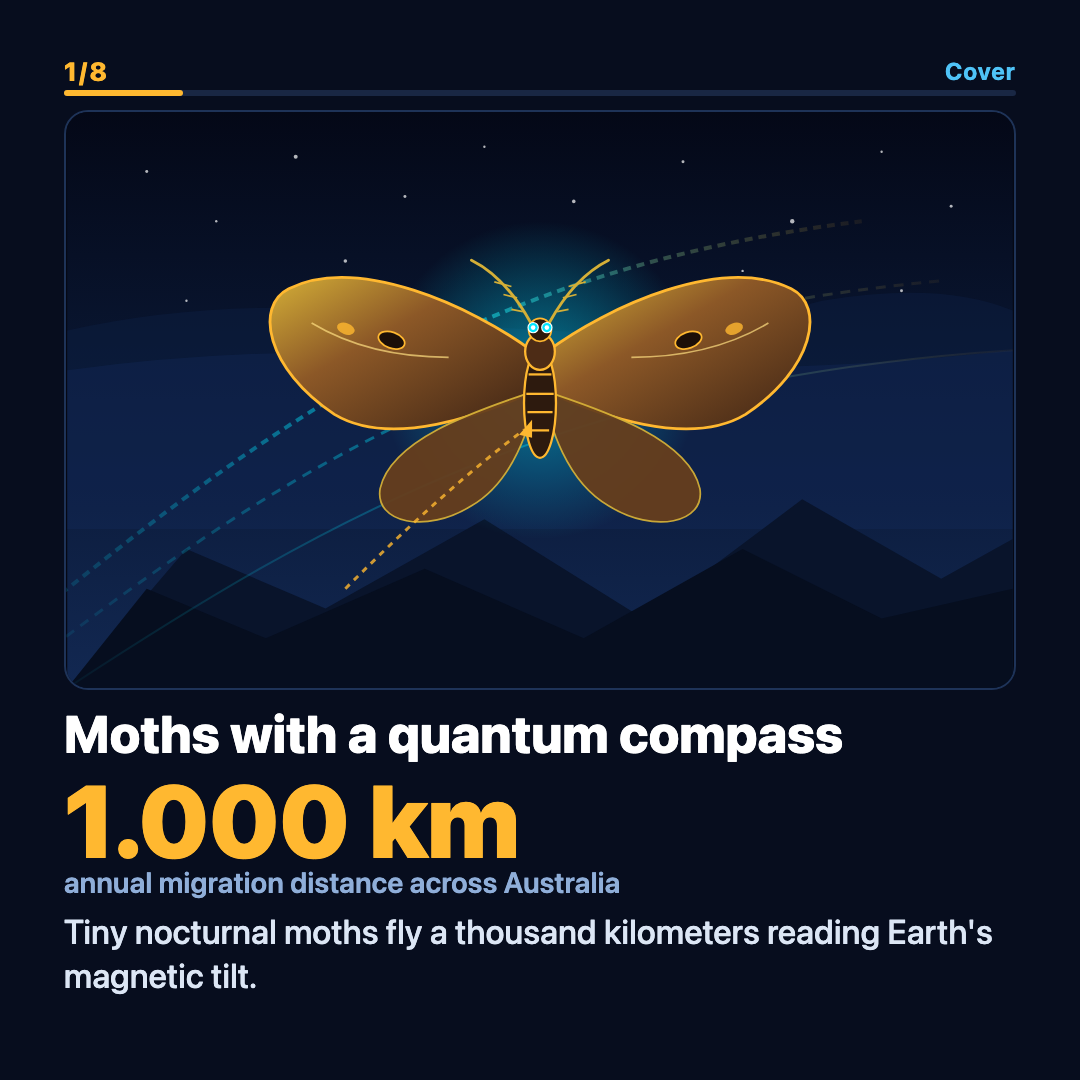
Bogong moths navigate thousand kilometer migrations using a light dependent quantum compass
5 ngày trước
00HOW DOES A TINY MOTH FIND ITS WAY ACROSS THE NIGHT?
Imagine being blindfolded in the dark with no maps, no compass, and no smartphone, yet required to walk over a thousand kilometers to a specific small mountain cave. For humans, that sounds impossible. Yet the Australian Bogong moth undertakes this exact epic journey every single year with stunning precision.
Note – Bogong moth: A migratory moth species measuring two to three centimeters in length, native to southeastern Australia, famous for flying over a thousand kilometers annually to summer alpine caves.
On November 18, 2026, in the journal Nature, an international research team led by scientists from Lund University in Sweden and Carl von Ossietzky University Oldenburg in Germany announced a breakthrough discovery. They proved that this tiny nocturnal moth possesses a sophisticated quantum compass in its eyes that detects the inclination angle of Earth's magnetic field to navigate when clouds completely block the night sky.
WHAT WAS THE SCIENTIFIC BACKGROUND OF THIS PUZZLE?
Every spring, billions of young Bogong moths take flight from the agricultural plains of Queensland, New South Wales, and Victoria. They journey over a thousand kilometers toward the cool high peaks of the Australian Alps. There, they pack into dark granite cave crevices to enter summer dormancy for four months, escaping the blistering heat of the lowlands. When autumn arrives, the surviving moths fly all the way back to their breeding grounds to mate, lay eggs, and die.
What fascinated biologists for decades is that adult moths live only one year. The young spring migrants have never seen the mountains or caves before, nor do they travel with experienced older moths to guide them. Every navigation instruction is hardwired into a brain smaller than a grain of rice. In 2018, scientists discovered that Bogong moths read the Milky Way and starry constellations to stay on course, much like ancient sailors steering by the North Star. Yet a deeper mystery remained. On overcast nights when thick clouds hide every single star, the moths still fly straight toward their destination without straying. How could they perceive direction through total darkness?
WHAT HAS CHANGED COMPARED TO PREVIOUS ASSUMPTIONS?
Previously, scientists believed that sensing Earth's magnetic field through light-dependent quantum mechanics was the exclusive realm of night-migrating songbirds such as European robins. Many researchers assumed insect nervous systems were simply too rudimentary to operate a sensor capable of detecting Earth's extremely subtle magnetic pull.
The new Nature study overturned that longstanding assumption. Through rigorous behavioral experiments, the team demonstrated that Bogong moths possess a genuine geomagnetic compass. Crucially, this compass does not measure standard north-south poles. Instead, it senses the tilt angle of magnetic field lines dipping into the ground, and it functions only under violet and blue light. This marks the first experimental proof that an insect species relies on a quantum inclination compass directly comparable to that of migratory birds.
HOW DID SCIENTISTS PROVE THIS REMARKABLE ABILITY?
To test their directional senses, researchers tethered individual moths inside specialized flight simulators outdoors and in laboratory settings, allowing the insects to steer freely in any direction. The simulator was encased inside large electromagnetic coils that allowed scientists to rotate and tilt the artificial magnetic field without introducing wind or temperature changes.
Note – Helmholtz coils: A paired set of identical electrical coils spaced along a common axis, used in laboratories to produce an exceptionally uniform and controllable magnetic field inside their volume.
The first experimental indicator revealed the peculiar nature of this compass. A pocket compass is a polarity compass whose needle swings horizontally toward magnetic north. But Earth's magnetic lines do not run flat along the ground; they angle downward into the planet like tilted skewers piercing a melon. The tilt angle is steep near the poles and flattens near the equator. When researchers flipped the vertical tilt of the artificial magnetic field while keeping the horizontal north-south direction unchanged, the moths instantly reversed course by one hundred and eighty degrees. Conversely, when scientists flipped the horizontal north-south polarity while maintaining the downward tilt angle, the moths continued in their original direction. This proved that Bogong moths read magnetic inclination rather than polarity.
Note – Inclination compass: A directional sensor that measures the angle at which Earth's magnetic lines dip into the ground relative to the horizontal plane, rather than simply pointing toward magnetic poles.
The second indicator revealed a strict dependence on light. The magnetic compass activated only when the moths received short-wavelength light between three hundred and eighty and five hundred nanometers, corresponding to violet and blue hues. When blue light was filtered out, leaving only red-yellow illumination or total darkness, the moths lost all sense of magnetic direction and circled aimlessly.
The definitive proof of a quantum mechanism emerged from radiofrequency experiments. The researchers injected a very weak broadband radiofrequency field, spanning one hundred and fifty kilohertz to sixty megahertz, into the simulator. The energy of this radio signal was far too low to cause heating or physical harm, but its oscillation frequency directly disrupted the spin dynamics of entangled electron pairs within the moth eye cells. As soon as the radiofield turned on, magnetic orientation collapsed entirely. This diagnostic disruption is the gold-standard hallmark of a quantum radical-pair mechanism.
Note – Radical-pair mechanism: A quantum chemical process where an absorbed photon creates two coupled electrons behaving like tightly synchronized dancing partners, whose spin states shift in response to subtle magnetic fields.
Note – Cryptochrome protein: A class of light-sensitive flavoproteins located in the retinas of various species that act like tiny biological antennas capturing violet and blue photons.
WHAT DOES THIS DISCOVERY MEAN FOR HUMANITY?
This breakthrough broadens our foundational knowledge of how living organisms harness quantum physics. It reveals a striking example of convergent evolution. Birds and insects diverged from a common ancestor more than five hundred million years ago, yet when faced with the identical challenge of night navigation, nature converged on the exact same quantum solution.
Note – Convergent evolution: An evolutionary process where distantly related organisms independently develop strikingly similar traits or mechanisms to solve similar environmental challenges.
The finding offers deep inspiration for bio-inspired quantum engineering. Today, human-engineered quantum sensors often demand extreme conditions like ultra-high vacuums or cryogenic temperatures. Deciphering how a moth eye runs a room-temperature quantum compass could inspire ultracompact, low-power directional sensors capable of functioning without global satellite navigation networks.
Nevertheless, the road from basic laboratory discovery to practical human applications remains long, likely requiring many years of additional research. Scientists have demonstrated the mechanism through behavioral responses, but have not yet observed the specific cryptochrome proteins reacting in real time within the retina. The exact neural pathways routing quantum magnetic signals from eye to moth brain also remain to be unraveled.
Crucially, the research sounds an urgent warning for ecological safety. Human civilization is flooding nocturnal habitats with artificial light pollution and electromagnetic smog from cell towers and wireless networks. Streetlights can wash out the violet-blue spectrum required by insect eyes, while urban radio waves risk jamming delicate quantum entanglement within sensory cells. If billions of migratory moths lose their bearings, critical pollination networks for native flora and primary food supplies for alpine wildlife face severe disruption. Moving forward, researchers plan field surveys across natural migratory corridors to quantify the real-world impact of urban electromagnetic emissions on traveling insect populations.
SOURCES
Nature – Bogong moths navigate with a light-dependent geomagnetic inclination compass – https://doi.org/10.1038/s41586-026-11322-9
Carl von Ossietzky Universität Oldenburg – Night-migrating moths use a magnetic compass – https://idw-online.de/en/news843920
Lund University – Night-migrating Bogong moths navigate with a light-dependent magnetic compass – https://www.lu.se/article/bogong-moths-navigate-magnetic-compass
0 comments
Ads
Related Posts
Ads