Ads
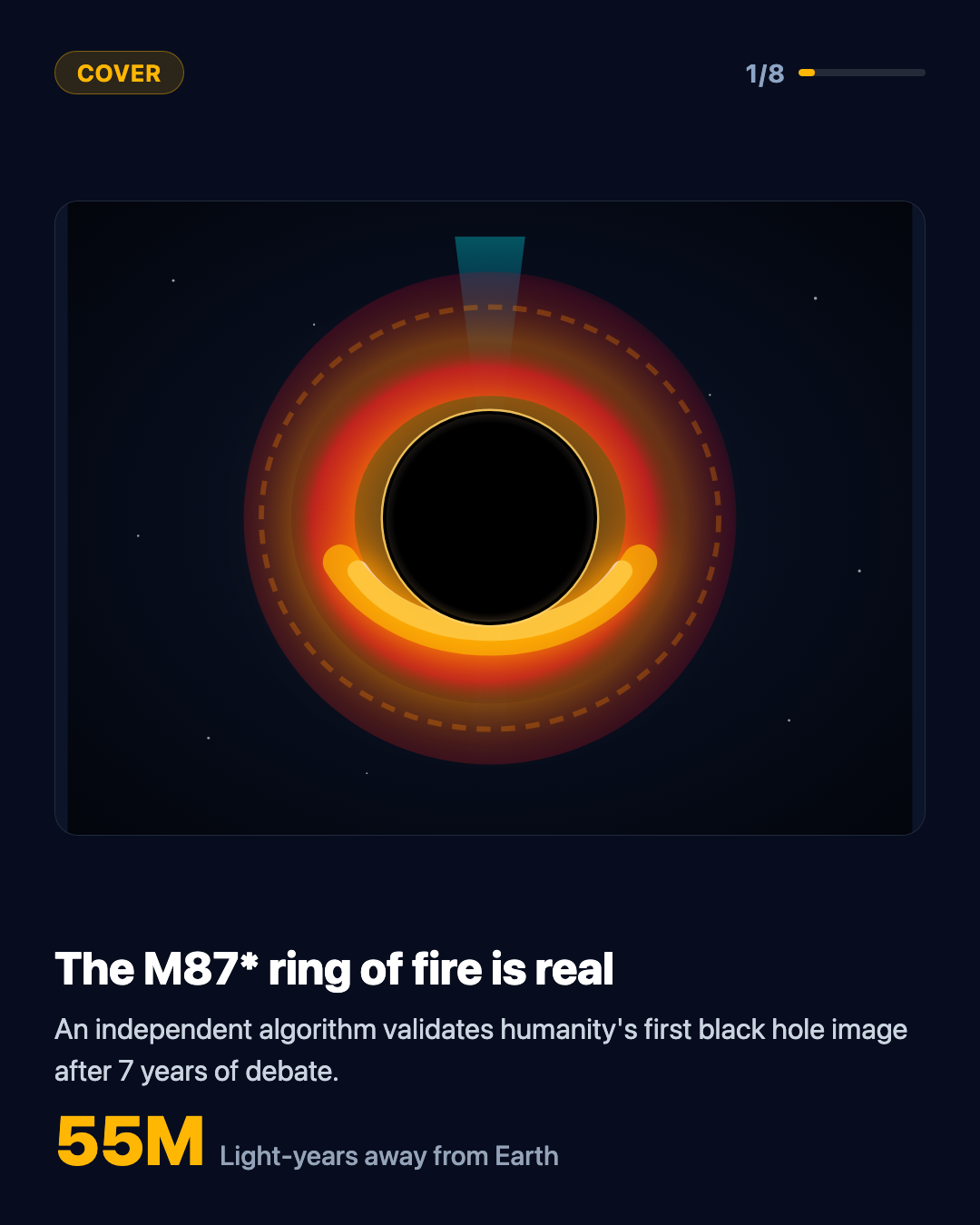
Independent algorithm validates humanity's first direct image of a black hole
7 ngày trước
00Imagine gazing at a world-famous photograph showing a mysterious glowing ring floating in cosmic darkness. For years, astronomers were troubled by a lingering question: Was this truly a colossal fiery donut drifting through deep space, or merely an optical blur caused by a shaking camera lens and image-processing software? On November 11, 2026, in the journal Nature, a research team at Australia's Commonwealth Scientific and Industrial Research Organisation (CSIRO) led by Dr. Samuel Lai published a definitive answer: The glowing ring of the M87* black hole is entirely genuine, resolving seven years of scientific debate.
WHAT WAS THE ORIGINAL ISSUE?
In 2019, humanity caught its first glimpse of a black hole located at the heart of galaxy Messier 87, roughly 55 million light-years away from Earth. A black hole is a region of spacetime where gravitational pull is so intense that nothing, not even light, can escape once it crosses an invisible boundary known as the event horizon.
Note – Event horizon: The point of no return surrounding a black hole, like the lip of a giant waterfall where the current rushes so violently that even light, the universe's fastest speedboat, cannot swim backward.
Because the black hole itself is completely dark, astronomers cannot photograph it directly. Instead, they capture the blazing glow emitted by superheated gas and dust swirling around it at near-light speeds before plunging inside. Right in the middle of that swirling glow sits a circular void called the black hole shadow.
Note – Black hole shadow: The circular dark silhouette at the center where light is completely swallowed, appearing clearly against the bright cosmic glow behind it.
To observe this minute silhouette across 55 million light-years, no single conventional telescope would suffice. Astronomers linked radio observatories scattered across continents into a global network, effectively creating a virtual telescope as large as planet Earth itself.
Note – Radio interferometry array: A technique linking multiple observatories across continents using atomic clocks, effectively turning them into a single virtual telescope as large as planet Earth.
WHAT JUST CHANGED?
While the 2019 image astonished the world, rigorous science demands independent scrutiny. Because Earth only hosts a handful of suitable observatories, the collected radio data resembled a jigsaw puzzle of tens of thousands of pieces with only a few dozen fragments in hand. To reconstruct a coherent image, the original team had to rely on interpolation algorithms to fill in the missing space.
In 2022, an independent research group re-analyzed the raw data and raised a serious alarm: They argued that the pristine circular ring might be a mathematical illusion generated by the imaging software. They suggested that initial programming assumptions had nudged disparate data points into forming an expected donut shape. This challenge cast doubt over one of the greatest observational triumphs of modern astronomy, compelling researchers to find an entirely uncompromised validation method.
HOW DID SCIENTISTS PROVE IT?
To settle the debate, four CSIRO researchers developed an entirely fresh computational pipeline named GenDIReCT. Instead of comparing signals between pairs of telescopes, which are easily corrupted by atmospheric water vapor, the team grouped telescopes into closed triplets. By summing signals around these triangles, atmospheric distortions and telescope hardware calibration errors naturally cancelled each other out, isolating pure cosmic signals.
Note – Closure invariants: A mathematical technique grouping data from at least three telescopes into closed triangles to cancel out atmospheric turbulence and instrument noise, much like three observers cross-checking vantage points to look through a foggy glass.
The second breakthrough came through unbiased machine learning. The researchers trained their generative computer vision model on thousands of everyday terrestrial pictures, such as natural landscapes, animals, and simple geometric shapes. The algorithm possessed zero prior exposure to black hole models and held no bias toward finding a circular ring.
Note – GenDIReCT algorithm: A specialized artificial intelligence model that reconstructs images from radio signals without using any prior templates of black holes, behaving like a forensic artist sketching an unknown scene purely from objective clues.
When feeding raw observational datasets from 2017, 2018, and 2021 into the new framework, the system began calculating from scratch. The outcome was unmistakable: A crisp glowing ring with an angular diameter of roughly 42 micro-arcseconds reliably emerged across every observational epoch. The central shadow rested precisely where Albert Einstein's General Relativity had predicted.
Note – Micro-arcsecond resolution: An extremely tiny angular measurement in astronomy, equivalent to spotting a single sesame seed on the surface of the Moon from the Earth.
MEANING FOR HUMANITY AND NEXT STEPS
This milestone brings deep reassurance to fundamental physics. It confirms beyond reasonable doubt that humanity's first direct image of a black hole was neither a computational artifact nor an artifact of human bias, but a true physical portrait of a cosmic titan. Albert Einstein's General Theory of Relativity has once again withstood its most demanding test under the universe's most intense gravitational conditions.
The success of GenDIReCT extends far beyond M87*. It provides an objective and robust analytical instrument for global radio astronomy, empowering researchers to decipher faint radio emissions from distant quasars and nascent protoplanetary disks giving birth to new planetary systems.
Nevertheless, limitations remain. Because ground-based telescopes must rotate with Earth over many hours of exposure, current techniques only produce static snapshots. For volatile objects like Sagittarius A* at our own galaxy's center, which fluctuates on minute-by-minute timescales, current imaging algorithms still face steep challenges.
The next horizon for astronomers is integrating orbiting space satellites into the array. Rather than capturing still portraits, the ambitious goal for the coming years is to record the first true motion pictures of glowing matter swirling into the abyss of a black hole.
SOURCES
Nature – Independent interferometric observable confirms black hole shadow in M87* – https://doi.org/10.1038/s41586-026-11241-9
CSIRO – New algorithm independently confirms first black hole image – https://www.csiro.au/en/news/all/news/2026/november/black-hole-independent-validation
Event Horizon Telescope Collaboration – First M87 Event Horizon Telescope Results – https://doi.org/10.3847/2041-8213/ab0ec7
0 comments
Ads
Related Posts
Ads