Ads
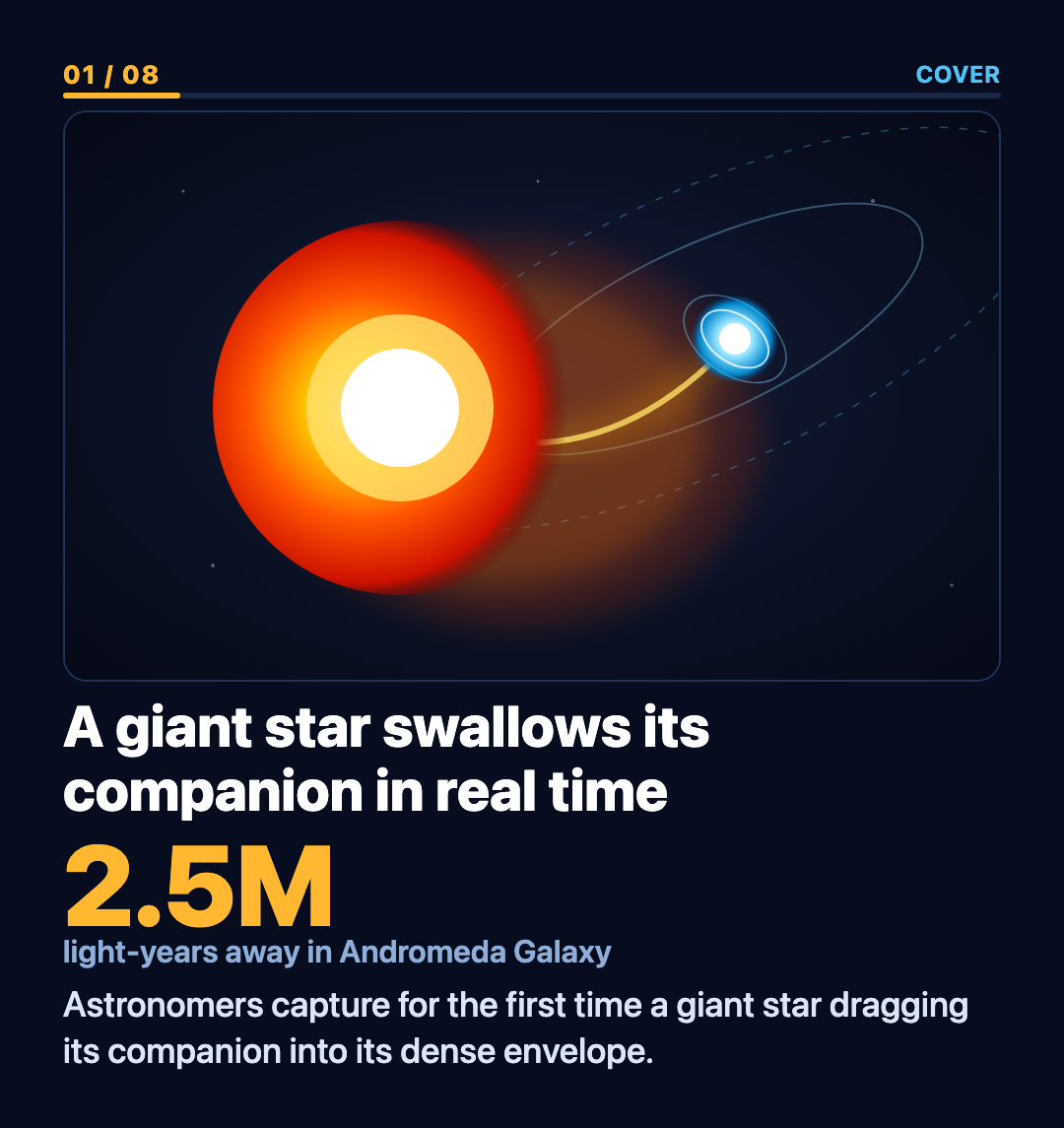
Telescopes catch a dying giant star swallowing its companion in real time
15 phút trước
00Imagine two dancers spinning across a ballroom floor when suddenly one swells to hundreds of times its normal size, enveloping its partner within a massive blazing cloak of gas. A dramatic scene that sounds like pure science fiction has now been directly verified in the living cosmos. On November 18, 2026, in the scientific journal Nature, an international team led by Dr. Viraj Karambelkar at Columbia University published the first direct observational evidence of an aging giant star pulling its companion deep into its outer atmosphere.
WHAT IS A COMMON ENVELOPE AND WHY DOES IT MATTER
Across the cosmos, most stars do not drift alone like our Sun, but are born in pairs known as binary star systems. When a star enters the twilight of its life and exhausts the hydrogen fuel in its core, it expands hundreds of times outward into a red giant, swelling much like a loaf of bread rising in an oven. If the distance between the two stars is tight enough, the bloated gas atmosphere of the dying giant will spill over and envelop its smaller companion. Both stars then orbit inside a single shared cocoon of gas, creating a state astrophysicists call a common envelope.
Note – Red giant star: an aging star that has expanded hundreds of times outward after exhausting its core hydrogen, much like a glowing ember puffing up before fading away.
Note – Common envelope: a vast shared cloud of gas enveloping two stars simultaneously when one star swells and swallows its partner, like two dancers bundled inside one giant sweater.
WHAT CHANGED AFTER FIFTY YEARS OF WAITING
For fifty years, ever since astrophysicist Bohdan Paczyński first proposed the common-envelope theory in 1976, this phase remained one of the most elusive missing links in stellar astronomy. Scientists could only reconstruct it through computer simulations or by observing cool dust debris long after the merger had concluded. For decades, prevailing mathematical models assumed that a companion star would need thousands of slow orbital revolutions over centuries to sink toward the core of the giant.
However, the celestial event designated AT 2025abao, located in the Andromeda Galaxy about 2.5 million light-years from Earth, shattered that long-held assumption. By re-examining archival survey data, scientists discovered that the system had been anomalously brightening and shedding dust since 2018 as orbital friction dragged the companion into the giant envelope. Crucially, once the companion penetrated into denser gas layers, the final plunge occurred within just seven orbits before a catastrophic explosion.
Note – Andromeda Galaxy: the nearest major spiral galaxy to our Milky Way, home to roughly one trillion stars and situated about 2.5 million light-years from Earth.
Note – Orbital friction: the drag force generated when a celestial body plows through dense gas and dust, much like a person wading through deep water feeling slowed and exhausted.
HOW ASTRONOMERS CAUGHT THE PHENOMENON RED-HANDED
To piece together this seven-year cosmic drama, researchers combined observations from three of humanity's premier astronomical observatories.
The first clue came from NASA's NEOWISE infrared satellite and the Zwicky Transient Facility survey in California. For three decades prior, the primary giant star, weighing about 7 times the mass of the Sun and spanning 350 times the Sun's radius, had shone steadily with a companion weighing 0.7 solar masses. Starting in 2018, the system unexpectedly warmed up and puffed out vast clouds of dust, signaling that the companion star was plowing through the giant's outer gas layers and shredding its surface.
The second indicator was a brilliant flare in October 2025. Over twenty-five days, the system surged roughly 100-fold in visible light, unleashing energy equal to 1.5 million times the luminosity of the Sun. This marked a luminous red nova, an outburst generated when the companion smashed into the dense stellar core and expelled between 10 and 20 percent of the Sun's mass into surrounding space.
The decisive proof came from the James Webb Space Telescope in December 2025, exactly 47 days after the peak eruption. Using its mid-infrared MIRI instrument, the telescope peered through the obscuring dust, measuring the temperature and chemistry of the expanding shell and verifying that a common-envelope inspiral had indeed taken place.
Note – Luminous red nova: a powerful stellar eruption shining brightly in red and infrared wavelengths caused by a stellar merger or collision, unlike a supernova which destroys the star completely.
Note – James Webb Space Telescope: the most advanced infrared space observatory in history, operating at cryogenic temperatures to peer through dense cosmic dust walls.
MEANING FOR HUMANITY AND NEXT SCIENTIFIC STEPS
This landmark discovery provides humanity with crucial empirical measurements to understand the birth of extreme astrophysical phenomena. The common-envelope phase acts as the essential funnel that brings wide binary stars from hundreds of millions of kilometers apart down to tight orbits spanning only a few million kilometers. Without this frictional drag and envelope ejection, binary stars could never get close enough to evolve into colliding neutron stars or black holes that radiate gravitational waves.
The primary beneficiaries of this discovery are astrophysicists and gravitational-wave researchers worldwide. With concrete physical data on friction rates and energy dissipation from AT 2025abao, scientists can now calibrate binary evolution models, improving forecasts for how often gravitational-wave chirps should ring across the universe.
Nevertheless, this remains basic research on a cosmic scale, and many years of work lie ahead to resolve lingering questions. Astronomers cannot yet confirm whether the two stellar cores merged completely into a single rejuvenated magnetic star, or whether the companion survived to form an ultra-compact binary buried inside the dust cocoon.
Over the coming years, the James Webb Space Telescope and major ground-based observatories will monitor AT 2025abao as its surrounding dust cools and clears, offering humanity an unprecedented view of whatever object survived this colossal cosmic feast.
Note – Gravitational waves: ripples that stretch and squeeze the fabric of spacetime when massive celestial bodies accelerate or collide, much like ripples spreading across a pond when a stone is thrown in.
SOURCES
Nature – An inspiral of a star inside a common envelope with its giant companion – https://doi.org/10.1038/s41586-026-11221-z
arXiv – An inspiral of a star inside a common envelope with its giant companion – https://arxiv.org/abs/2611.23470
NASA – James Webb Space Telescope and NEOWISE observations of AT 2025abao – https://www.nasa.gov
0 comments
Ads
Related Posts
Ads