Ads
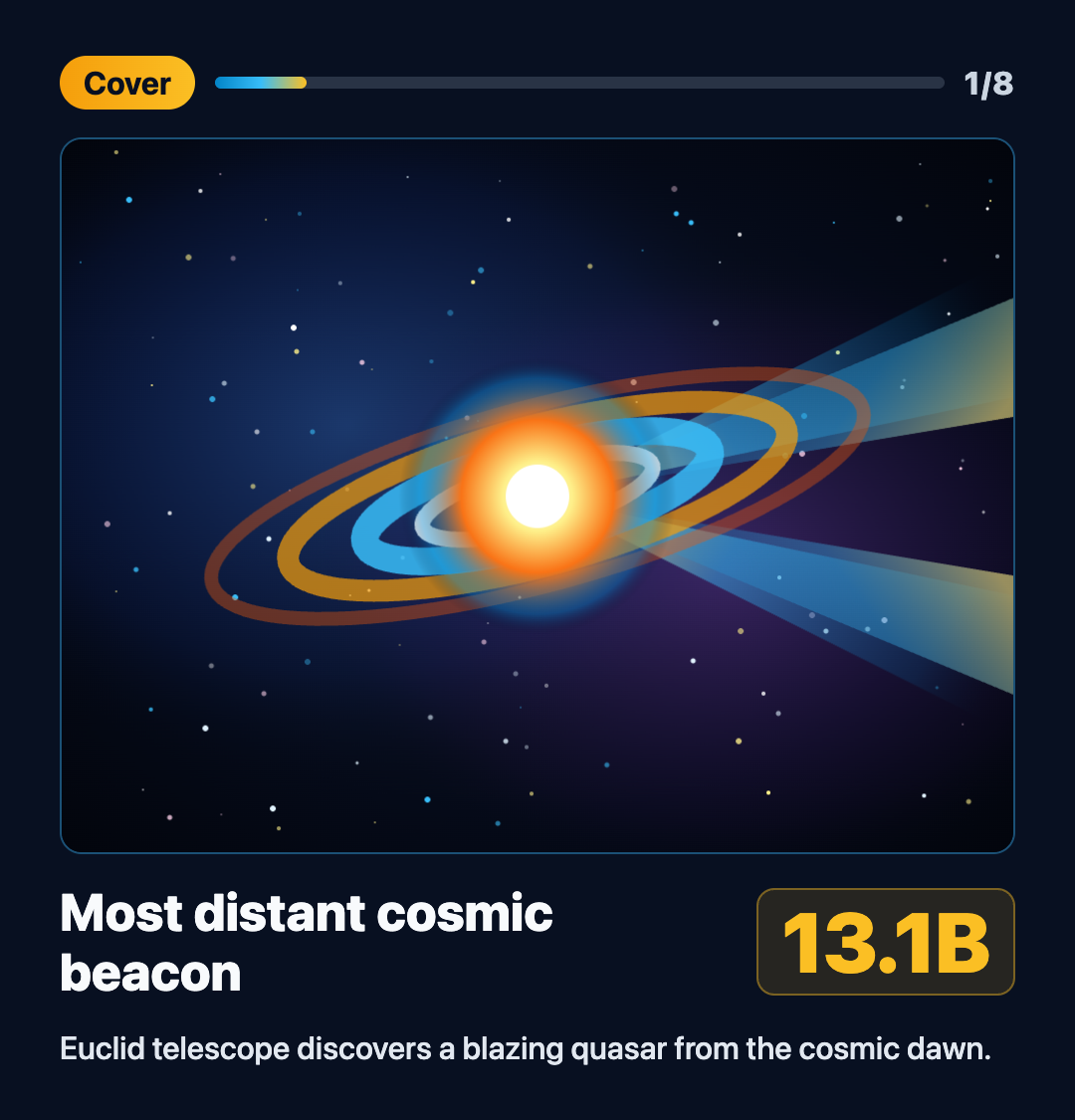
Euclid telescope discovers the most distant cosmic beacon ever known
khoảng 15 giờ trước
00If you stand on a pitch-black coastline and spot a distant beam of light shining from dozens of miles away, you instantly know that a colossal structure stands out at sea. Across the vast cosmic ocean, astronomers have just detected a similarly extraordinary beacon. On November twenty-fourth twenty twenty-six, in the peer-reviewed journal Astronomy & Astrophysics, an international team from the European Space Agency Euclid mission reported the discovery of the most distant and ancient quasar ever identified by humanity, designated J1504+6252 and nicknamed Dún Aonghasa.
WHAT WAS THIS ISSUE ORIGINALLY
Looking up into the night sky is truly a journey backward in time. Light travels at an immense yet finite speed, meaning that light originating from a distant cosmic body takes millions or billions of years to reach Earth. To catch a glimpse of the earliest moments following the Big Bang, scientists search for intensely brilliant objects. The brightest beacons in the cosmos are quasars, where a monstrous black hole actively devours swirling reservoirs of gas and dust.
Note – Quasar: the intensely luminous core of an infant galaxy where a gargantuan black hole pulls in surrounding matter like water spiraling down an open drain, heating matter to millions of degrees and outshining hundreds of galaxies combined.
Note – Supermassive black hole: an enormous black hole containing millions to billions of times the mass of our Sun, serving as an invisible gravitational anchor that keeps hundreds of billions of stars orbiting within a galaxy.
WHAT HAS CHANGED FROM PREVIOUS ASSUMPTIONS
For many years, astrophysicists suspected that a redshift of eight represented a stubborn barrier for exceptionally luminous quasars. The most distant quasars previously known belonged to a period when the universe was already nearly seven hundred million years old. Many researchers believed that in earlier epochs, supermassive black holes simply lacked sufficient time to feed and grow large enough to power such dazzling beacons.
Note – Redshift: the phenomenon where light from distant cosmic objects stretches toward longer and redder wavelengths as the fabric of the universe expands, much like the pitch of a train horn drops as the train rushes away from you.
However, quasar J1504+6252 has been uncovered at a redshift of eight point thirteen. This redshift places it when the universe was merely six hundred thirty million years old, barely five percent of its current age. Even more startlingly, the black hole lurking at its heart already tips the cosmic scales at three hundred sixty million times the mass of the Sun. Finding such a behemoth so early in cosmic history defies the most cautious theoretical predictions.
HOW DID ASTRONOMERS CATCH THE SIGNAL
This discovery was made possible by uniting a dedicated space telescope with the world's most powerful ground-based observatories. First, the European Space Agency Euclid space telescope surveyed a vast expanse of the sky during its wide-field survey. The ultra-sensitive near-infrared camera on Euclid detected a faint infrared point source exhibiting an unusual spectral signature.
Note – Euclid Space Telescope: an orbital observatory developed by the European Space Agency stationed at the second Lagrange point, functioning like a wide-angle cosmic camera capturing billions of galaxies to construct a three-dimensional map of the universe.
As soon as Euclid pinpointed the target, the James Webb Space Telescope along with the W. M. Keck Observatory in Hawaii and the Large Binocular Telescope swiveled their instruments to capture deep spectroscopic data. The peer-reviewed spectral analysis confirmed a stretched hydrogen emission line corresponding cleanly to a redshift of eight point thirteen. Simultaneously, measuring the ferocious velocity of gas swirling around the central core allowed astronomers to gauge the mass of the black hole at three hundred sixty million solar masses.
MEANING FOR HUMANITY AND OUR UNDERSTANDING
This ancient quasar opens a pristine observational window into the Epoch of Reionization, a key cosmic dawn when the universe emerged from darkness into star-filled daylight. The discovery reveals that massive cosmic structures had already taken shape and were dynamically sculpting early galaxies while the cosmos was still in its infancy.
Note – Epoch of Reionization: the transformative era in the early universe when dense atomic hydrogen fog was gradually ionized and cleared away by energetic light from the first stars and quasars, much like morning mist dissipating under sunrise.
The finding presents a profound puzzle for modern astrophysics: how could a black hole expand so rapidly in such a compressed timeframe. According to the standard Eddington limit, a black hole created from a dying stellar core cannot devour matter fast enough to accumulate hundreds of millions of solar masses within six hundred million years, as the radiation pressure of hot infalling gas would push incoming fuel away. This forces theorists to consider more radical growth mechanisms, such as pristine gas clouds collapsing directly into heavy initial seeds, or periods of super-Eddington feeding where black holes gorged far faster than conventional models allow.
Note – Eddington limit: the maximum rate at which a black hole can feed before the intense outward push of light and radiation blows surrounding matter away, much like blowing too hard on a spoonful of soup and splashing the broth out of your spoon.
As a basic research milestone, this work enriches humanity's foundational understanding of how our universe and physical laws evolved. Astrophysicists and curious thinkers worldwide gain new insight into early cosmic architecture. Because this finding currently represents a single record-holding quasar, scientists remain cautious. Over the coming years, Euclid will survey roughly one-third of the entire sky to seek companion beacons, while the James Webb Space Telescope continues probing the ambient gas environment surrounding this ancient cosmic wonder.
SOURCES
Astronomy & Astrophysics – Euclid: Discovery of a quasar at z = 8.13 hosting a 360-million-solar-mass black hole – https://doi.org/10.1051/0004-6361/202662243
arXiv – Euclid: Discovery of a quasar at z = 8.13 hosting a 360-million-solar-mass black hole – https://arxiv.org/abs/2611.31385
European Space Agency – Euclid discovers the most distant quasar to date – https://www.esa.int/Science_Exploration/Space_Science/Euclid/Euclid_discovers_most_distant_quasar
0 comments
Ads
Related Posts
Ads