Ads
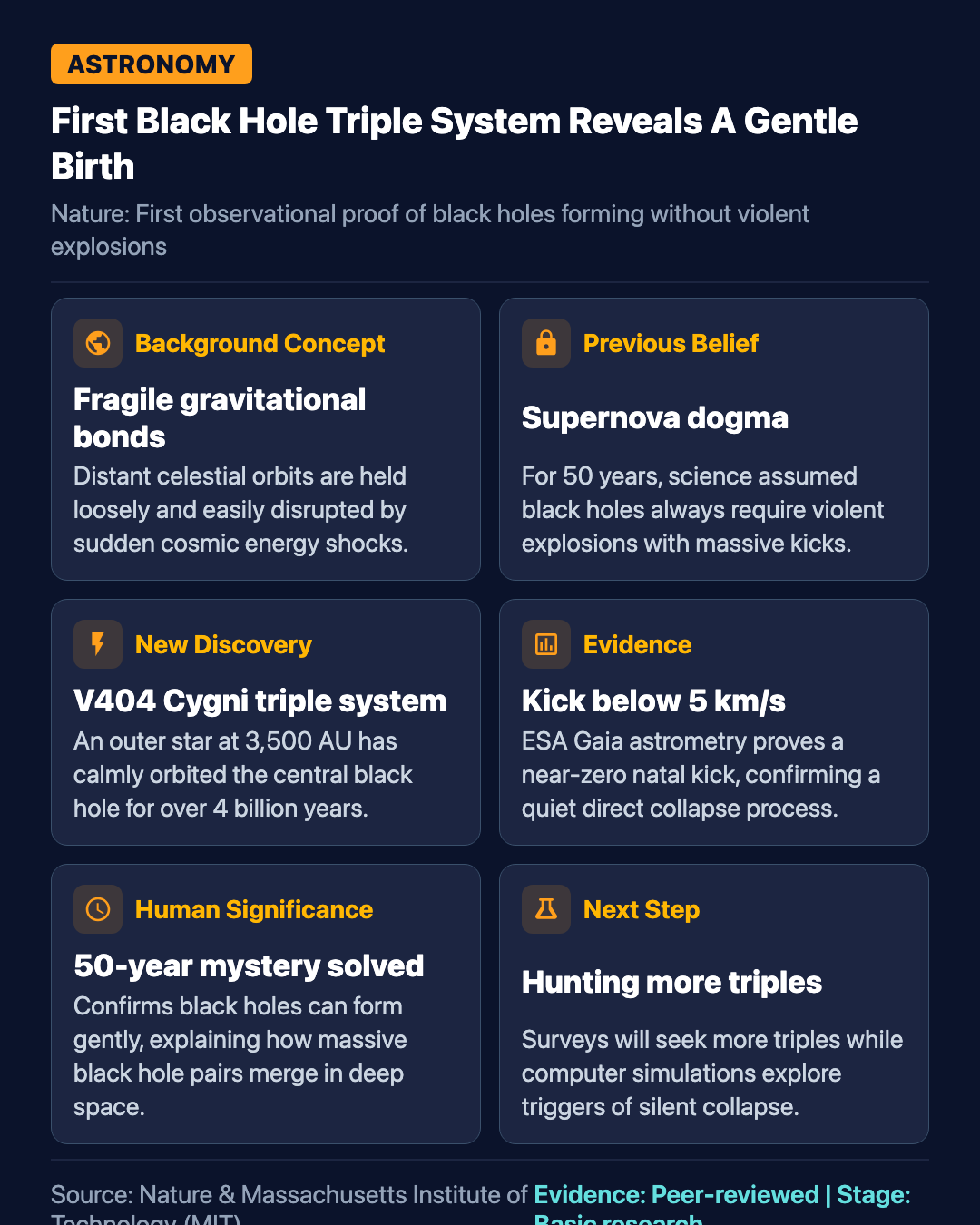
First Black Hole Triple System Reveals A Gentle Birth
khoảng 1 giờ trước
00Imagine holding a delicate cluster of helium balloons by a thin thread. If someone suddenly detonated a powerful firecracker right next to you, the violent shockwave would instantly sever the thread and scatter the balloons into the sky. For more than half a century, astronomers across the globe believed that a similarly violent scenario must always accompany the birth of a black hole in the universe. However, a landmark study published in the journal Nature on October 23, 2024, by physicists at the Massachusetts Institute of Technology and the California Institute of Technology, has provided compelling evidence to the contrary. The researchers identified the first-ever black hole triple system in astronomical history, revealing that the universe's ultimate light-swallowing engines can sometimes be born with surprising gentleness.
Note – Black hole: A region in space where gravity is so intense that neither matter nor light can escape, acting like an invisible cosmic whirlpool that pulls in anything passing its threshold.
Note – Triple star system: A family of three celestial bodies bound together by gravity and orbiting a common center of mass, much like three children holding hands while twirling on a playground.
WHAT DID WE PREVIOUSLY BELIEVE ABOUT BLACK HOLE BIRTHS?
According to decades of established astrophysical theory, stellar-mass black holes form only when an aging massive star exhausts its nuclear fuel. The star's core suddenly collapses, unleashing immense energy and driving a cataclysmic supernova explosion. This blast violently rips away the star's outer layers, hurling them into deep space at thousands of kilometers per second.
Note – Supernova: A cataclysmic cosmic explosion marking the violent death of a massive star, blasting away outer layers and shining as brightly as an entire galaxy of stars combined.
Crucially, real-world cosmic explosions are rarely symmetrical. When explosive energy erupts unevenly, the collapsing core experiences a forceful backward recoil, known as a natal kick. This reaction kick typically launches the newly minted black hole through space at velocities ranging from dozens to hundreds of kilometers per second. If the newborn black hole had previously shared a wide orbit with a distant companion star, the fragile gravitational bond between them would be severed instantly by the kick, casting the companion star into solitary exile.
Note – Natal kick: A powerful recoil that jolts a newborn celestial object when an explosion is uneven, just like the sharp backward kick of a heavy rifle when a bullet is fired.
WHAT UNEXPECTED SECRET DID V404 CYGNI REVEAL?
Located roughly 8,000 light-years from Earth in the constellation Cygnus, the V404 Cygni system has been widely studied by astronomers since 1989. For decades, it was classified as a conventional binary system featuring a central black hole roughly nine times the mass of our Sun actively pulling gas from an inner companion star orbiting just 6.5 days away.
However, a careful re-examination of optical images and astronomical databases revealed the unexpected presence of a third star far out on the system's periphery. This outer tertiary star resides approximately 3,500 astronomical units away from the central black hole. That is 3,500 times the distance between Earth and the Sun, or nearly 100 times the distance between Pluto and the Sun. At such a vast distance, the outer star takes about 70,000 Earth years to complete just one leisurely orbit around the inner binary.
Note – Astronomical unit: The average distance from Earth to the Sun, approximately 150 million kilometers. Driving an ordinary car at 100 kilometers per hour non-stop would take over 170 years to complete this distance.
At that tremendous distance, the gravitational tether binding the outer star to the black hole is extraordinarily tenuous, fragile as a gossamer thread. Had the progenitor star erupted in a standard supernova accompanied by a natal kick, that delicate tether would have snapped long ago. The fact that this outer star has remained loyally bound to the black hole for roughly four billion years provides clear evidence that the black hole formed without a violent explosion. Instead, the giant progenitor star underwent direct collapse, quietly imploding under its own weight into a black hole without triggering a destructive blast.
Note – Direct collapse: The process where a massive star caves inward under its own immense gravity directly into a black hole without exploding, much like a giant building quietly collapsing into the ground without blasting debris outward.
HOW DID ASTRONOMERS UNCOVER THE EVIDENCE?
The discovery began when the researchers examined optical sky surveys and noticed two luminous points positioned remarkably close together. To verify whether the distant outer star was genuinely bound to the black hole system or merely an unrelated background star aligning by sheer coincidence, the team analyzed precise astrometric data from the European Space Agency's Gaia space observatory.
Years of Gaia tracking revealed that the distant outer star and the inner black hole pair share the exact same proper motion through the galaxy, traveling together across the sky in the same direction and at the same speed. Statistical models demonstrated that the probability of two unrelated stars moving in such lockstep purely by chance is just one in ten million. Subsequent optical spectroscopy gathered from the W. M. Keck Observatory atop Mauna Kea in Hawaii confirmed that the three-dimensional cosmic distance of the outer star matches the black hole system.
The research team then conducted tens of thousands of dynamic computer simulations tracking the system's orbital evolution. The simulations revealed that for a companion star at 3,500 astronomical units to remain bound, any natal kick delivered to the newborn black hole must have been less than 5 kilometers per second. This near-zero velocity recoil firmly rules out an energetic, mass-ejecting supernova explosion during the black hole's birth.
WHAT DOES THIS MEAN FOR HUMANITY AND WHAT COMES NEXT?
This finding contributes profound value to humanity's understanding of how matter evolves across cosmic epochs. For decades, theoretical physicists hypothesized that massive stars could implode directly into black holes without blowing up, but conclusive observational evidence had remained elusive. The discovery in V404 Cygni provides that long-sought proof, confirming that nature has multiple pathways to form black holes and helping explain the origins of surprisingly massive black hole mergers detected by gravitational-wave observatories on Earth.
Astrophysicists and cosmologists studying the evolution of our universe stand as the immediate beneficiaries of this milestone. Stellar evolution models must now incorporate this gentle formation channel, refining how scientists estimate black hole populations across galaxies. As basic research focused on expanding humanity's understanding of the cosmos, this discovery does not have direct consumer applications, nor does it carry ethical hazards or societal risks.
Significant mysteries still await resolution. Because V404 Cygni represents the sole fully confirmed black hole triple discovered to date, scientists cannot yet determine what fraction of stellar-mass black holes form via direct collapse. Furthermore, researchers still need to pinpoint the precise physical conditions, such as chemical composition or stellar spin rates, that cause an aging giant star to collapse in complete silence rather than detonate into a brilliant supernova.
The next step for the global astronomical community is to systematically comb through Gaia's expansive star catalog to uncover additional black hole triples. Meanwhile, theoretical physicists are constructing advanced supercomputer simulations to capture the exact mechanics of a massive star drawing its final breath in absolute cosmic silence.
SOURCES
Nature – The black hole low-mass X-ray binary V404 Cygni is part of a wide triple – https://doi.org/10.1038/s41586-024-08120-6
MIT News – Physicists discover first black hole triple – https://news.mit.edu/2024/physicists-discover-first-black-hole-triple-1023
European Space Agency – Gaia finds black hole with distant companion – https://www.esa.int/Science_Exploration/Space_Science/Gaia
0 comments
Ads
Related Posts
Ads