Ads
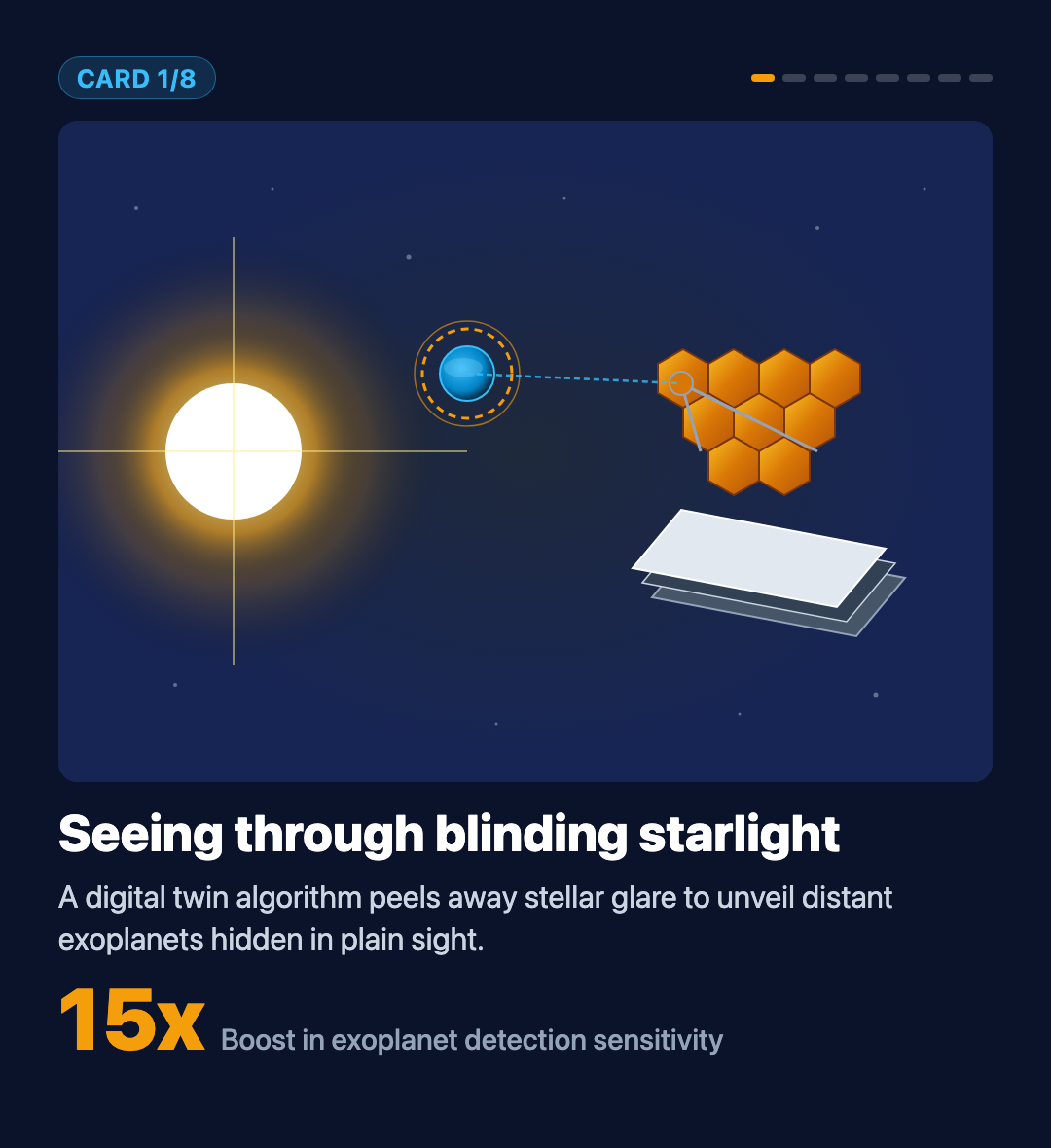
A digital twin helps James Webb see through blinding starlight
4 ngày trước
00Imagine standing tens of kilometers away in pitch darkness, attempting to spot a tiny firefly flickering directly adjacent to a high-powered automobile high beam shining straight into your eyes. For decades, that exact extreme contrast has tormented astronomers attempting to directly image worlds orbiting distant stars.
On November 4, 2026, a research team led by astronomer Rodrigo Ferrer-Chavez and Assistant Professor Jason J. Wang from Northwestern University, in collaboration with the Space Telescope Science Institute and Caltech, published a landmark breakthrough in the journal Nature. They developed an algorithm called FLIP that builds a physics-based digital twin of the James Webb Space Telescope optical system. By deploying this virtual replica, astronomers can precisely isolate and strip away blinding stellar glare, unmasking distant exoplanets that have remained hidden in plain sight.
WHY HAS DIRECT EXOPLANET IMAGING BEEN SO DIFFICULT?
Across the cosmos, host stars outshine their orbiting planets by factors of millions to billions. Pointing a telescope toward a distant planetary system normally floods sensitive detectors with brilliant starlight, drowning out the faint planetary glow. To counter this, engineers outfitted the James Webb Space Telescope with an internal mask known as a coronagraph. This mechanism operates much like holding your hand up to shield your eyes from the blazing Sun so you can distinguish objects around it.
Note – Exoplanet: A planet situated outside our Solar System that revolves along an orbital path around a different host star within the Milky Way.
Yet light fundamentally propagates as a wave. When starlight encounters the edges of this microscopic optical mask, it bends and diffracts. Furthermore, the James Webb telescope relies on eighteen gold-coated hexagonal mirrors operating one and a half million kilometers from Earth. Minute mechanical vibrations and subtle temperature fluctuations cause light rays to scatter chaotically, generating speckled patterns of false light termed optical glare. These speckles are vastly brighter than the planet itself, making it nearly impossible to distinguish true planetary signals from optical illusions.
Note – Coronagraph: A specialized instrument placed inside a telescope designed to block out blinding direct light from a central star.
Note – Optical glare: Speckled noise artifacts appearing across astronomical sensors caused by light waves scattering unevenly across mirror surfaces.
HOW DOES A DIGITAL TWIN TRANSFORM THE SEARCH?
Traditionally, astronomers eliminated this speckle glare through classical reference subtraction. They physically slewed the space telescope toward a nearby reference star devoid of planets, recorded its glare pattern, and subtracted that image from the target star observation. In theory, subtracting the reference glare leaves only the elusive planet behind.
However, the deep space environment presents unforgiving challenges. Even the slightest telescope reorientation alters the angle at which solar radiation strikes the sunshield, shifting the thermal equilibrium. This minuscule temperature change causes the eighteen hexagonal mirrors to expand or contract by mere nanometers, roughly one eighty-thousandth the width of a human hair. That microscopic drift warps the speckle pattern just enough that the two star images no longer match, causing subtraction algorithms to fail and potentially erasing the real planet altogether.
To bypass this mechanical barrier, the Northwestern University team engineered a completely different approach. Rather than pointing the telescope at another star, they used advanced computing to create a digital twin of the entire telescope optical path called the FLIP algorithm. Rather than an ordinary simulation, this physics-informed neural framework models the precise laws of wave optics. It tracks how individual light waves traverse space, bounce off each gold mirror segment, and interact with the coronagraph at the exact millisecond of observation.
Note – Digital twin: A sophisticated computer model that replicates the exact physical structures and real-world behavior of an operating machine in real time.
Note – FLIP algorithm: An acronym for Physics-based Learning for Imaging Planets, combining mathematical optical equations with machine learning to extract astronomical signals.
Note – Wave optics: The branch of physics that treats light as propagating waves like ripples on water, calculating how wavefronts bend and interfere.
HOW DID THE VIRTUAL MACHINE CAPTURE A CONCEALED WORLD?
To validate this digital framework, researchers fed FLIP raw observational data collected by the James Webb Space Telescope Near-Infrared Camera targeting the 51 Eridani planetary system, located approximately one hundred light-years from Earth. The system hosts a gas giant named 51 Eridani b, roughly twice the mass of Jupiter, orbiting its parent star at a distance comparable to Saturn in our Solar System.
The planet had previously been discovered by ground telescopes in 2015. However, when the James Webb telescope targeted it at a mid-infrared wavelength of 4.3 microns, blinding stellar glare completely overwhelmed the planet. This 4.3-micron wavelength is critical for detecting atmospheric carbon dioxide and deciphering planetary chemistry. Previous attempts using standard reference subtraction failed completely, leaving behind a chaotic disk of noise and no detectable sign of the planet.
When raw data entered the FLIP algorithm, the digital twin simultaneously solved for the nanometer-scale wavefront aberrations across the eighteen mirror segments at the exact moment of exposure. By reconstructing the true optical glare of the host star, the software peeled away the blinding noise, revealing a sharp, isolated point of light corresponding to 51 Eridani b with high signal-to-noise contrast. Rigorous analysis confirmed that the FLIP framework enhances the telescope detection sensitivity by two to fifteen times.
Note – Near-Infrared Camera: A scientific instrument on the James Webb telescope designed to capture longer infrared wavelengths that penetrate through cosmic dust clouds.
A GIANT STRIDE TOWARD DISCOVERING A SECOND EARTH
This technological breakthrough delivers immense value to modern astrophysics. Instead of spending billions of dollars and waiting decades to construct and launch a larger, more stable space telescope, scientists have dramatically boosted the capability of the James Webb telescope through computational software alone. The algorithm saves up to half of the observatory highly competitive observation time by eliminating the need to slew toward reference stars. Furthermore, the global astronomical community can now re-examine vast archives of existing space telescope data with FLIP, potentially revealing previously overlooked worlds.
Nevertheless, researchers maintain realistic expectations regarding current limitations. This study serves as a trial demonstrated on a hot, luminous gas giant comparable to Jupiter. Bridging the gap from giant gas planets to directly imaging small, rocky Earth-sized worlds within habitable zones remains a monumental challenge requiring years of dedicated research. Earth-like planets are ten billion times fainter than their host stars, demanding starlight suppression thousands of times stricter. In addition, the FLIP framework requires substantial supercomputing resources to optimize millions of physical parameters for each observation.
The research team is now scaling FLIP across public space telescope archives to uncover previously undetected exoplanets. Concurrently, the authors are collaborating with NASA to embed physics-based digital twin architectures directly into flight and data systems for future observatories, most notably the Habitable Worlds Observatory, slated for launch in the 2040s with the historic goal of detecting biosignatures on Earth-like worlds.
SOURCES
Nature – Imaging exoplanets below the telescope stability limit – https://doi.org/10.1038/s41586-026-11213-z
Northwestern University – Digital twin of James Webb Space Telescope reveals hidden exoplanets – https://news.northwestern.edu/stories/2026/11/digital-twin-jwst-exoplanets
ScienceDaily – How a 'digital twin' of the James Webb Space Telescope finds hidden worlds – https://www.sciencedaily.com/releases/2026/11/261104142530.htm
Optica – Enhancing direct exoplanet imaging through physics-informed optical modeling – https://www.optica-opn.org/home/newsroom/2026/11/flip_jwst_exoplanets
0 comments
Ads
Related Posts
Ads