Ads
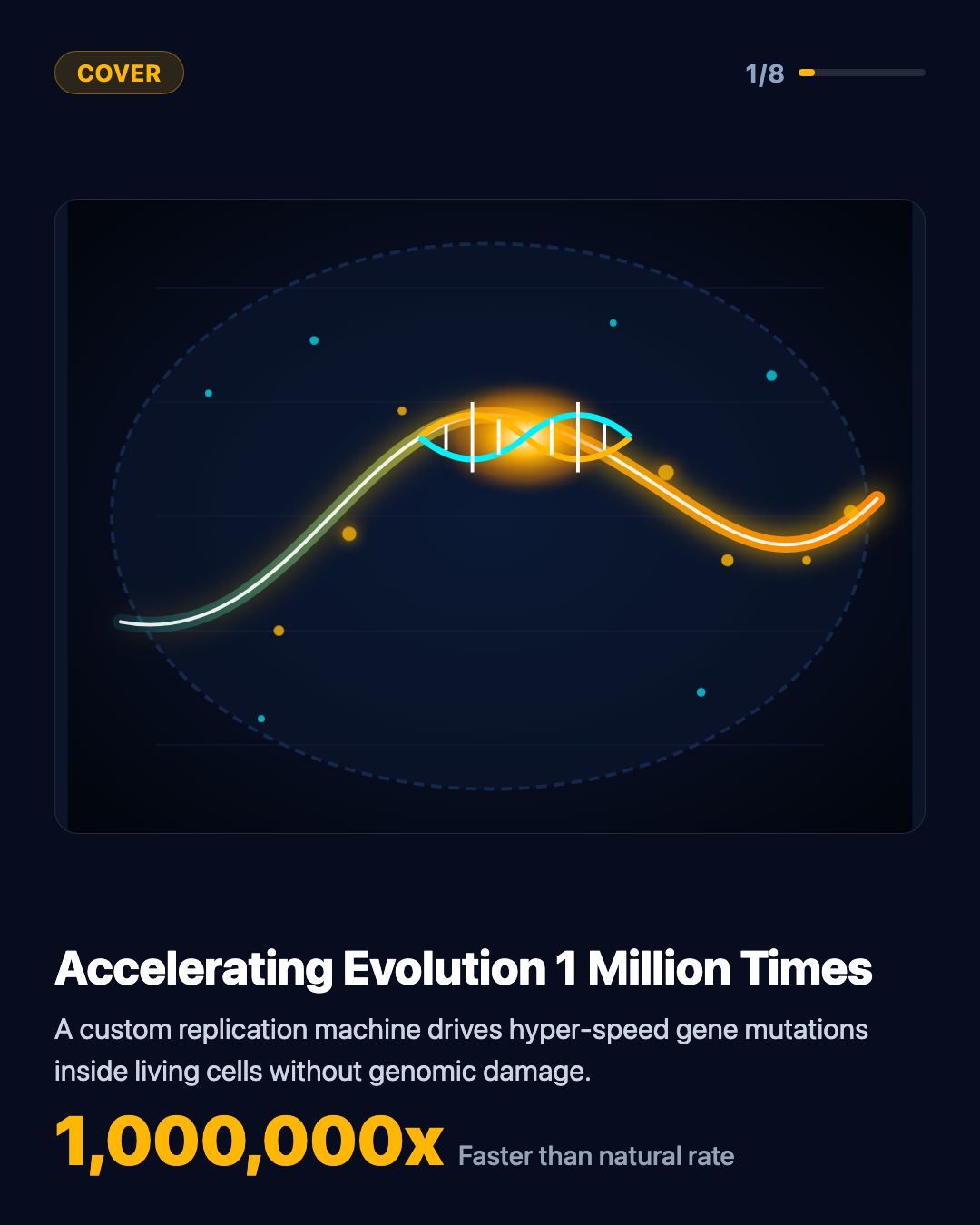
Custom Molecular Engine Accelerates Gene Evolution One Million Times in Living Cells
7 ngày trước
00CAN EVOLUTION OUTRUN TIME ITSELF
Imagine holding a massive encyclopedia with millions of delicate pages. The scribe copying it is so meticulous that only a single typographical error slips through across thousands of years. That extraordinary precision ensures the survival instructions of life are handed down undamaged across generations. But if you urgently need to tweak a specific recipe on page 50 to create a new medicine or an enzyme that digests plastic waste, natural evolution would make you wait millions of years. If you deliberately force the scribe to type haphazardly to create mutations, the entire book quickly turns into incomprehensible gibberish and the organism dies.
A landmark study published in the journal Science on November 8, 2024 has broken this evolutionary bottleneck. Led by Professor Chang C. Liu at the University of California, Irvine, in collaboration with researchers from Harvard Medical School and the Broad Institute, the team engineered a specialized molecular engine inside living yeast cells. This platform forces a chosen target gene to evolve at a rate exceeding one million times normal genomic drift, while leaving the host cell's 12 million letters of native genetic code completely safe and intact.
WHAT WAS THIS PROBLEM AND WHY DO HUMANS CARE
To survive, all living organisms must preserve immense genomic stability. On average, only about one error occurs for every billion DNA letters copied during cell division. This sluggish pace protects living cells against lethal genetic failures. Yet for bioengineers trying to build useful new molecular tools, that same slowness represents a frustrating wall.
For decades, scientists have pursued directed evolution in the laboratory to breed customized enzymes. However, traditional approaches require tedious, labor-intensive cycles: researchers must extract DNA into test tubes, expose it to chemicals or mutagenic machinery, reinsert it into cells, and screen for the best variants. This manual cycle is like dismantling a race car down to its bolts after every lap before assembling it again to race. If researchers try to speed up mutation rates directly inside whole living cells, the organism suffers error catastrophe and dies long before producing any useful protein.
Note – Error catastrophe: A fatal breakdown occurring when an organism accumulates too many random mutations across its genome, causing vital biological machinery to collapse like a building whose architectural blueprints have been printed with errors on every floor.
Note – Directed evolution: A laboratory strategy mimicking natural selection to accelerate genetic changes and select molecules serving human purposes, similar to a farmer selecting the hardiest wheat grains after each harvest.
WHAT HAS CHANGED COMPARED TO BEFORE
The team at UC Irvine discovered a way around this deadlock through an upgraded platform called OrthoRep. The core breakthrough lies in carving out a private speedway inside ordinary baker's yeast that is completely isolated from the cell's daily genetic housekeeping.
The researchers introduced an orthogonal DNA replication system into the cell. This architecture consists of an independent cytoplasmic DNA cassette paired with an engineered DNA polymerase that only recognizes that specific cassette. The custom enzyme was designed to make mistakes at an extraordinary frequency, exceeding one mutation for every ten thousand base pairs replicated. This rate is over one million times faster than the host cell's baseline mutation rate. Crucially, this error-prone enzyme completely ignores the yeast's 12 million base-pair nuclear genome. As a result, the target gene undergoes millions of years of evolutionary trial-and-error inside living, dividing cells, while the host yeast thrives normally in its incubator.
Note – OrthoRep: A biological copying system engineered to operate side-by-side with host machinery while remaining entirely independent, like installing a dedicated test printer in an office that prints experimental drafts without interfering with the main company records.
HOW DO SCIENTISTS KNOW THIS EXPERIMENTALLY
To test the system under rigorous conditions, the researchers loaded OrthoRep with TrpB, a metabolic enzyme subunit responsible for producing the amino acid tryptophan, which yeast requires to grow. They intentionally used a maladapted version of TrpB that cannot function effectively on its own, then placed the yeast into an environment starved of tryptophan. This setup created an intense survival test: only yeast populations whose TrpB gene evolved solo catalytic activity could multiply.
The scientists ran hundreds of yeast populations in parallel across hundreds of generations over just a few weeks. High-throughput sequencing revealed that TrpB accumulated dozens of new mutations, achieving more than 15% sequence divergence from the starting gene. Many evolved variants carried over 60 distinct amino acid substitutions. In nature, accumulating such deep protein divergence typically takes tens of millions of years of Darwinian selection.
This massive experimental dataset allowed researchers to map the fitness landscape of the enzyme in unprecedented detail. They discovered that protein evolution is strictly shaped by underlying biophysical constraints, such as maintaining structural folding stability and electrostatic surface charge in water. Surprisingly, these fundamental constraints were missed by advanced artificial intelligence models trained solely on static natural protein databases.
Note – TrpB enzyme: A molecular catalyst that performs the final chemical step in synthesizing tryptophan, an essential building block of life, much like a worker bolting the final wheel onto a bicycle frame.
Note – Fitness landscape: A conceptual map illustrating how various genetic mutations affect an organism's ability to survive, resembling a mountain range where the highest peaks represent the most effective molecular variants.
WHAT THIS MEANS FOR HUMANITY AND THE FUTURE
This discovery marks an exciting turning point for synthetic biology and molecular engineering. Instead of relying only on what billions of years of natural evolution happen to have produced, researchers now command an on-demand evolutionary accelerator right on the lab bench. The work provides deep fundamental insights into how protein sequences navigate complex evolutionary fitness landscapes to adapt to new environments.
The most immediate beneficiaries will be biotechnology, green chemistry, and medicine. This platform could be harnessed to rapidly evolve enzymes capable of breaking down ocean plastics into harmless components within hours, or to develop clean biological catalysts that synthesize life-saving pharmaceuticals without toxic solvents. In healthcare, hyper-accelerated continuous evolution could accelerate the discovery of bespoke therapeutic antibodies and receptors tailored to neutralize cancer targets or emerging pathogens.
Nevertheless, the distance from laboratory yeast to everyday clinical and industrial implementation will still take many years. At present, the technology has been established only in single-celled yeast. Moving orthogonal replication into mammalian or human cells presents formidable technical hurdles to ensure zero accidental mutagenesis in the host genome. Furthermore, designing clever environmental selection screens that force genes to evolve in the desired direction remains a delicate art, as sequence space is vast and contains many evolutionary dead ends. Robust biosafety guardrails will also be essential to ensure accelerated evolution platforms are never misapplied to enhance pathogens or toxins.
The next steps for the research team include expanding OrthoRep to evolve broader classes of complex human proteins, while coupling high-speed experimental evolution with generative artificial intelligence models to both accelerate discovery and accurately predict the molecular shapes of tomorrow's biology.
SOURCES
Science – Continuous evolution of user-defined genes at 1 million times the genomic mutation rate – https://doi.org/10.1126/science.adm9073
bioRxiv – Continuous evolution of user-defined genes at 1-million-times the genomic mutation rate – https://doi.org/10.1101/2023.11.13.566922
University of California, Irvine – Accelerating directed evolution with OrthoRep – https://liulab.com
0 comments
Ads
Related Posts
Ads