Ads
Rocks from the Moon far side reveal surprising prolonged volcanic past
8 ngày trước
00Looking up at the night sky, we always see the exact same familiar face of the Moon gazing back at Earth, marked by dark, flat plains resembling ancient scars. Yet for the entire history of humanity, the other side of the Moon remained veiled in mystery because it perpetually turns its back on us. On November 15, 2024, researchers from the Chinese Academy of Sciences published the first laboratory analyses of lunar soil and rock samples brought back by the Chang'e-6 spacecraft in the journals Nature and Science.
The findings reveal that scalding volcanic lava erupted across the lunar far side around 2.8 billion years ago. This discovery upends long-standing scientific assumptions, demonstrating that the hidden heart of our celestial neighbor remained warm and volcanically alive far longer than anyone previously thought.
WHAT WAS THE ORIGINAL MYSTERY OF THE MOON'S FAR SIDE?
The Moon acts like a locked coin in orbit: the time it takes to rotate once on its axis exactly equals the time it takes to complete one orbit around Earth. This gravitational synchronization means humanity only ever sees the near side from the ground, leaving the far side permanently hidden from our view.
Note – Lunar far side: The half of the Moon that perpetually faces away from Earth due to gravitational tidal locking, much like two ballroom dancers holding hands as they spin so that each dancer only sees the front of their partner and never their back.
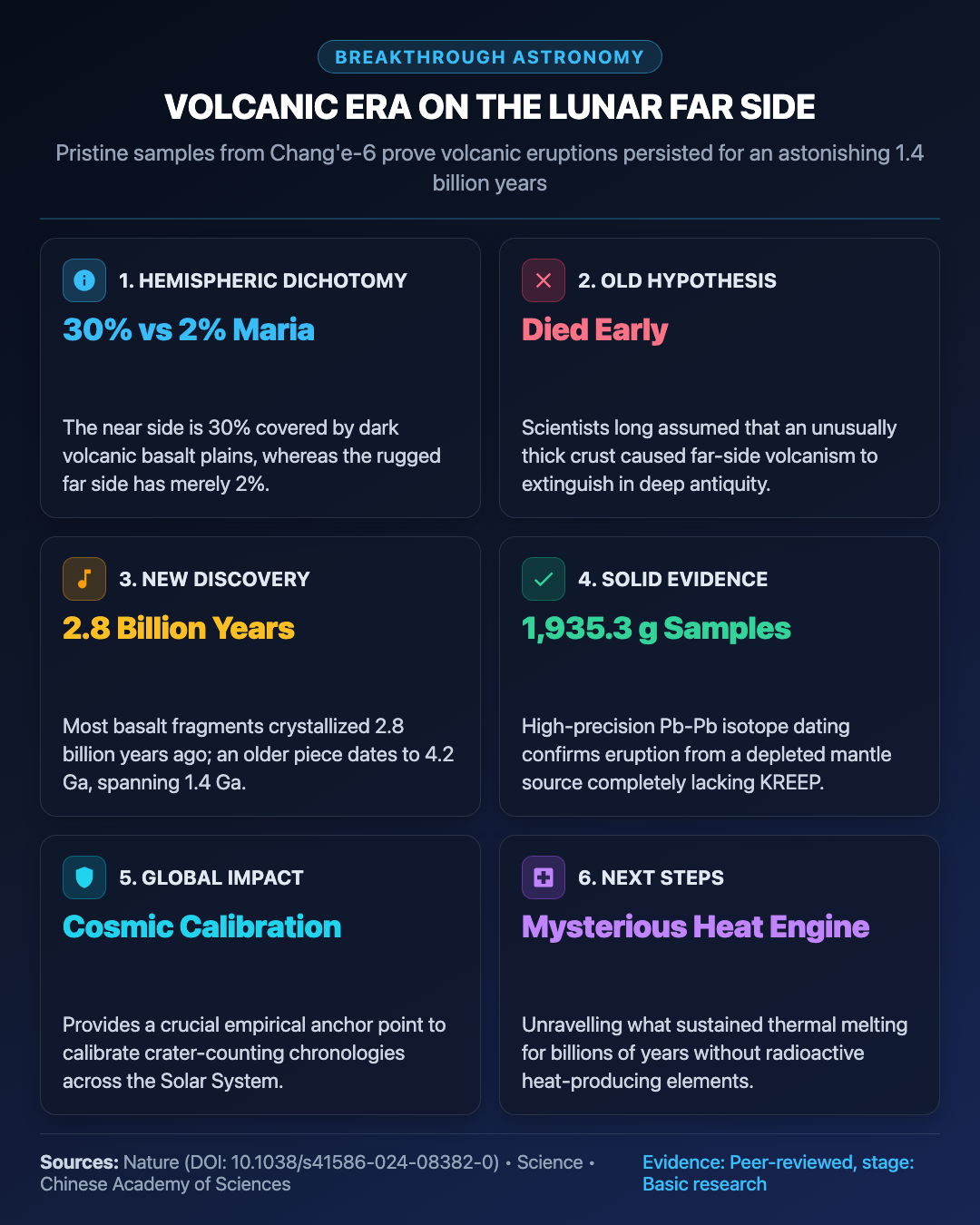
Strangely, the two hemispheres are starkly asymmetrical, resembling a loaf of bread baked unevenly in an oven. The near side has a thin crust covered by dark, smooth basalt plains that blanket nearly one third of its surface. In contrast, the far side features a thick crust battered by millions of meteor impacts, with dark lava plains covering less than two percent of its terrain. For more than half a century after Apollo astronauts brought rocks home, humans only touched rocks from the near side, leaving the far side a missing chapter in lunar geological history.
Note – Basalt: A dark, heavy volcanic rock that forms when molten magma breaches a planetary surface, cools, and solidifies, just like spilled candle wax pooling and hardening into a solid crust.
OLD THEORIES SHATTERED BY HISTORIC PHYSICAL SAMPLES
For decades, planetary scientists believed that the far side had frozen solid and died early in lunar history. The reasoning was straightforward: the crust there was unusually thick, acting like a giant thermal blanket that prevented deep magma from breaching the surface. Crucially, remote surveys indicated that the far side lacked heat-producing radioactive elements, which normally act like underground heating coils keeping rock molten.
In 2024, the Chang'e-6 mission made history by touching down in the South Pole-Aitken basin, a gigantic ancient impact scar on the lunar far side, retrieving 1,935.3 grams of pristine lunar dust and rock before returning safely to Earth.
Note – South Pole-Aitken basin: A colossal impact crater on the lunar far side measuring roughly 2,500 kilometers across, about the distance from London to Athens, blasted out by a devastating asteroid strike during the solar system's violent youth.
Placing these microscopic fragments under advanced microscopes revealed an astonishing truth. Volcanic activity on the far side did not extinguish early. A massive eruption took place approximately 2.8 billion years ago, between 2.80 and 2.83 billion years in the past. Furthermore, researchers identified an older high-aluminum basalt piece dating back 4.2 billion years. This proves that volcanic activity on the far side persisted for at least 1.4 billion years, a far longer active span than theoretical models ever predicted.
HOW DID SCIENTISTS UNCOVER THE AGE OF THE ROCKS?
To date these tiny rocks with microsecond precision across billions of years, two independent research teams relied on radioisotope dating across hundreds of mineral grains smaller than a single strand of hair.
Note – Radioisotope dating: A laboratory technique that determines the age of ancient rocks based on the steady decay rate of unstable radioactive atoms, functioning like a microscopic hourglass sealed the moment liquid lava cools into rock.
Scientists measured the gradual decay of lead into lead and rubidium into strontium using secondary ion mass spectrometers. Independent laboratories in Beijing and Guangzhou achieved virtually identical numbers, providing an unshakeable wall of empirical evidence that successfully cleared rigorous peer review in Nature and Science.
Chemical testing uncovered an even deeper puzzle. On the near side, late-stage volcanism was fueled by pockets of radioactive materials known as KREEP. In stark contrast, the 2.8-billion-year-old basalts from the far side were completely depleted of KREEP, proving they melted out of an energy-starved mantle.
Note – KREEP: An acronym for geological material rich in potassium, rare earth elements, and phosphorus, often accompanied by radioactive uranium and thorium that act as natural underground nuclear stoves.
SIGNIFICANCE FOR SCIENCE AND HUMANITY
This milestone significantly deepens human understanding of how rocky planets form, evolve, and cool down over billions of years. The Moon is a preserved geological fossil of the early solar system; unravelling its thermal history offers clues about the violent infancy of Earth and the evolution of neighbors like Mars and Mercury.
Practically, these physical samples provide an invaluable calibration benchmark for impact crater chronology across planetary science. Previously, scientists estimated the ages of celestial bodies by counting visible impact craters on orbital photographs. Having an absolute physical age of 2.8 billion years for this far-side terrain gives astronomers worldwide a reliable physical anchor to date planetary surfaces across the solar system.
Note – Impact crater chronology: A method for estimating the age of a planetary surface by counting the density of impact scars, similar to guessing the age of an old truck based on the number of dents and scratches on its body.
The global planetary science community directly benefits from these findings, which will also inform future plans for long-term lunar habitats and far-side radio observatories. Nonetheless, this represents basic laboratory research and remains far removed from everyday consumer applications.
The discovery also highlights a glaring scientific gap: without radioactive KREEP heaters, what kept the deep lunar interior hot enough to melt rock and drive volcanism for 1.4 billion years? Possible mechanisms include immense asteroid impacts thinning the crust or localized tidal compression generating friction heat. In subsequent steps, scientists plan to analyze ancient volatile gases and water signatures trapped within the Chang'e-6 minerals to unlock the true thermal engine of the far side.
SOURCES
Nature – Lunar farside volcanism 2.8 billion years ago from Chang'e-6 basalts – https://doi.org/10.1038/s41586-024-08382-0
Science – A sample of the Moon's far side retrieved by Chang'e-6 contains 2.83-billion-year-old basalt – https://doi.org/10.1126/science.adt1093
CNN – Rocks from the far side of the moon reveal a volcanic past, surprising scientists – https://edition.cnn.com/2024/11/15/science/chang-e-6-far-side-moon-volcanic-history
0 comments
Ads
Related Posts
Ads