Ads
The injured heart signals the brain to induce healing sleep
khoảng 14 giờ trước
00THE INJURED HEART SIGNALS THE BRAIN TO INDUCE HEALING SLEEP
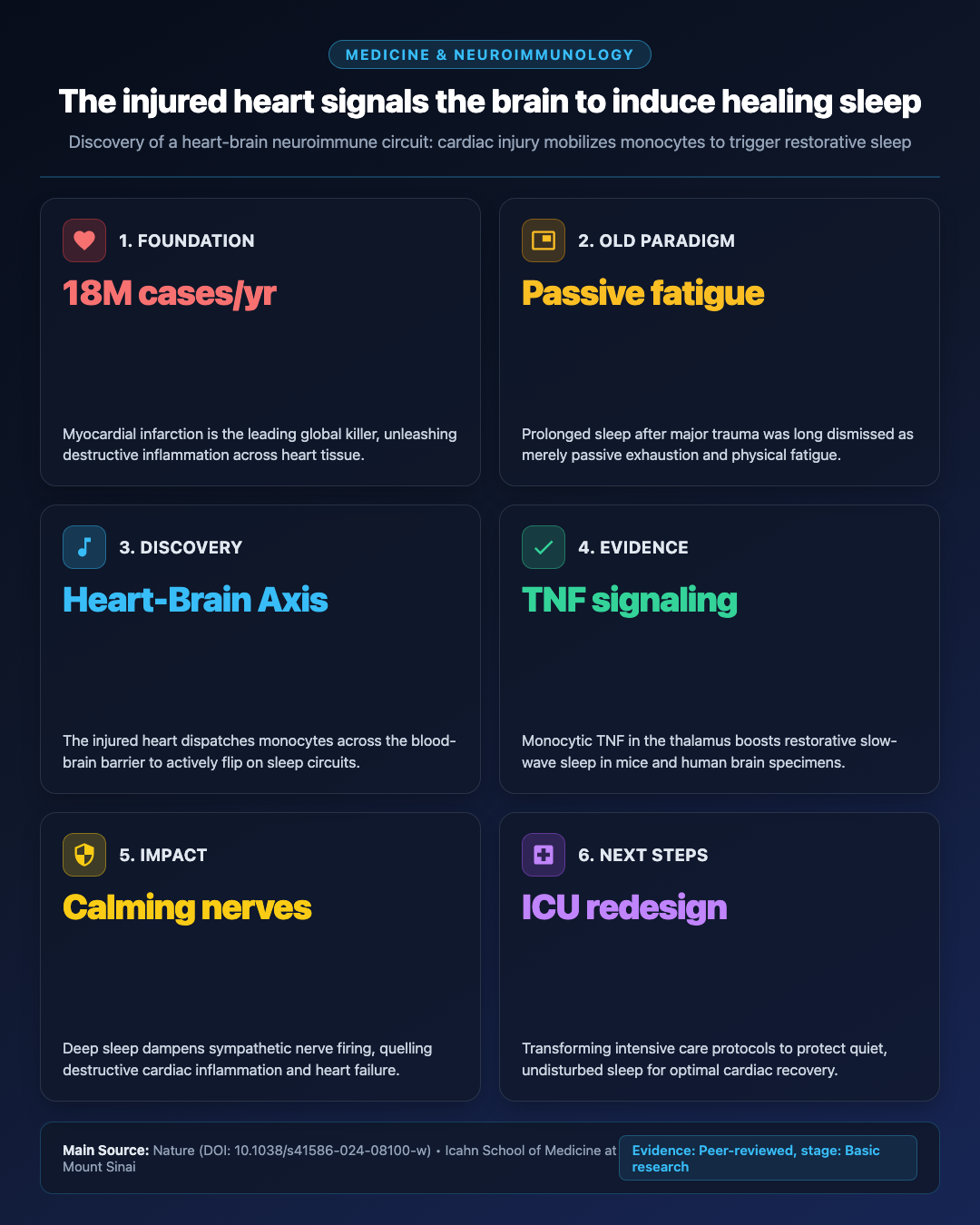
Whenever our bodies face severe illness or injury, our instinct is to curl up and sleep deeply. We long assumed that profound sleepiness was merely passive exhaustion, a biological surrender to physical distress. But a landmark study published in Nature on October 30, 2024, by scientists at the Icahn School of Medicine at Mount Sinai shows the exact opposite. After a severe cardiac injury, the heart does not simply suffer in silence. It dispatches immune messengers to the brain, dialing into central command to flip on a restorative sleep switch that protects it from runaway inflammation.
WHAT WAS THE ORIGINAL PROBLEM?
The human heart is the ultimate engine of life, beating over one hundred thousand times daily to circulate oxygen throughout the body. To keep running smoothly, tiny coronary arteries must continually supply fuel to every muscle fiber. When an atherosclerotic plaque ruptures and forms a clot, blood flow is abruptly cut off, starving downstream heart muscle of oxygen in a myocardial infarction.
Note – Myocardial infarction: A sudden blockage of a coronary artery supplying the heart, like a main water pipe getting clogged, leaving downstream grass to wither from lack of water and nutrients.
As heart muscle cells perish, an alarm sounds throughout the body. The sympathetic nervous system ramps up, quickening heart rate and raising blood pressure to push blood through. Meanwhile, an immense army of immune cells rushes in to clear debris. But when this firefighting response becomes overly intense, the resulting inflammation attacks healthy tissue, enlarging the scar and putting the patient at serious risk of deadly arrhythmias or heart failure.
Note – Sympathetic nervous system: The branch of the nervous system that acts as the body's gas pedal, accelerating heart rate and blood pressure to respond to danger.
WHAT HAS CHANGED COMPARED TO PREVIOUS BELIEFS?
For decades, medicine viewed post-heart attack slumber as a passive byproduct of exhaustion. Hospital cardiac intensive care units were designed with bright fluorescent lights, ringing alarms, and frequent nighttime wake-ups for routine checks. Undisturbed sleep was rarely prioritized as an active biological therapy.
Note – Monocytes: Mobile immune patrol cells circulating in the bloodstream, clearing cellular debris and broadcasting alerts when tissue damage strikes.
The Mount Sinai team overturned this view. Through rigorous experiments, they proved that post-infarction sleep is an active survival program commanded by the injured heart. When cardiac necrosis occurs, the body releases monocytes into the blood. But instead of only rushing to the heart, a specialized squad of these white blood cells travels straight to the brain, crossing through the choroid plexus into the thalamus.
Note – Choroid plexus: A specialized gateway network deep inside the brain that produces cerebrospinal fluid and strictly controls which cells enter neural tissue from the blood.
HOW DID SCIENTISTS UNCOVER THIS MECHANISM?
To unravel this communication highway, lead author Dr. Philip Huynh and senior author Dr. Cameron McAlpine recorded brain activity in mice following experimental myocardial infarction. They discovered that slow-wave sleep duration and pressure rose sharply after cardiac injury.
Note – Slow-wave sleep: The deepest, most restorative phase of sleep, when heart rate and breathing slow down, creating ideal conditions for tissue repair.
Tracking cells fluorescently, the scientists found monocytes accumulating in the lateral posterior nucleus of the thalamus. Here, resident microglia retrained these cells to release tumor necrosis factor. This molecule bound to receptors on neighboring neurons, switching on prolonged slow-wave sleep.
Note – Tumor necrosis factor: A chemical messenger secreted by immune cells, acting like an emergency dispatch to coordinate cell actions around damage.
During deep sleep, the brain releases the gas pedal of the sympathetic nervous system. Diminished stress signaling allows cardiac macrophages at the injury site to calm down and stop damaging healthy tissue. Conversely, when researchers disrupted post-infarct sleep in mice, sympathetic outflow surged, igniting a wave of inflammation that expanded the cardiac scar and worsened pump function. Examining postmortem brain tissue from human patients who died within two days of an acute heart attack, the researchers found the identical monocyte recruitment in the choroid plexus and thalamus. Clinical cohort data also confirmed that patients with poor sleep after a heart attack faced significantly higher rates of recurrent cardiovascular complications.
HUMAN SIGNIFICANCE AND THE ROAD AHEAD
This discovery deepens fundamental knowledge about the close dialogue between heart, brain, and immune system. Restorative sleep is not wasted time, but a finely tuned biological brake that calms inflammation and protects cardiac muscle.
Tens of millions of cardiac patients each year and critical care teams stand to benefit. These findings suggest hospital environments should reduce nighttime noise and light, protecting natural sleep as an integral part of healing.
However, this is basic preclinical research, not direct clinical advice. Patients must never self-medicate with sleeping pills without doctor guidance, as sedative-induced sleep lacks the restorative architecture of natural slow-wave sleep.
Moving from bench to bedside will take several years of randomized clinical trials. Scientists are now testing non-pharmacological methods, such as gentle acoustic stimulation, to support natural healing sleep after cardiac injury.
SOURCES
Nature – Myocardial infarction augments sleep to limit cardiac inflammation and damage – https://doi.org/10.1038/s41586-024-08100-w
Mount Sinai Health System – Mount Sinai Researchers Discover Brain-Heart Connection That Promotes Healing After a Heart Attack – https://www.mountsinai.org/about/newsroom/2024/mount-sinai-researchers-discover-brain-heart-connection-that-promotes-healing-after-a-heart-attack
EurekAlert – Heart attacks alter brain wiring to induce sleep and promote cardiac healing – https://www.eurekalert.org/news-releases/1063124
0 comments
Ads
Related Posts
Ads