Ads
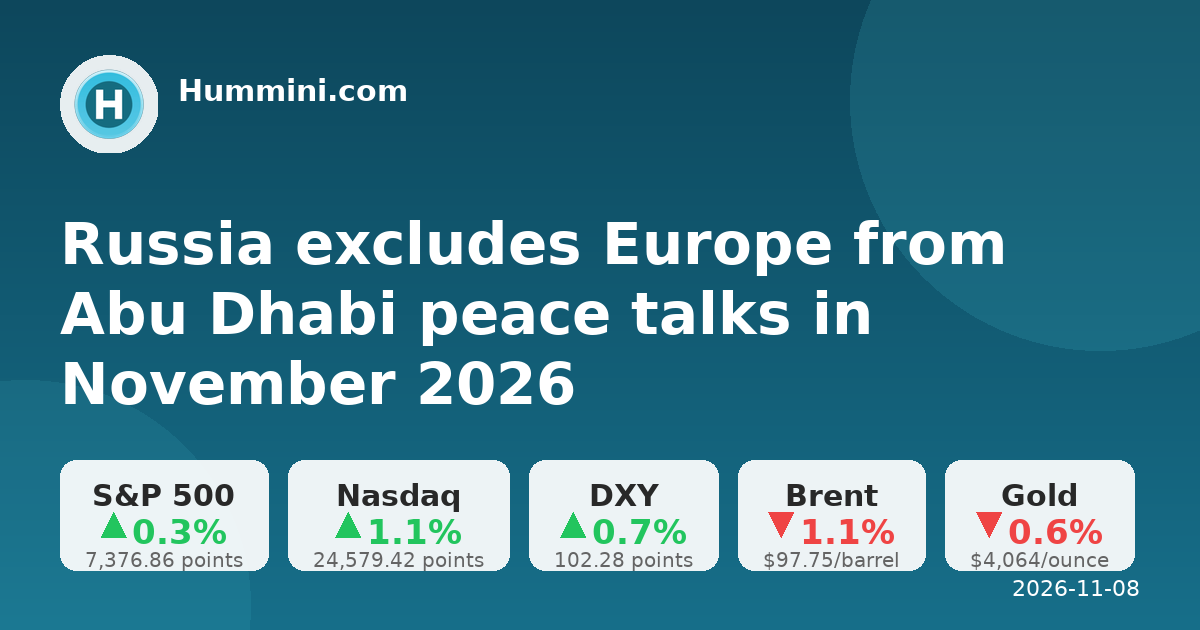
Russia excludes Europe from Abu Dhabi peace talks in November 2026
khoảng 3 giờ trước
00WORLD TEMPERATURE
3.9/5. International diplomacy fractures ahead of the Abu Dhabi summit, the Strait of Hormuz standoff drags on, and an expanding Ebola outbreak hits Central Africa.
BRIEFING
Updated from 05:00 to 12:00 on November 8, 2026 (Hanoi time), covering only breaking news and new developments.
1. Moscow formally rejected any direct European role in the upcoming Abu Dhabi trilateral talks while dispatching Deputy Foreign Minister Sergei Ryabkov to join the negotiations.
2. The US Treasury froze the assets of 4 individuals and 41 entities operating as shell networks for Cambodia-based conglomerate Prince Group across five jurisdictions.
3. The World Health Organization confirmed the Ebola outbreak in DR Congo surpassed 10,700 cases and 5,200 deaths, clearing two new vaccine candidates for immediate field trials.
4. UN Secretary-General António Guterres issued a stark warning against the growing international normalization of armed force and the erosion of global legal treaties.
5. Washington maintained high military readiness while Qatari mediators pushed an urgent 48-hour proposal to resolve the naval confrontation in the Strait of Hormuz.
1. RUSSIA EXCLUDES EUROPE FROM ABU DHABI TALKS AND EXPANDS US-FOCUSED DELEGATION
On Sunday morning, Moscow officially ruled out any direct European presence at the upcoming trilateral security consultations in Abu Dhabi, while adding Deputy Foreign Minister Sergei Ryabkov to its negotiating team, according to Reuters and The Moscow Times.
The Russian Foreign Ministry stressed that the meetings scheduled for November 10–11 in the United Arab Emirates will strictly involve Russia, the United States, and a Ukrainian delegation headed by foreign intelligence chief Rustem Umerov. The addition of Ryabkov, who oversees arms control and relations with Washington, signals the Kremlin’s desire to pivot the talks toward broader strategic bilateral terms with the United States. To reassure nervous European allies, White House envoys Steve Witkoff and Jared Kushner scheduled separate consultations in Brussels with European Union and NATO leadership regarding post-war security guarantees.
This diplomatic maneuvering follows a massive Russian overnight aerial assault that launched 172 drones and 36 ballistic missiles against Kyiv's energy infrastructure and key bridges over the Dnipro River, triggering widespread blackouts.
Strategic significance: Sidelining European representatives demonstrates Moscow's persistent strategy to negotiate the continent's security architecture exclusively with Washington. Splitting Western engagement into parallel tracks risks weakening Kyiv’s negotiating leverage, particularly as Ukraine grapples with crippling energy disruptions ahead of the talks.
2. US SANCTIONS NETWORK OF 41 SHELL COMPANIES TIED TO PRINCE GROUP
The US Department of the Treasury announced on November 7 comprehensive asset freezes against 4 individuals and 41 entities accused of laundering money for the Cambodia-based Prince Group criminal syndicate, according to the Office of Foreign Assets Control (OFAC).
The sanctions target Qiu Yong, a senior Prince Group executive holding multiple passports, and his personal assistant Zhao Mengyao for orchestrating shell companies to clean billions of dollars in illicit proceeds. The 41 designated commercial entities span five jurisdictions, including 23 businesses in Cambodia, along with registered corporate shells in Hong Kong, Singapore, Mauritius, and the British Virgin Islands. The action also froze assets belonging to He Yujing, who allegedly transferred a luxury mansion in Tokyo to shield wealth for the syndicate-linked CCU Commercial Bank.
Founded by Chinese-born businessman Chen Zhi, Prince Group was previously identified by US and UK authorities as a transnational criminal organization operating sprawling scam compounds and forced-labor rings in Sihanoukville. Under mounting international pressure, Cambodian authorities previously detained Chen Zhi and froze nearly 1 billion dollars in real estate, while international law enforcement seized billions in cryptocurrency. The latest round of sanctions aims to cut off proxy intermediaries attempting to move funds underground.
Strategic significance: This sweeping financial action signals Washington's resolve to dismantle the secondary corporate infrastructure shielding cyber fraud across Southeast Asia. Even so, the rapid migration of scam syndicates across offshore jurisdictions suggests that unilateral financial designations will primarily slow illicit capital flows rather than eradicate tech-enabled fraud networks entirely.
3. CONGO EBOLA SURPASSES 10,700 CASES AS WHO CLEARS TWO NOVEL VACCINE TRIALS
The World Health Organization confirmed on November 7 that the ongoing Bundibugyo Ebola virus outbreak in the Democratic Republic of the Congo has surpassed 10,700 confirmed cases and claimed over 5,200 lives, becoming the second-largest Ebola epidemic on record, according to Reuters and WHO surveillance updates.
Health officials reported a crude case fatality rate near 49 percent, with active transmission confirmed across eight provinces, including Ituri, North Kivu, and South Kivu. Cross-border risks escalated after Kenya recorded 9 confirmed cases and 2 deaths, while an infected individual in Nigeria required emergency medical evacuation to Switzerland. With standard Ebola vaccines ineffective against the Bundibugyo strain, the WHO Technical Advisory Group approved the emergency addition of two candidate vaccines—Oxford University's ChAdOx1 BDBV and Moderna's mRNA-1469—into the active Tumaini clinical trial in the DRC.
The Bundibugyo species previously caused smaller outbreaks in Uganda in 2007 and 2012, but never at this magnitude. Persistent armed conflict in eastern Congo, widespread civilian displacement, and heavy seasonal rains continue to severely hamper contact tracing and early clinical intervention.
Strategic significance: The worsening public health emergency in Congo tests the emergency response capacity of global health agencies amid strained international humanitarian budgets. If the newly cleared vaccine candidates demonstrate clinical efficacy in the field, it will represent a historic biomedical breakthrough against neglected tropical pathogens; conversely, uncontrolled urban spread in Central Africa could ignite a devastating regional humanitarian crisis.
4. UN SECRETARY-GENERAL WARNS AGAINST GLOBAL NORMALIZATION OF ARMED FORCE
United Nations Secretary-General António Guterres issued a stern warning on November 7 that unlawful armed force is increasingly being treated as routine in international affairs, according to the Associated Press and UN News.
Speaking at an honorary doctorate ceremony at Spain’s University of Salamanca, Guterres stressed that multiple nations have adopted an à la carte approach to international law, using military aggression to redraw borders. The UN chief cited ongoing devastation from Ukraine and the Gaza Strip to Sudan and the Sahel, where civilian populations suffer the brutal consequences of the law of the jungle replacing legal norms. He appealed directly to world governments to uphold the UN Charter, declaring that power must always remain subordinate to human dignity and the rule of law.
The address arrives with less than two months remaining in Guterres' final term leading the global body. Salamanca holds symbolic weight as the historic birthplace of modern international jurisprudence, pioneered in the sixteenth century by scholar Francisco de Vitoria.
Strategic significance: Guterres' legacy remarks reflect the profound institutional paralysis gripping multilateral diplomacy amid intensifying regional conflicts. With frequent vetoes in the UN Security Council blocking collective peace enforcement, the Secretary-General's address serves as a solemn warning that the post-war international order risks sliding into unconstrained great-power rivalry.
5. US AND IRAN DEADLOCKED OVER 48-HOUR QATARI PLAN FOR STRAIT OF HORMUZ
Washington signaled on Sunday morning that it will not accept Tehran's rigid seven-point ultimatum, while Qatari diplomats mounted an urgent push for a 48-hour compromise to reopen maritime traffic through the Strait of Hormuz, according to The Guardian and The Media Line.
Under the framework proposed by Doha, the United States would suspend its naval interdiction of Iranian ports and unfreeze roughly 8 billion dollars in overseas assets, in exchange for Tehran permitting International Atomic Energy Agency inspectors to verify damaged nuclear sites and down-blend highly enriched uranium. However, President Donald Trump reiterated that US military forces remain locked and loaded, insisting that Washington will not agree to terms without sweeping nuclear rollbacks. Tehran maintains that the strategic waterway will remain restricted until comprehensive economic sanctions and oil export embargoes are lifted unconditionally.
Strategic significance: The prolonged diplomatic standoff leaves the Strait of Hormuz on a knife-edge where any localized incident could trigger a wider confrontation. While both Washington and Tehran appear eager to avoid a full-scale regional conflict that would destabilize global energy markets before winter, the deep divide over core security demands keeps the probability of a durable compromise precarious.
NEXT 48–72 HOURS
Russian, Ukrainian, and US security delegations arrive in Abu Dhabi for the start of trilateral talks on November 10 without European representation.
White House envoys hold parallel consultations in Brussels with European Union and NATO officials to coordinate post-war security terms.
Global energy markets and maritime carriers monitor Washington's final decision on the 48-hour de-escalation window proposed by Qatar.
The World Health Organization and Congolese health authorities initiate emergency field trials for two novel Ebola vaccines across priority hotspots in eastern DRC.
SOURCES
Russia excludes Europe from Abu Dhabi talks and expands US-focused delegation:
Reuters – Russia rules out European presence at trilateral Abu Dhabi security consultations – https://www.reuters.com/world/europe/russia-excludes-europe-abu-dhabi-talks-2026-11-08/
The Moscow Times – Ryabkov joins Russian delegation as Moscow sidelines Europe from peace talks – https://www.themoscowtimes.com/2026/11/08/russia-ukraine-abu-dhabi-europe-exclusion-a89412
Critical Threats – Russian offensive campaign assessment focuses on diplomatic coercion ahead of UAE summit – https://www.criticalthreats.org/analysis/russian-offensive-campaign-assessment-november-8-2026
US sanctions network of 41 shell companies tied to Prince Group:
U.S. Department of the Treasury – Treasury targets Prince Group money laundering and illicit finance network – https://home.treasury.gov/news/press-releases/jy2704
The Record Media – US sanctions 41 entities and four individuals tied to Cambodian cyber scam empire – https://therecord.media/us-treasury-sanctions-prince-group-scam-syndicate-cambodia
Decrypt – Treasury hits Cambodian scam conglomerate with fresh sanctions on crypto laundering shells – https://decrypt.co/291045/us-sanctions-prince-group-cambodia-scam-network
Congo Ebola surpasses 10,700 cases as WHO clears two novel vaccine trials:
World Health Organization – Ebola virus disease outbreak in the Democratic Republic of the Congo update – https://www.who.int/emergencies/disease-outbreak-news/item/2026-DON590
Reuters – WHO adds Oxford and Moderna vaccines to clinical trial as Congo Ebola toll mounts – https://www.reuters.com/business/healthcare-pharmaceuticals/who-congo-ebola-vaccine-trials-bundibugyo-2026-11-08/
European Centre for Disease Prevention and Control – Epidemiological update on Bundibugyo ebolavirus in DR Congo – https://www.ecdc.europa.eu/en/publications-data/ebola-bundibugyo-drc-november-2026
UN Secretary-General warns against global normalization of armed force:
UN News – UN chief warns against normalisation of force in international relations at Salamanca – https://news.un.org/en/story/2026/11/1156821
Associated Press – Guterres decries erosion of global law and rise of law of the jungle – https://apnews.com/article/un-guterres-salamanca-international-law-warning-2026
The Hindu – Outgoing UN Secretary-General warns of dangerous shift toward force over diplomacy – https://www.thehindu.com/news/international/guterres-salamanca-address-international-law/article68841290.ece
US and Iran deadlocked over 48-hour Qatari plan for Strait of Hormuz:
The Guardian – Qatari mediators push two-day timeline to avert US-Iran clash in Strait of Hormuz – https://www.theguardian.com/world/2026/nov/08/us-iran-qatar-hormuz-nuclear-mediation
The Media Line – Tehran rejects initial US response as Gulf diplomacy tests 48-hour window – https://themedialine.org/top-stories/iran-us-qatar-hormuz-stalemate-nuclear-talks/
Arab News – Washington keeps military options open while reviewing Qatari proposal for maritime corridor – https://www.arabnews.com/node/2589140/middle-east
0 comments
Ads
Related Posts
Ads