Ads
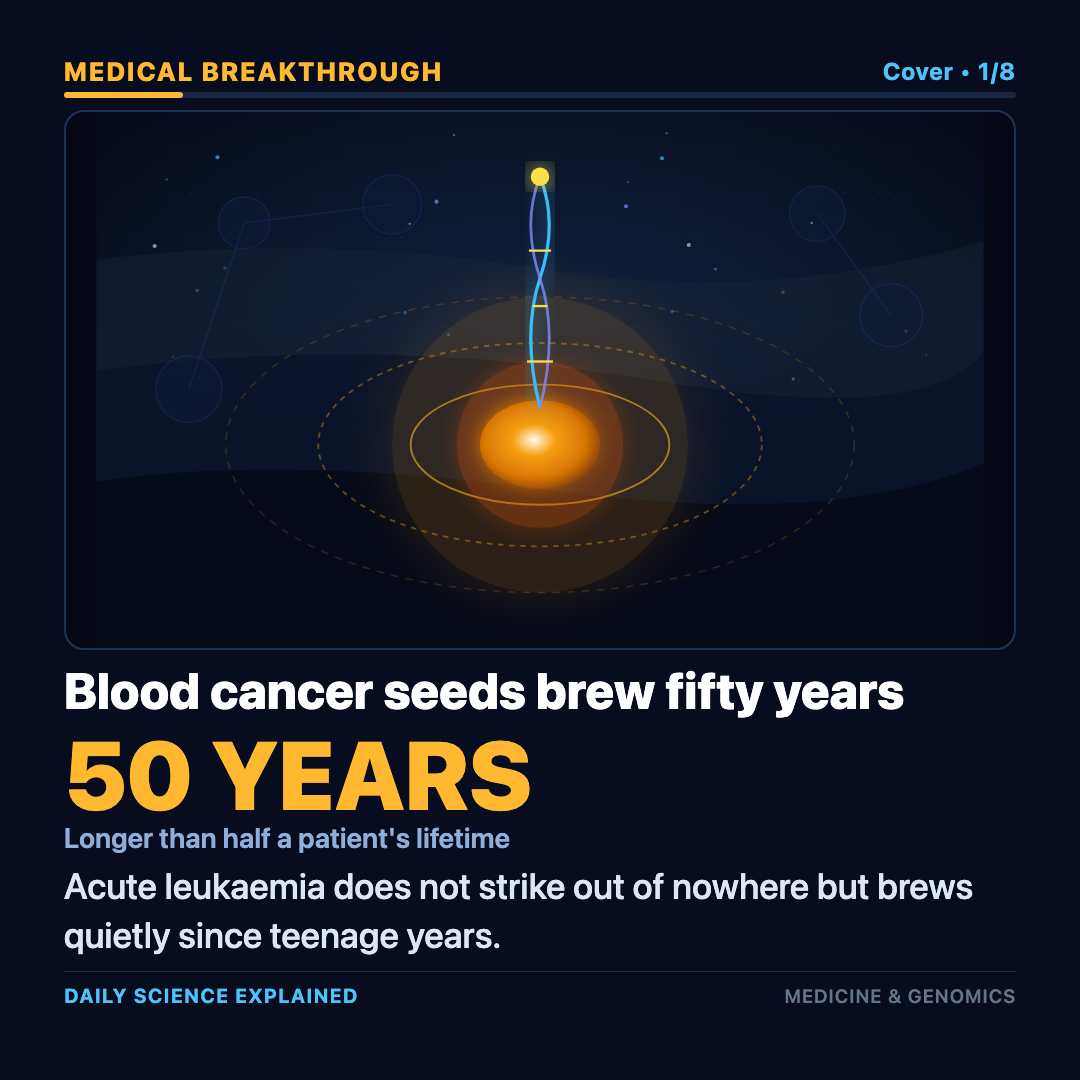
Acute myeloid leukaemia brews silently inside the body for half a century
3 ngày trước
00A destructive forest fire may look like it erupted from a single stray spark on dry grass, but in reality damp leaf litter beneath has been steadily accumulating heat for weeks. For decades, medicine viewed acute myeloid leukaemia in a similar light as an unforeseen lightning bolt, because patients often suffer rapid physical decline just weeks after initial symptoms appear. However, an extensive study published in the journal Nature on November 11 2026 by researchers at the University of Cambridge and University College London has completely overturned this perspective. Genetic evidence demonstrates that the very first seeds of this lethal disease actually take root in the body during adolescence, brewing silently for more than fifty years before clinical manifestation.
Note – Acute myeloid leukaemia: A life threatening malignancy occurring when bone marrow produces massive waves of immature white blood cells, akin to a currency printing press spitting out defective banknotes that clog the entire circulation system.
WHY WAS THIS DISEASE ONCE VIEWED AS A SUDDEN BOLT OF LIGHTNING
The bone marrow inside our bodies operates like an immense construction site humming around the clock. To sustain life, hematopoietic stem cells divide continuously to generate approximately one hundred billion new blood cells every single day, including oxygen carrying red cells, wound healing platelets, and disease fighting white cells. Across such an astronomical workload, replication errors in the genetic code of DNA are virtually inevitable. Most of these mistakes are harmless or swiftly dismantled by internal cellular repair mechanisms. However, if a stem cell accidentally acquires a malicious driver mutation, it begins proliferating into a persistent cell lineage with an unfair survival advantage.
Note – Hematopoietic stem cells: The master stem cells residing within bone marrow that function like versatile master builders capable of generating every type of mature blood cell that nourishes the human body.
Note – Driver mutation: A crucial glitch in the DNA sequence that grants a cell the ability to outlive or outdivide its normal counterparts, much like a vehicle with a stuck accelerator pedal.
When a mutated stem cell clone starts expanding in the bone marrow of otherwise healthy individuals, the condition is known as clonal hematopoiesis. For years, medical experts observed that this phenomenon is widespread in older adults, yet generally assumed the final transformation into acute leukaemia was a sudden catastrophic accident occurring within a brief window of months.
Note – Clonal hematopoiesis: A biological state where a population of blood cells derived from a single mutated ancestral stem cell expands to form an outsized fraction of the bone marrow, similar to an invasive weed crowding out a flowerbed.
HOW A HALF CENTURY SECRET OVERTURNS OUR PREVIOUS BELIEFS
The longstanding belief that acute myeloid leukaemia needs merely a few months or a couple of years to emerge has completely collapsed in the face of new genetic evidence. The research team at the Early Cancer Institute at the University of Cambridge discovered that in approximately two thirds of patients, the first driver mutation appeared before the age of twenty.
This reveals that for an individual diagnosed with leukaemia at age seventy, the underlying seeds had quietly taken root in their bone marrow for over half a century. Throughout decades of youth and middle age, this initial mutant clone expanded at an extraordinarily leisurely pace, gaining only a minute fraction of marrow dominance each year without triggering any warning bells on standard routine blood tests. They behaved like quiet glowing embers buried deep under ashes, awaiting the right conditions to flare up.
A MOLECULAR TIME MACHINE AND THE POWER OF DUPLEX SEQUENCING
To uncover a secret spanning fifty years, researchers could not rely solely on samples collected after clinical diagnosis. Instead, they tapped into an extraordinary archive of sequential annual blood samples collected across fifteen years from more than two hundred thousand women enrolled in a large scale screening trial in the United Kingdom. Scientists compared the serial blood samples of individuals who eventually developed acute leukaemia against age matched healthy controls.
The evidentiary foundation was established using duplex sequencing, a technology with unprecedented sensitivity. This method reads each individual strand of the DNA double helix separately, eliminating technical sequencing noise and enabling the detection of a single rare mutant molecule among one hundred thousand normal molecules. Armed with this molecular time machine, the team reconstructed the multi decade evolutionary family tree of blood cells year by year.
Note – Duplex sequencing: An ultra sensitive genetic analysis technique that independently sequences both complementary strands of a DNA molecule to eliminate technical read errors, similar to comparing two original carbon copies of an ancient manuscript.
The resulting data demonstrated that leukemogenesis follows a clear compounding evolutionary trajectory. The initial mutation grants a modest survival edge across decades. Decades later, when that clone randomly picks up a second or third driver mutation, its proliferation rate explodes exponentially. A somatic sweep ensues, aggressively outcompeting healthy bone marrow cells and precipitating the acute onset of clinical disease.
Note – Somatic sweep: The evolutionary process whereby a hyper competitive mutant clone expands rapidly and crowds normal healthy cells out of their ecological niche, akin to an aggressive invasive fish overtaking a lake ecosystem.
THE FUTURE OF PREVENTIVE MEDICINE AND THE NEXT SCIENTIFIC MILESTONES
This peer reviewed research fundamentally transforms how humanity approaches blood cancer. Rather than confronting an ambush that strikes without warning at the eleventh hour, medicine now recognizes a five decade window of opportunity to intervene. This paradigm shift paves the way for early surveillance programs that could stratify high risk individuals, monitoring pre leukemic changes long before abnormal cells seize control.
The principal beneficiaries will be future patients and older individuals living with clonal hematopoiesis. Nevertheless, researchers caution that this work represents basic foundational research, not an immediate clinical cure for everyday hospital use. The road from biological discovery to patient care remains several years long. A major hurdle is that the vast majority of people harboring early mutant clones will never develop full blown leukaemia during their natural lifespans. Developing precise mathematical algorithms to distinguish those destined for disease from those who will remain healthy is essential to avoid unwarranted anxiety and unnecessary treatment.
The next priority for the international scientific community is refining predictive risk models and identifying targeted therapeutic molecules capable of selectively purging aberrant pre cancer clones without poisoning vital healthy stem cells. The threshold of preventive oncology has swung open, turning a formerly sudden tragedy into an observable and conquerable biological journey.
SOURCES
Nature – Evolutionary dynamics in the years preceding acute myeloid leukaemia – https://doi.org/10.1038/s41586-026-11269-x
University of Cambridge – Decades-long evolution of acute myeloid leukaemia revealed – https://www.cam.ac.uk/research/news/decades-long-evolution-of-acute-myeloid-leukaemia-revealed
ScienceDaily – How blood cancer brews silently for decades before diagnosis – https://www.sciencedaily.com/releases/2026/11/261111103045.htm
0 comments
Ads
Related Posts
Ads