Ads
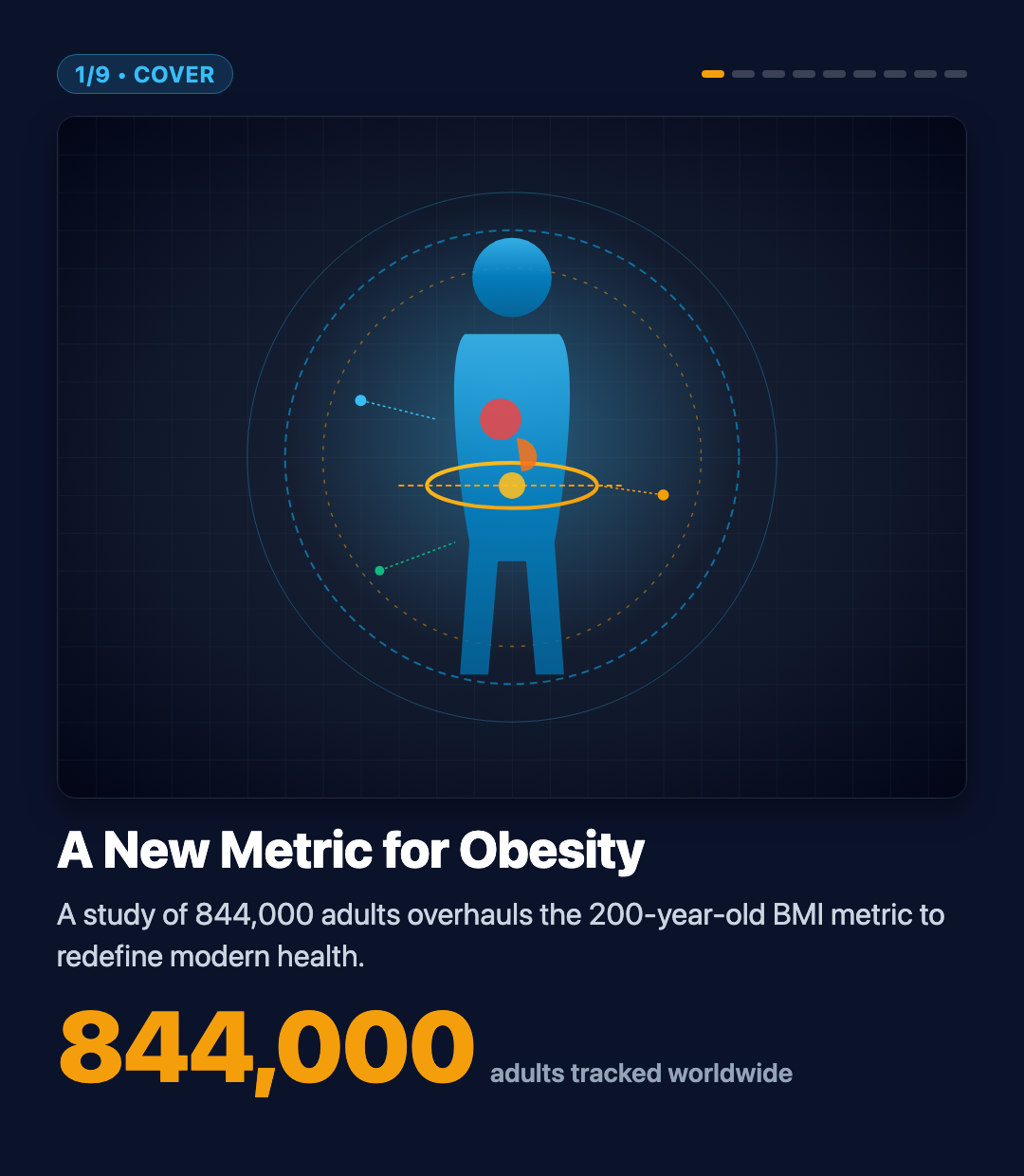
Global study overhauls centuries old obesity metric across 844000 people
4 ngày trước
00Bathroom scales and smartphone fitness apps have long judged human health through a single number known as BMI. An athletic bodybuilder packed with dense muscle can easily be labeled dangerously obese, while a lean individual carrying toxic visceral fat around vital organs is declared perfectly healthy. That longstanding medical flaw has now been decisively addressed by landmark research published on November 11, 2026 in the journal Nature, led by an international team from Tongji Medical College and King's College London.
WHAT THE OLD METRIC WAS AND WHY WE CARE
Imagine assessing the safety of a bridge solely by weighing each passing vehicle, without checking whether the truck is carrying lightweight cotton or dense iron ore that could crush the support pillars. That is precisely how Body Mass Index has operated for nearly two centuries. Formulated in the 1830s by Belgian mathematician Adolphe Quetelet, BMI simply divides weight by height squared. The formula cannot distinguish muscle from bone, and critically, cannot tell where fat is stored inside the body. As obesity evolved into a global epidemic affecting over one billion people, relying on such a crude formula to prescribe potent drugs, approve surgeries, or deny insurance created massive systemic errors.
Note – Body Mass Index (BMI): a metric calculated by dividing weight by height squared, much like estimating vehicle cargo stress solely from length and total mass without inspecting the cargo inside.
WHAT TRULY CHANGED IN OUR UNDERSTANDING OF OBESITY
Conventional medicine long assumed that crossing arbitrary BMI thresholds automatically equated to active disease. The new study empirically validates a global clinical framework dividing excess adiposity into two fundamentally distinct conditions termed preclinical obesity and clinical obesity. By combining waist circumference and waist-to-height ratio to detect harmful deep belly fat, scientists demonstrated that carrying excess fat is not inherently a disease state. In preclinical obesity, fat cells expand but cardiovascular, hepatic, renal, and physical mobility functions remain fully preserved. In contrast, obesity becomes a life-threatening illness only when excess fat actively impairs organ function or daily living.
Note – Preclinical obesity: a condition where excess body fat accumulates while vital organs and metabolic pathways continue functioning normally, akin to a vehicle carrying extra cargo while its engine and brakes remain in peak condition.
Note – Clinical obesity: a genuine disease state where excess fat impairs internal organ function or limits daily physical mobility, comparable to an overloaded truck suffering transmission failure and broken axles.
WHAT EVIDENCE PROVES THE OLD FORMULA FAILED
Published in Nature, the peer-reviewed investigation analyzed multi-year health data from 844,108 adults across four nations: China, the United Kingdom, the United States, and Spain. Representing the population of a major metropolis, this massive cohort allowed scientists to track individual health trajectories over decades.
Comparative analysis revealed that standard BMI misdiagnosed 1.2% to 3.1% of healthy individuals as obese, generating unwarranted psychological distress and unnecessary prescriptions. More dangerously, BMI completely overlooked 5.2% to 8.6% of individuals at high risk of premature death simply because their overall weight appeared normal while dangerous fat accumulated silently around internal organs.
Crucially, ten-year longitudinal tracking showed that 77% to 91% of individuals with preclinical obesity never progressed to clinical obesity. Meanwhile, individuals diagnosed with clinical obesity experienced a staggering 69% increase in mortality risk compared to healthy baseline participants.
Note – Visceral fat: deep fat wrapped around internal organs such as the heart, liver, and intestines, acting like toxic sludge clogging machinery rather than harmless fat stored beneath the skin.
Note – Waist-to-height ratio: an anthropometric measurement dividing waist circumference by height, exposing dangerous abdominal fat far more accurately than scale weight alone.
WHAT THIS MEANS FOR GLOBAL MEDICINE AND FUTURE CARE
This breakthrough empowers healthcare systems to stop treating arbitrary scale readings and start treating authentic physiological health. Hundreds of millions of overweight individuals can be spared unwarranted social stigma, while lean individuals harboring dangerous visceral fat can be detected and protected early. Clinicians and insurers gain clear scientific criteria to direct expensive next-generation weight-loss therapies to those facing genuine physiological damage.
Nevertheless, integrating this framework into routine hospital workflows remains years away as medical societies update guidelines. Because this was a large observational cohort study rather than a randomized trial, it does not prove that pharmaceutical intervention during the preclinical stage improves long-term outcomes. Readers should recognize these findings as public health science rather than individualized clinical advice. The next scientific step involves interventional trials to refine targeted therapies tailored specifically to each stage.
Note – Intervention trial: a rigorous medical study where participants are randomly assigned to specific therapies or lifestyle changes to objectively evaluate real-world clinical efficacy.
SOURCES
Nature – Validation of clinical and preclinical obesity across global cohorts – https://doi.org/10.1038/s41586-026-11237-5
King's College London – Major study validates new clinical framework for obesity diagnosis – https://www.kcl.ac.uk/news/2026/11/obesity-framework-validation
Science Media Centre – Expert reaction to Nature study on clinical and preclinical obesity framework – https://www.sciencemediacentre.org/roundup/nature-obesity-validation-2026
0 comments
Ads
Related Posts
Ads