Ads
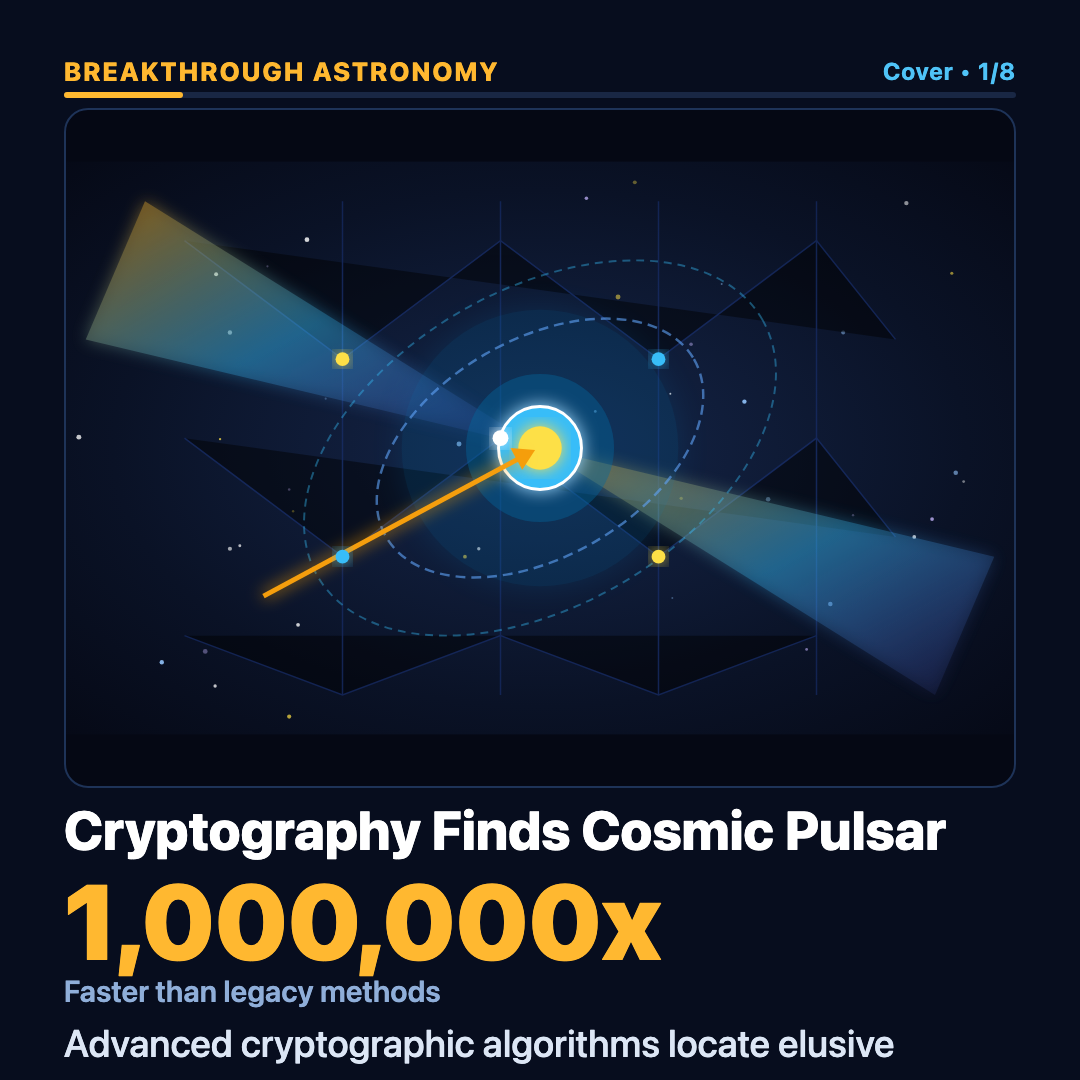
Cryptographic Algorithm Discovers Hidden Cosmic Pulsar One Million Times Faster
4 ngày trước
00Imagine standing beneath the eaves of a roof during a quiet winter drizzle, trying to figure out the exact drip rate of a high overhead faucet when you only hear a single faint drop once every week. That is precisely the daunting challenge astrophysicists have grappled with for the past fifteen years while hunting for gamma-ray pulsars across deep space. On November 19, 2026, an international research team led by the Max Planck Institute for Gravitational Physics and the Weizmann Institute of Science announced a remarkable breakthrough in Physical Review Letters. By borrowing advanced mathematical tools from cyber cryptography, they uncovered a previously hidden pulsar within archival sky data roughly one million times faster than conventional methods.
WHY DOES THE SKY HIDE COSMIC HEARTBEATS?
Across the cosmos, when a massive star exhausts its nuclear fuel and collapses, its remnant core is compressed so violently that millions of tons of matter are crammed into the volume of a single teaspoon. This super-dense sphere spins at dizzying speeds, shooting intense beams of energetic radiation from its magnetic poles like a cosmic lighthouse sweeping across the oceanic night. Whenever these beams sweep past Earth, astronomical instruments register a regular flash. Spotting these natural lighthouses allows scientists to test fundamental laws of physics under extreme conditions, ranging from Einstein's general relativity to the inner workings of ultradense matter.
Note – Pulsar: A super-dense dead star spinning hundreds of times per second, sweeping radiation across space just like an ocean lighthouse.
However, most of these celestial beacons emit high-energy gamma rays. Across vast interstellar distances of thousands of light-years, these high-energy beams become so thin that only sensitive space-borne observatories outside Earth's atmosphere can catch occasional individual photons.
Note – Gamma rays: The most energetic form of light in the universe, behaving like intense invisible energy blasts compared to everyday visible light.
THE SIGNAL DROUGHT IN THE BLACK OF SPACE
For fifteen years, NASA's Fermi Gamma-ray Space Telescope has continuously observed the high-energy sky. Yet detecting the steady rhythm of a pulsar in this data is like solving a ten-thousand-piece puzzle when you only receive one piece per week. For many faint sources, the Fermi telescope registers merely a handful of photons every seven days, completely engulfed by noisy background radiation from the surrounding Milky Way.
Note – Fermi Space Telescope: NASA's space observatory that has spent fifteen years hunting elusive high-energy gamma rays scattered across the cosmos.
To determine whether these sparse photons originate from a rotating pulsar, researchers must simultaneously guess three distinct variables: the rotation rate of the star, its gradual spin-down rate over time, and its precise sky coordinates. If a trial guess is off by just a fraction of a microsecond across decades, the photons fail to line up in phase, and the signal dissolves entirely. Traditional methods relied on semicoherent grid searches, testing billions upon billions of parameter combinations one by one. This brute-force search required massive supercomputer clusters and enormous electrical energy, yet frequently missed targets. Standard searches could consume six hundred CPU years of computing power without securing a detection.
Note – CPU hours: A unit measuring the time a single computer processor core must run continuously to complete a specific computational task.
WHEN CODEBREAKERS STEPPED INTO THE OBSERVATORY
Confronted with an intractable computational roadblock, theorists Dotan Gazith and Barak Zackay from the Weizmann Institute of Science recognized a profound mathematical symmetry. They realized that arranging sparse photon arrival times into a coherent temporal rhythm is mathematically identical to finding the shortest vector on a multidimensional geometric lattice. This problem is the cornerstone of lattice-based cryptography, the leading framework designed to protect digital communications against future attacks by quantum computers.
Note – Lattice cryptography: An advanced encryption method based on multi-dimensional geometric grids, where finding the shortest route between points is exceedingly difficult.
Instead of mechanically checking countless empty coordinates, lattice reduction algorithms behave like a geometric compass in high-dimensional space. The algorithm cuts directly through complex multidimensional grids toward the most synchronized point, skipping entire vast deserts of meaningless noise.
Note – Shortest Vector Problem: A mathematical challenge of locating the closest grid point to the origin in multidimensional space, like spotting the nearest pebble on a vast gravel beach.
Deploying this lattice technique onto fifteen years of Fermi archival observations, researchers at the Max Planck Institute discovered an elusive, isolated pulsar named PSR J1622–7204. This stellar remnant spins at two hundred sixty-one rotations per second. Astonishingly, the entire parameter search took just ten CPU hours on a standard desktop workstation. The new approach operates roughly one million times faster than traditional methods, turning an impossible centuries-long supercomputing grind into a simple morning computation. The discovery passed rigorous peer review and was published in Physical Review Letters.
UNLOCKING ARCHIVAL SKY TREASURES FOR THE FUTURE
This algorithmic leap offers profound value for foundational science. Astronomers are no longer constrained by insurmountable computing bottlenecks, allowing them to thoroughly comb through fifteen years of Fermi archives to resolve hundreds of mysterious unidentified gamma-ray sources across the sky. The immediate beneficiary is the astrophysics community, which gains natural cosmic laboratories to detect subtle gravitational waves and probe the limits of general relativity.
Nevertheless, scientists emphasize clear boundaries regarding application. This breakthrough represents basic research at the intersection of mathematics and astronomy, not a consumer technology ready for everyday deployment. Currently, the algorithm is optimized exclusively for isolated pulsars that exist alone in space. When a pulsar orbits a companion star in a binary system, gravitational tugs warp the pulse timing, drastically multiplying the dimensions of the search space. The next research phase focuses on generalizing lattice tools to tackle these binary systems, paving the way to map the deepest and most energetic secrets of our galaxy.
SOURCES
Physical Review Letters – Gamma-Ray Pulsar Discovery Using a Lattice-Based Method – https://doi.org/10.1103/vlt2-xzgk
Max Planck Institute for Gravitational Physics – Cryptographic algorithm accelerates cosmic pulsar discoveries – https://www.aei.mpg.de/pulsar-lattice-search
NASA Goddard Space Flight Center – Fermi LAT Gamma-ray Observatory Data Archives – https://fermi.gsfc.nasa.gov
0 comments
Ads
Related Posts
Ads