Ads
Artificial intelligence learns to design complete gene editing machines from scratch
7 ngày trước
00Imagine a skilled mechanic who can listen to an engine and pinpoint precisely which bolt has shaken loose. Yet if asked to design an entirely new jet engine from scratch, specifying every single screw and valve without a prior blueprint, the task becomes virtually impossible. Cellular biology presents a very similar challenge: humans have learned to read the genetic code and modify individual fragments of DNA, but composing complex, functional biological machines from the ground up has long remained an elusive dream. On November 15, 2024, a team of researchers from the Arc Institute, Stanford University, and the University of California, Berkeley published a milestone study in the journal Science: a biological foundation model named Evo that learns the foundational language of life and designs complete, functional molecular machines that operate with high fidelity in laboratory test tubes.
This breakthrough marks the first time an artificial intelligence system has demonstrated the ability to understand and design biology across biological scales, spanning from single molecular letters up to the architecture of whole genomes. The achievement opens an unprecedented path toward programming biological systems in a manner analogous to writing computer software.
Note – Foundation model: An artificial intelligence system trained on vast datasets to capture broad fundamental rules across an entire domain, much like a person reading an entire library of books before writing essays or solving advanced problems.
HOW IS THE LANGUAGE OF LIFE WRITTEN?
Every living creature on Earth, from microscopic single-celled bacteria to humans, carries a vast instruction manual written with four chemical letters: A, T, G, and C. This genetic information operates according to a guiding principle of molecular biology: DNA acts as the master architectural blueprint preserved within the cellular vault, RNA serves as the courier copying instructions for immediate use, and proteins are the mechanical workhorses executing the physical and biochemical tasks required to sustain life.
Note – Central dogma of molecular biology: The core framework explaining how genetic information flows within living cells, passing from master DNA blueprints to intermediate RNA messengers to assemble functional protein machinery, comparable to translating an architectural blueprint into work orders to construct a physical house.
Yet reading the book of life is vastly more intricate than reading human text. A single altered letter can break a critical protein machine, while large-scale biological coordination often depends on regulatory sequences positioned tens of thousands of letters apart along the double helix. Historically, human researchers have only been able to examine isolated words and phrases, unable to comprehend the full holistic dance linking all three molecular layers.
BEYOND ISOLATED MOLECULES TO MULTI-LAYERED GENOMIC DESIGN
Prior to Evo, computational biological models typically operated as narrow specialists. Some tools excelled at predicting how a single isolated protein folds in space, while others examined very short stretches of regulatory DNA spanning fewer than a few thousand letters. These tools were akin to translators peering at individual words through a tiny keyhole, missing the broader context of an entire chapter. When tasked with co-designing complex biological systems where multiple independent parts must seamlessly interact, traditional models reached an impasse.
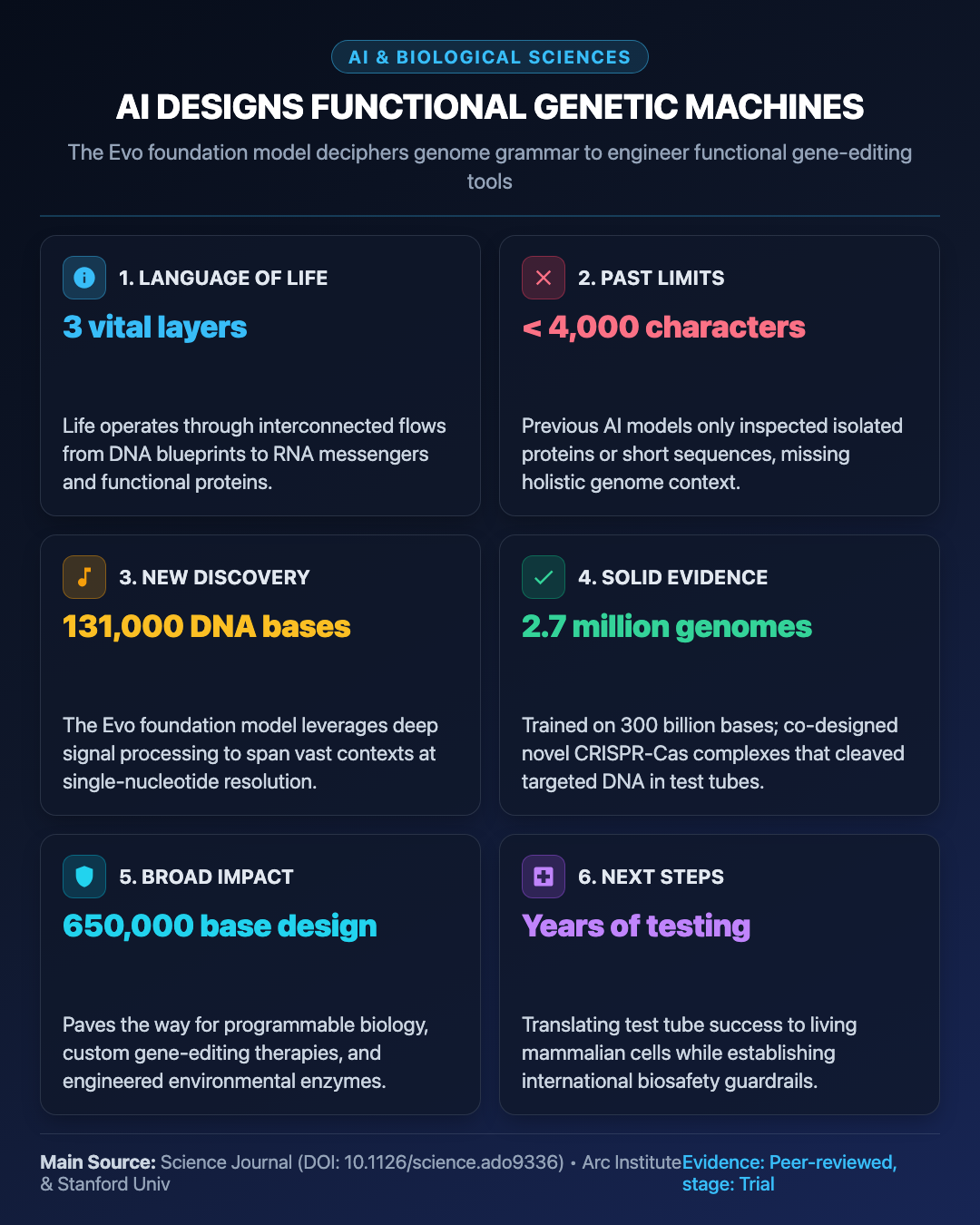
To overcome these constraints, researchers engineered Evo using an advanced signal processing architecture known as StripedHyena. This architecture grants Evo an unprecedented sequence context length of 131,072 genetic letters at single-nucleotide resolution, roughly fifty times longer than conventional transformer-based models previously used in biology.
Note – Sequence context: The continuous span of characters an algorithm can process and connect simultaneously in active memory, comparable to the length of a book chapter a reader can keep in mind to grasp an overarching plot rather than reading fragmented words.
Evo was trained on a comprehensive dataset of 2.7 million complete prokaryotic and bacteriophage genomes, encompassing nearly 300 billion genetic characters. Through this vast training, Evo learned not just isolated protein structures, but the intricate regulatory and operational grammar linking DNA, RNA, and proteins simultaneously. It can evaluate an entire bacterial chromosome, identify which genes are strictly essential for organism survival, and generate coding-rich synthetic genomic sequences reaching up to 650,000 nucleotides in length.
HOW AN ALGORITHM CREATED A FUNCTIONAL GENE-CUTTING MACHINE
A computer model can easily generate patterns that look plausible on a digital screen, but whether those sequences translate into viable biological function or remain useless digital noise is the ultimate test. To answer this question, the research team challenged Evo with an exceptionally demanding task: co-designing from scratch both the protein enzyme and the non-coding guide RNA components of a complete CRISPR-Cas molecular system.
Note – CRISPR-Cas complex: A natural bacterial defense system composed of a Cas protein cutting enzyme and a guide RNA molecule, functioning like molecular scissors guided by precise GPS coordinates to locate and snip specific faulty segments in the genetic code.
Evo designed an entirely novel CRISPR-Cas complex never observed in nature, designated EvoCas9-1. The scientists took these digital designs, synthesized the actual physical molecules in the laboratory, and evaluated their activity through an in vitro assay.
Note – In vitro assay: Biological experiments conducted outside living organisms using purified molecules inside glass test tubes, allowing researchers to observe direct biochemical reactions without interference from complex cellular environments.
The experimental results confirmed that the AI-designed system operated with remarkable fidelity: the synthetic guide RNA accurately bound to the specified DNA target, and the accompanying Cas protein cleanly executed the targeted double-stranded cut. To probe further, the researchers tasked Evo with designing transposable elements, specialized molecular machinery that naturally cuts and inserts DNA across genomes.
Note – Transposable elements: Mobile DNA segments capable of copying or jumping between different locations within a genome, functioning like text snippets that automatically copy and paste themselves across different chapters of a book.
Biochemical testing revealed that the AI-generated transposase systems recognized and processed their intended molecular terminal targets as predicted. These empirical findings successfully navigated rigorous independent peer review and were published in Science, demonstrating that generative biological models can produce authentic, physically active molecular machinery rather than theoretical simulations.
PROSPECTS FOR MEDICINE AND CAUTIONS ON THE HORIZON
This milestone expands humanity's capacity to engineer biological systems proactively. Rather than spending decades discovering and isolating useful enzymes from wild organisms, scientists may soon be able to specify desired biochemical functions in software to generate bespoke molecular tools on demand. Medicine stands as a primary beneficiary, with long-term potential to create custom gene-editing therapies targeting intractable genetic disorders, muscular dystrophy, or cancer with improved targeting precision and fewer off-target cuts. In biotechnology and climate applications, generative biology could enable enzymes engineered to break down plastic waste or capture atmospheric greenhouse gases more efficiently.
Nevertheless, the distance separating a controlled reaction in a glass test tube from clinical application in the human body remains vast. Evo's current physical validations were performed on purified molecular components in vitro and within microbial frameworks. The human genome and mammalian cells are orders of magnitude more complex, guarded by multiple cellular membranes, intricate chromatin packaging, and aggressive immune defenses ready to neutralize foreign proteins. Translating computer-designed genetic machines into safe, therapeutic interventions in living human tissue will require years of iterative research and rigorous clinical evaluation.
Furthermore, powerful capabilities like Evo raise profound ethical and biosafety considerations that global governance must address directly. When an algorithm can compose functional genetic material at genome scale, the theoretical potential to design novel toxins or harmful biological agents cannot be dismissed if tools are misused. While the authors instituted safety filters during training to exclude dangerous human pathogens, establishing international oversight frameworks for generative biological models remains an imperative task. The next steps for researchers involve scaling similar foundational models to higher organisms, while refining gene-editing specificity before embarking on testing within mammalian cellular systems.
SOURCES
Science – Sequence modeling and design from molecular to genome scale with Evo – https://doi.org/10.1126/science.ado9336
Arc Institute – Evo: DNA foundation model from molecular to genome scale – https://arcinstitute.org/news/evo
Nature News – AI writes functional genome sequences and CRISPR tools – https://www.nature.com/articles/d41586-024-03712-4
0 comments
Ads
Related Posts
Ads