Ads
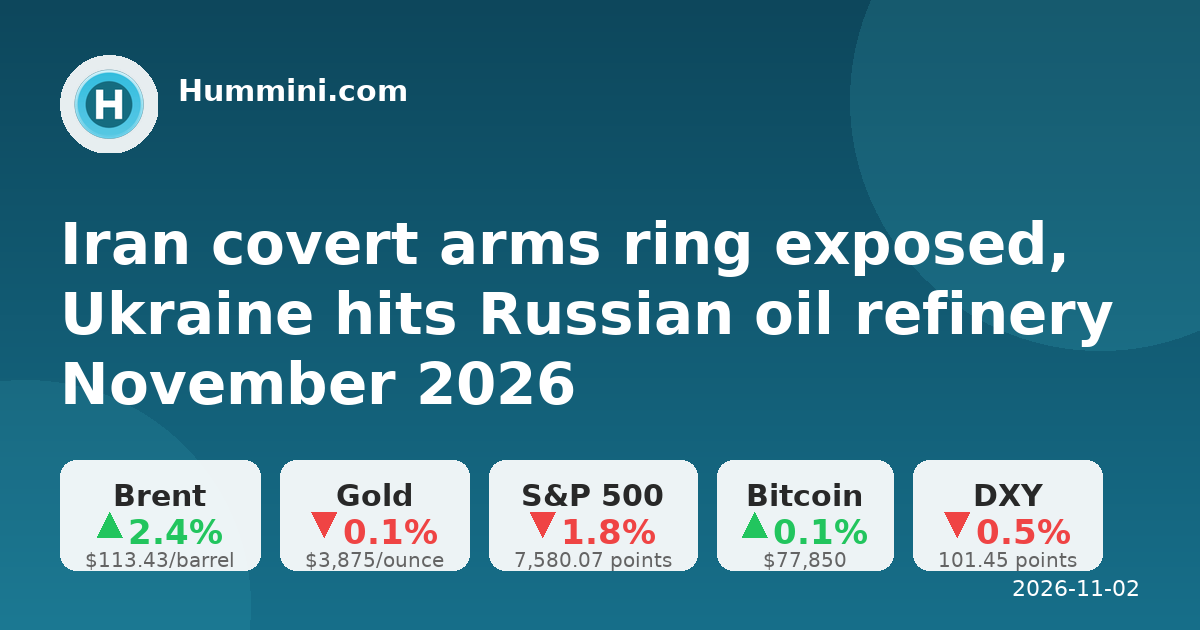
Iran covert arms ring exposed, Ukraine hits Russian oil refinery November 2026
khoảng 1 giờ trước
00WORLD TEMPERATURE
3.8/5. Global tensions mount as Iran's covert arms ring is exposed while critical Russian energy infrastructure comes under renewed fire.
BRIEFING
Updated from 19:08 on November 1 to 05:00 on November 2, 2026 (Hanoi time), covering only new events and fresh developments.
1. A Reuters investigation reveals a covert network of over 5,000 front companies funneling more than $2 billion in military hardware to Iran's defense ministry.
2. Ukrainian long-range drones strike Lukoil's NORSI refinery in Kstovo, damaging Russia's fourth-largest oil processing plant 800 kilometers from the border.
3. Seven key OPEC+ producers agree to freeze December crude output targets at September levels to steady markets amid Gulf shipping threats.
4. Acting President Iliana Yotova wins Bulgaria's presidential runoff with over 50% of the vote, becoming the nation's first elected female head of state.
5. Russia's FSB detains a teenager plotting a mass shooting at a Moscow park following an urgent intelligence tip from the United States.
6. The European Union enforces a new €2 handling fee per product category on small cross-border parcels, directly targeting low-cost Chinese platforms like Temu and AliExpress.
7. Thousands gather at Novi Sad station to honor 16 victims of a fatal roof collapse following a historic student-led electoral victory over Aleksandar Vučić's party.
8. Cyclonic Storm Murasu intensifies over the Bay of Bengal with gusts up to 120 km/h, heading for a projected landfall along India's Andhra Pradesh coast.
1. REUTERS EXPOSES 5,000 FRONT FIRMS FUNNELING $2 BILLION IN ARMS TO IRAN
A Reuters investigation published on November 1 revealed that Iran operated a covert network of more than 5,000 front entities to purchase over $2 billion in weapons, missile components, and propellants since early 2025. The illicit network enabled Tehran to circumvent Western sanctions and an ongoing U.S. naval blockade.
All 5,000 entities share the same registered address in Tehran and bear the MOD prefix representing Iran's Ministry of Defense and Armed Forces Logistics. A single numbered entity, MOD 346428, processed approximately $2.3 billion in defense-related goods, including heavy multi-axle trucks adaptable as mobile missile launchers and solid rocket propellants. To evade conventional banking scrutiny, 97% of transactions were settled without currency transfers, financed by shadow oil revenues held in offshore accounts. Communications and financial records directly connect the front companies to state-owned Bank Sepah and senior missile commanders within the Islamic Revolutionary Guard Corps.
Tehran accelerated the shadow procurement drive following missile exchanges with Israel. Prior to the report, none of the 5,000 numbered entities had been placed on Western sanctions blacklists.
Strategic significance: Western enforcement authorities face a major regulatory blind spot as traditional corporate screening proved powerless against state-directed shell entities operating at unprecedented scale. Uncovering these supply conduits is likely to trigger secondary sanctions from Washington and Brussels against regional maritime intermediaries and overseas financial networks across the Middle East and Asia. However, as long as illicit crude revenues continue circulating through off-ledger accounts, Iranian authorities can easily register replacement front companies with fresh serial numbers to maintain weapons flows.
2. UKRAINIAN DRONES STRIKE RUSSIA'S FOURTH-LARGEST OIL REFINERY IN KSTOVO
Ukrainian long-range drones struck Lukoil's NORSI oil refinery in Kstovo on November 1, causing significant damage to Russia's fourth-largest oil processing facility, according to Nizhny Novgorod Governor Gleb Nikitin.
Footage from the scene showed flames rising from distillation units and the adjacent Novogorkovskaya combined heat and power plant. Located 800 kilometers from the Ukrainian border, NORSI processes 15 to 17 million metric tons of crude oil annually and supplies critical fuel volumes to the Moscow metropolitan region. The explosions triggered local panic buying, with queues of 30 to 40 cars forming at nearby petrol stations. Russian officials claimed over 100 drones were intercepted across the region with no casualties, while Ukrainian defense firm Fire Point claimed responsibility for the strike.
The attack comes days after Ukrainian drones hit the Novokuybyshevsk refinery, formally ending an informal pause on targeting Russian energy infrastructure requested by Washington ahead of the U.S. midterm elections.
Strategic significance: Kyiv's military leadership signals a willingness to take high political risks with Western partners to deal severe blows to the Kremlin's economic engine. Targeting critical refining capacity right before the winter heating season forces the Russian military to redeploy frontline air defenses like Pantsir and S-400 systems to safeguard deep rear facilities. Should gasoline shortages spread to Moscow, domestic political pressure on the Russian leadership will spike, raising the likelihood of severe retaliatory strikes against Ukraine's civil power grid.
3. OPEC+ FREEZES DECEMBER CRUDE OUTPUT TARGETS AMID STRAIT TENSIONS
Seven core members of the OPEC+ alliance agreed on November 1 to maintain December crude oil production targets unchanged at September 2026 levels, according to an OPEC Secretariat statement.
The consensus was reached during an online ministerial session between Saudi Arabia, Russia, Iraq, Kuwait, Algeria, Kazakhstan, and Oman. This marks the third straight month that the petroleum cartel has kept output levels frozen, keeping voluntary reductions of roughly 2 million barrels per day in place through year-end. OPEC+ leaders opted for caution as commercial tankers traversing the Strait of Hormuz face persistent missile and drone threats. While regional export flows have partially recovered, several member nations continue pumping below their official allocations due to domestic operational hurdles.
The decision comes as global crude markets remain caught between Middle East conflict fears and projections of a potential crude surplus in early 2027.
Strategic significance: The oil alliance is deliberately holding its ground to keep prices anchored around $113 per barrel, protecting fiscal revenues against unpredictable outcomes in upcoming U.S. elections. Postponing policy adjustments turns the full 21-member ministerial summit scheduled for November 29 into a high-stakes showdown. If member states fail to agree on updated 2027 production baselines while disrupted crude volumes return to the market, internal quota disputes could trigger a renewed price war.
4. ILIANA YOTOVA WINS RUNOFF TO BECOME BULGARIA'S FIRST FEMALE PRESIDENT
Preliminary vote counts on the night of November 1 confirmed that acting President Iliana Yotova secured a decisive victory in Bulgaria's presidential runoff, becoming the first democratically elected female head of state in the country's history, according to public broadcaster BNT.
Backed by the Socialist-led left and Prime Minister Rumen Radev, Yotova captured between 50.7% and 58.2% of the vote across independent parallel tallies. Pro-Western reformist candidate Andrey Gyurov finished second with roughly 38.6% to 44% and conceded defeat on election night. The vote concluded a tense campaign conducted under tight security following recent drone strikes on commercial shipping in the Black Sea.
Strategic significance: Yotova's victory strengthens Sofia's neutralist, Moscow-accommodating factions that advocate maintaining diplomatic channels with the Kremlin while opposing direct military arms shipments to Ukraine. This outcome creates institutional friction for the European Union and NATO as they strive to preserve a unified defense front across southeastern Europe. However, should the new presidency challenge broader Brussels economic accords, Bulgaria risks diplomatic isolation and renewed domestic cabinet instability.
5. RUSSIA ARRESTS SUSPECTED ATTACKER AT MOSCOW PARK AFTER US TIP
Russia's Federal Security Service announced on November 1 that it detained a teenager plotting a mass-casualty attack at the Tsaritsyno Museum Reserve in southern Moscow following an actionable counter-terrorism tip provided by the United States, according to the TASS news agency.
The U.S. Embassy in Moscow had issued an emergency security notice a day earlier warning of a credible threat against the Tsaritsyno park complex while coordinating intelligence with Russian security agencies. FSB operatives subsequently identified and apprehended the suspect, a Russian juvenile. Investigators revealed that the suspect had posted videos on TikTok wearing tactical gear and a balaclava while brandishing an imitation automatic rifle alongside a caption stating he had found a location at Tsaritsyno. A search of his residence uncovered airsoft weapons and tactical gear, alongside evidence that he frequented neo-Nazi Telegram channels and researched past mass shootings. The FSB issued an official statement expressing gratitude to American partners for the timely intelligence.
The arrest occurred against a backdrop of elevated domestic security alerts across Moscow public venues following the deadly Crocus City Hall concert hall attack earlier in 2024.
Strategic significance: The quiet coordination between Washington and Moscow proves that back-channel counter-terrorism lines remain functional even as bilateral diplomatic ties sit at historical lows over the Ukraine war. Providing actionable warnings allows the United States to uphold its international duty-to-warn doctrine while achieving a rare humanitarian save. Nonetheless, an isolated intelligence tip is unlikely to bridge the deep institutional mistrust dividing the Kremlin and Western intelligence agencies.
6. EU IMPOSES TWO-EURO HANDLING LEVY ON SMALL CROSS-BORDER PACKAGES
The European Union officially enacted a mandatory €2 handling fee per customs declaration category on e-commerce packages shipped directly to consumers from outside the bloc beginning November 1, according to the European Commission.
The new regulation applies to all cross-border parcels regardless of their declared retail value. Crucially, the €2 fee is levied on each distinct product category listed on a customs declaration rather than per individual parcel. A single package containing three separate product types, such as a phone case, a cotton shirt, and an electronic charging cable, incurs an aggregate handling fee of €6. This administrative charge stacks directly on top of the €3 customs duty per product category introduced in July when the EU abolished the duty-free exemption for parcels under €150. Brussels explained that the surcharge is necessary to cover ballooning inspection and customs processing costs driven by billions of low-cost parcels entering Europe annually, over 90% of which originate from Chinese retailers.
The regulatory measure lands immediately ahead of the peak year-end holiday shopping rush, directly squeezing commercial models popularized by Chinese platforms like Temu, AliExpress, and Shein.
Strategic significance: The handling fee serves as targeted economic leverage designed to erase the price edge enjoyed by direct-to-consumer Chinese marketplaces, safeguarding domestic European retailers burdened with local value-added taxes and environmental compliance. With baseline levies exceeding €5 per product type prior to standard VAT, low-ticket multipack ordering becomes far less economically appealing for European households. To preserve market share, Chinese cross-border e-commerce giants will likely accelerate investments in European warehouse networks, transforming a tariff barrier into a race for localized fulfillment infrastructure.
7. THOUSANDS MARK NOVI SAD DISASTER IN SERBIA AFTER HISTORIC ELECTION SHIFT
Thousands of Serbian citizens and university students gathered under steady rain at the Novi Sad railway station on November 1 to mark the second anniversary of a canopy collapse that claimed 16 lives, according to the Associated Press.
Attendees observed a moment of silence, laid 16 wreaths and red wooden hearts bearing the names of the victims, and lit white candles near the site of the fatal failure. In contrast to prior anniversaries marked by violent police confrontations, the gathering remained peaceful, characterized by mourning and heightened expectations for legal accountability. The November 1, 2024 station collapse ignited two years of persistent student-led anti-corruption rallies across Serbian cities. That civic pressure eventually triggered snap parliamentary elections last week, where a student-led opposition coalition scored a historic triumph, unseating the governing bloc of President Aleksandar Vučić after more than 14 years in power.
The Novi Sad canopy collapse, which occurred shortly after a railway modernization contract executed by foreign consortiums, had become a national symbol of state corruption and neglected public infrastructure oversight.
Strategic significance: The memorial underscores a pivotal transition for Serbia's civic movement, shifting from street demonstrations to assuming the responsibilities of constitutional governance. The newly elected coalition faces intense popular pressure to prosecute former infrastructure officials without paralyzing the broader civil administration. The greatest challenge for Belgrade's incoming leadership lies in fulfilling anti-corruption mandates while balancing fragile diplomatic ties between the European Union and Moscow amid intense domestic polarization.
8. CYCLONE MURASU INTENSIFIES OVER BAY OF BENGAL HEADING FOR SOUTHERN INDIA
The India Meteorological Department issued red alerts on November 1 as a deep depression in the Bay of Bengal intensified into Cyclonic Storm Murasu, advancing rapidly toward the coast of Andhra Pradesh, according to The Hindu.
Cyclone Murasu is tracking west-northwest over the southwestern Bay of Bengal, packing sustained winds of 100 to 110 km/h with gusts reaching 120 km/h as it approaches the shoreline. Forecasters project landfall between the coastal towns of Nellore and Narsapur between late night on November 2 and the morning of November 3. The government of Andhra Pradesh mobilized rescue battalions from the National Disaster Response Force and initiated evacuations across low-lying coastal villages. Heavy downpours are also forecast across neighboring Tamil Nadu, prompting municipal authorities in Chennai and Tiruvallur to order school closures starting November 2 to prevent flood-related disruptions.
India's eastern seaboard regularly experiences severe storms during the post-monsoon transition months of October and November, but increasing cyclonic intensity in recent years continues to strain municipal drainage systems.
NEXT 48–72 HOURS
American voters head to the polls on November 3 for Election Day to decide control of the House of Representatives and a third of the Senate following historic early voting turnout.
Cyclone Murasu is forecast to make landfall along the Andhra Pradesh coast of India between the late night of November 2 and the morning of November 3, bringing 120 km/h wind gusts and severe flooding.
Bulgaria's Central Election Commission will publish final certified results for the presidential runoff confirming the election of Iliana Yotova.
The Swedish Riksdag holds a confirmation vote on prime ministerial nominee Elisabeth Thand Ringqvist on November 3 to resolve the ongoing government stalemate.
SOURCES
Reuters – Exclusive: Iran's secret military procurement network – https://www.reuters.com
Kyiv Post – Ukrainian drones hit major Russian refinery NORSI in Kstovo – https://www.kyivpost.com
OPEC – OPEC Secretariat statement on 2026 voluntary production adjustments – https://www.opec.org
Bulgarian National Radio – Acting President Iliana Yotova wins presidential runoff – https://bnrnews.bg
TASS – Russian FSB thwarts mass attack in Moscow park with US help – https://tass.com
European Commission – New handling fees on non-EU e-commerce parcels take effect – https://ec.europa.eu
Associated Press – Thousands commemorate Novi Sad station victims in Serbia – https://apnews.com
The Hindu – Cyclonic storm Murasu over Bay of Bengal heading for Andhra coast – https://www.thehindu.com
0 comments
Ads
Related Posts
Ads