Ads
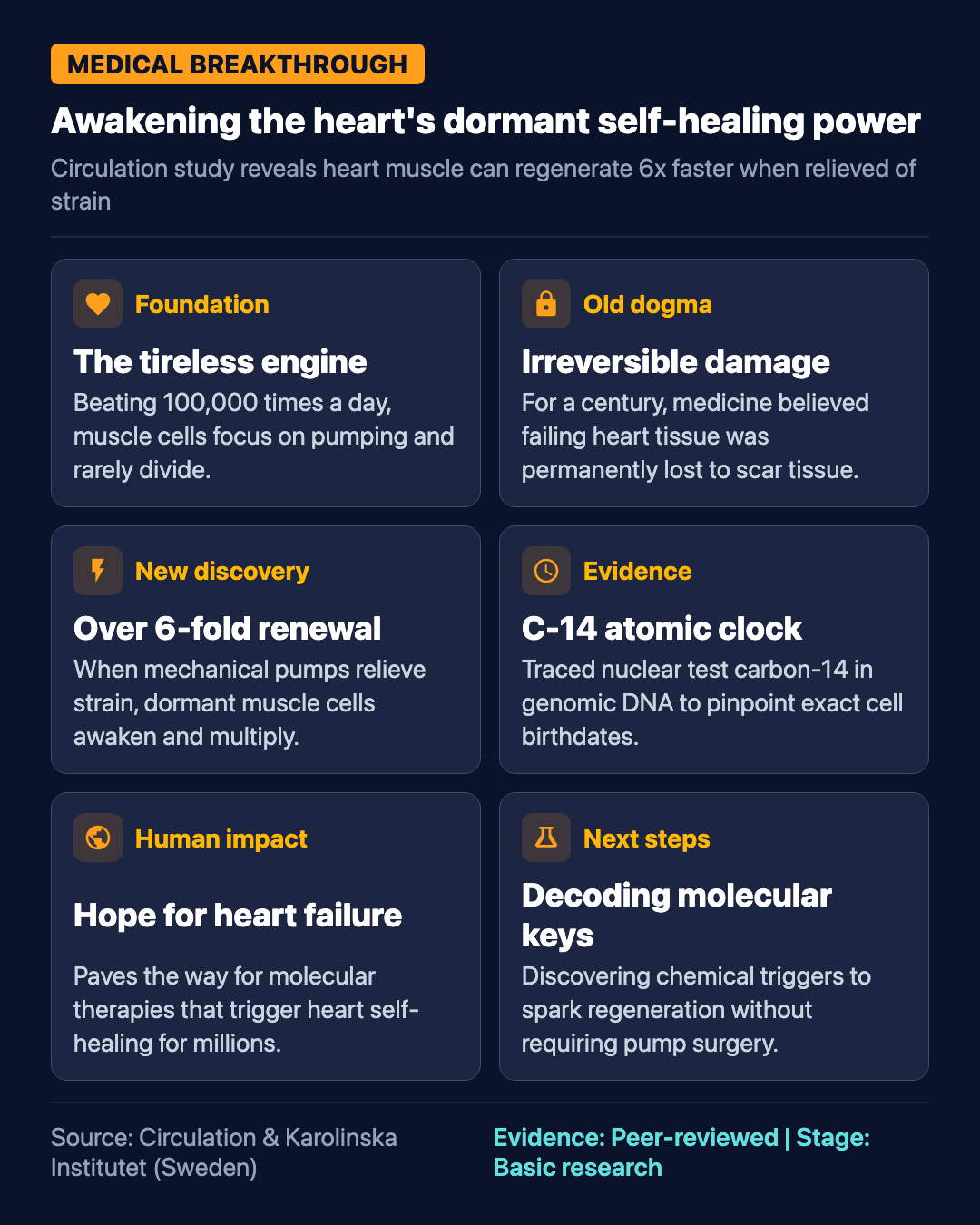
Awakening the hidden self-healing power dormant inside the human heart
1 ngày trước
00When you accidentally scrape your finger, fresh skin swiftly seals the cut within days. A cracked bone stitches itself back together over a few weeks thanks to cells that rapidly divide and multiply. Yet for more than a century, mainstream medicine held that the human heart follows an unforgiving rule: once heart muscle cells are damaged or lost to disease, they are gone forever, replaced only by stiff and unyielding scar tissue.
In late 2024, an international research team led by the Karolinska Institutet in Sweden, in collaboration with Technische Universitat Dresden and the University of Utah, published a landmark study in the journal Circulation, an official publication of the American Heart Association. Their empirical evidence demonstrated that the human heart does not permanently lose its self-repair capability. Even when pushed into end-stage failure, the heart preserves an extraordinary regenerative capacity and can generate fresh muscle cells at an accelerated rate when relieved of mechanical strain.
WHAT HAS BEEN THE CENTURY-OLD MYSTERY
Picture the human heart as a fist-sized water pump working continuously twenty-four hours a day without a single second of rest. Every single day, this muscular engine beats roughly 100,000 times, translating to nearly 37 million beats a year, and pumps over 7,500 liters of blood across thousands of kilometers of blood vessels. To sustain such an exhausting workload, heart muscle cells made an evolutionary compromise early in childhood: they devoted all their resources to mechanical contraction, virtually abandoning their ability to divide.
Note – Cardiomyocytes: Specialized living muscle cells that contract rhythmically to pump blood throughout the body, working like ultra-durable pistons in an engine that never shuts off.
In a healthy adult, the turnover of heart muscle cells proceeds at a barely noticeable pace, renewing less than 1% each year. This means that across a normal human lifetime, fewer than half of our heart muscle cells are ever replaced. When severe cardiovascular illness strikes, the surviving muscle cells are forced to work double-time to compensate for weakened tissue. Trapped under crushing workload, their already modest renewal rate drops toward zero, making heart failure one of the leading causes of death worldwide.
Note – Heart failure: A medical condition where the heart weakens or stretches until it cannot pump effectively, similar to an overburdened, leaking household water pump that lacks pressure to push water to upper floors.
WHAT HAS SHIFTED IN OUR UNDERSTANDING
For decades, the prevailing dogma assumed that failing heart muscle was a burnt-out engine with permanently destroyed regenerative machinery. It was believed that once heart failure reached its late stages, the biological window for renewal was shut tight forever. However, the findings from the Karolinska Institutet team uncovered an entirely different reality: the regenerative program is not lost, but rather suffocated beneath relentless mechanical strain.
Note – Left Ventricular Assist Device: A miniature mechanical pump implanted in the chest to draw blood directly from the left ventricle and deliver it to the aorta, acting like an auxiliary booster engine that shares the pulling load when the main locomotive is strained.
Note – Mechanical unloading: The process of relieving heavy physical pressure from heart muscle using mechanical pumps or medical interventions, much like lifting a crushing backpack off an exhausted hiker so they can catch their breath and recover.
When patients with advanced heart failure received an implanted Left Ventricular Assist Device to shoulder the pumping burden, their heart muscle was finally granted a true physical rest. Under mechanical unloading, wall stress across the heart muscle fibers dropped dramatically. In patients who responded with improved cardiac function, dormant heart muscle cells suddenly woke up. Data revealed that cardiomyocyte generation rates in these recovering hearts surged to more than six times that of a completely healthy adult heart, and dozens of times higher than in patients with unsupported failing hearts.
HOW DID SCIENTISTS UNCOVER THE TRUTH
Measuring the division of microscopic cells occurring deep within a living human chest is impossible with conventional microscopes. This peer-reviewed study examined heart tissue samples collected from patients undergoing heart transplantation or pump explantation, pairing them with an atomic clock rooted in Cold War history.
Note – Radiocarbon dating: A method of determining cell age based on the concentration of carbon-14 incorporated into genomic DNA from historical atmospheric nuclear tests, functioning like a natural timestamp that marks the exact year a cell was born.
Between 1955 and 1963, atmospheric nuclear weapon tests doubled global levels of the radioactive isotope carbon-14. Following the test ban treaties, atmospheric carbon-14 concentrations declined predictably over the decades as oceans and biosphere absorbed the excess. Whenever a heart cell divides and synthesizes a new genome, it locks the ambient atmospheric carbon-14 signature of that moment into its DNA. By isolating cardiomyocyte nuclei and measuring their isotopic ratios using accelerator mass spectrometry, the researchers pinpointed the birthdate of individual cells, much like reading the growth rings of an ancient tree. Mathematical turnover models integrating these isotopic timestamps provided definitive proof of an unprecedented burst of heart muscle regeneration.
WHAT DOES THIS MEAN FOR HUMANITY
This discovery is profoundly significant because it demonstrates that the human heart harbors a dormant regenerative capacity preserved across adulthood, rather than being permanently devoid of repair. This opens an exciting frontier for cardiology and regenerative medicine. Tens of millions of people living with chronic heart failure worldwide gain a new perspective of hope, moving beyond the stark dichotomy of scarce organ donor waitlists or permanent mechanical pumps.
Note – Latent regenerative potential: An inherent capacity for self-repair and cell division coded into genetics that remains dormant under extreme stress, like a dormant seed resting in dry soil waiting for rainwater to sprout.
Nevertheless, translating this laboratory insight into bedside medical treatments remains many years away and is currently at an early basic research stage. A mechanical assist pump is an invasive device that carries severe risks including bleeding, thrombosis, and systemic infections, meaning surgical pump placement cannot serve as a broad regenerative therapy. It must be emphasized that this is a basic scientific study and does not constitute clinical treatment advice. Furthermore, this rapid cell renewal was observed specifically in patients who responded positively to mechanical unloading, and scientists do not yet understand why others fail to show a similar recovery.
The next challenge for researchers is to identify the precise biochemical pathways and mechanosensitive receptors that connect physical resting to cell cycle reactivation. If scientists can design small-molecule drugs that mimic the molecular effects of mechanical unloading without requiring open-heart surgery, humanity may one day possess pharmaceutical therapies capable of prompting the heart to heal itself from within.
SOURCES
Circulation (American Heart Association) – A Latent Cardiomyocyte Regeneration Potential in Human Heart Disease – https://doi.org/10.1161/CIRCULATIONAHA.123.067156
Karolinska Institutet – Human heart has latent ability to regenerate – https://ki.se
ScienceDaily – Human heart has latent ability to regenerate – https://www.sciencedaily.com/releases/2024/11/241105121400.htm
0 comments
Ads
Related Posts
Ads