Ads
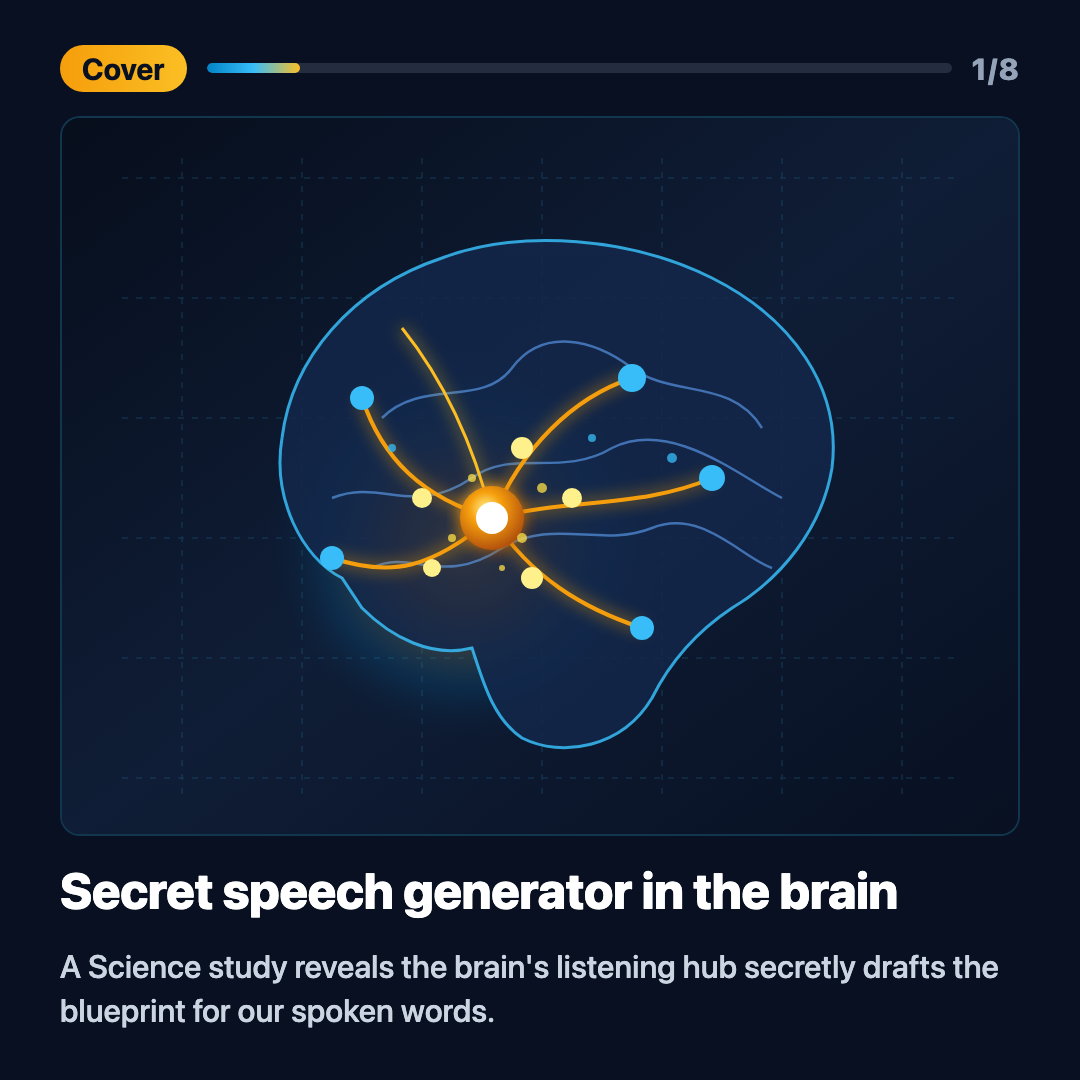
Brain region long thought to only listen secretly drafts our words
1 ngày trước
00When you run into an old friend on the street and get ready to say hello, what actually happens inside your head before your lips begin to move? For more than a century, medical science believed the human brain divided this labor like a traditional radio station: one station was dedicated to listening and receiving sound, while an entirely separate station handled broadcasting. However, a landmark study published in the journal Science on November 19, 2026, by neuroscientists at the University of California, San Francisco (UCSF) led by Dr. Alexander Silva and Dr. Edward Chang, reveals that our brain's supposed listening station secretly acts as an architect drafting the master blueprint for every upcoming word.
WHAT WAS THE ORIGINAL PROBLEM?
Back in 1874, German neurologist Carl Wernicke identified a region in the left temporal lobe specialized in comprehending auditory language. The classic textbook model taught across medical schools held that Wernicke's area acted as a passive microphone, receiving and decoding the meaning of heard words before routing those signals across a neural highway to Broca's area in the frontal lobe. Broca's area was believed to be the sole master controller directing the vocal cords, tongue, and lips to articulate speech.
Note – Wernicke's area: A specialized region in the temporal lobe that acts like a microphone and interpreter, decoding heard sounds into meaningful concepts.
Note – Broca's area: A frontal lobe brain region responsible for directing the vocal cords, tongue, and lips to physically articulate words.
Yet this two-station division left a perplexing clinical paradox unsolved for a century and a half. When stroke or physical trauma damaged Wernicke's area, patients did not simply lose the ability to understand others. Mysteriously, their own spontaneous speech became severely disordered. They could still vocalize fluently, but their sentences dissolved into fragmented, nonsensical strings of words, a condition known as receptive aphasia. If this area were merely a passive listening post, why would a person's own expressive speech break down so profoundly?
WHAT CHANGED COMPARED TO PREVIOUS UNDERSTANDING?
The new study resolves this long-standing puzzle by demonstrating that Wernicke's area does not wait idly for incoming sound. Within this cortex lies a specialized subregion called the left posterior superior temporal gyrus. Researchers discovered that this specific zone lights up with intense neural electrical activity roughly two hundred and fifty milliseconds before a speaker utters the very first sound.
Note – Left posterior superior temporal gyrus: A discrete subzone within Wernicke's area on the left hemisphere that acts like an architect's desk, drafting the structural blueprint of words before articulation.
Two hundred and fifty milliseconds is a quarter of a second, faster than an ordinary blink of an eye. During this fleeting window, the brain actively constructs an abstract linguistic blueprint of the upcoming word, determining its length, syllable structure, and familiarity within the mental lexicon. The listening hub, it turns out, lays the structural foundation of the linguistic house before handing the blueprints over to the construction crew in the frontal lobe to execute vocal movements.
HOW DID SCIENTISTS DISCOVER THIS?
To observe neural behavior with millisecond precision, the research team at UC San Francisco collaborated with clinical volunteers undergoing intracranial monitoring for surgical epilepsy management. Neurosurgeons placed flexible grids containing hundreds of micro-electrodes directly onto the exposed cortical surface of the brain, a high-resolution recording technique known as electrocorticography.
Note – Electrocorticography: A clinical technique placing micro-electrode grids directly onto the exposed cerebral cortex to record electrical impulses with millisecond precision without skull interference.
As patients performed tasks such as reading words or naming objects displayed on a screen, the electrode array captured precise neural impulses. The data revealed that electrical bursts in the left posterior superior temporal gyrus did not track auditory feedback from the ears, nor did they mirror the physical movements of the mouth. Instead, the activity encoded abstract linguistic properties of whole intended words. To confirm that this region is causally required for speech, the researchers applied brief, gentle electrical pulses to temporarily disrupt the subzone. Immediately, participants paused or substituted incorrect words, confirming that this anatomical hub is indispensable for speaking.
WHAT DOES THIS MEAN FOR HUMANITY?
This discovery expands our fundamental understanding of how the human brain generates language and settles a hundred-and-fifty-year-old debate regarding post-stroke aphasia. Recognizing that word blueprints originate in the temporal cortex prior to reaching motor speech centers provides clinicians with a much clearer understanding of why speech output disintegrates after focal brain injuries.
Note – Brain-computer interface: A direct communication technology that decodes neural electrical impulses and translates them into synthesized speech or text on a screen.
In biomedical engineering, the findings offer substantial promise for advancing brain-computer interfaces aimed at restoring communication to individuals with paralysis or severe motor neuron diseases like amyotrophic lateral sclerosis. Until now, most speech neuroprostheses have attempted to decode signals from motor cortex areas controlling the mouth and vocal tract. By tapping into the earlier blueprint stage in the temporal lobe, future assistive devices could synthesize natural speech much more rapidly and fluidly.
Nevertheless, moving from laboratory discovery to everyday assistive devices remains a multi-year journey. The research was conducted in a specialized clinical cohort of surgical patients, requiring broader independent replication across diverse populations. Developing safe, miniaturized wireless implants that can monitor neural signals without causing tissue irritation also remains a major engineering hurdle. Furthermore, accessing abstract linguistic blueprints at an early stage introduces essential ethical considerations regarding cognitive privacy and personal mental autonomy. Looking ahead, scientists plan to refine machine learning decoders to reliably distinguish intended public speech from fleeting internal thoughts.
SOURCES
Science – A neural code for generative speech production in human Wernicke's area – https://doi.org/10.1126/science.aef8963
University of California San Francisco – Brain's listening hub drafts words before we speak – https://www.ucsf.edu/news/2026/11/wernicke-speech-code
Neuroscience News – Decoding the Brain's Speech Blueprint in Wernicke's Area – https://neurosciencenews.com/wernickes-area-speech-26119/
0 comments
Ads
Related Posts
Ads