Ads
Printing molecular movable types enables mass digital data storage on DNA
khoảng 2 giờ trước
00THE DATA VAULT OF THE FUTURE
Imagine the entire information of the global Internet, from billions of videos and books to humanity's vast photographic archives, shrinking neatly into a container the size of a pea. This seemingly science-fiction concept took a major step toward practical reality. An international research team led by Peking University alongside Arizona State University published an entirely new data storage method on the genetic double helix in the journal Nature on October 23, 2024.
Instead of laboriously and expensively synthesizing custom gene fragments from scratch, the team engineered a molecular printing press. Borrowing principles from ancient movable-type printing, this platform stamps digital data bits onto existing molecular strands, opening up super-dense data preservation at drastically lower costs.
Note – DNA molecule: The double-stranded biological chain that carries living instructions inside cells, comparable to a microscopic rope assembled from millions of durable information links.
WHAT WAS THE ORIGINAL PROBLEM
With each passing day, humanity generates mountains of digital data that are rapidly overwhelming silicon and metal data centers. Current hard drives and server farms consume astonishing quantities of electrical power, occupy massive real estate, and typically degrade after only five to ten years of continuous use. Scientists have long recognized that the carrier of genetic information is nature's ultimate hard drive.
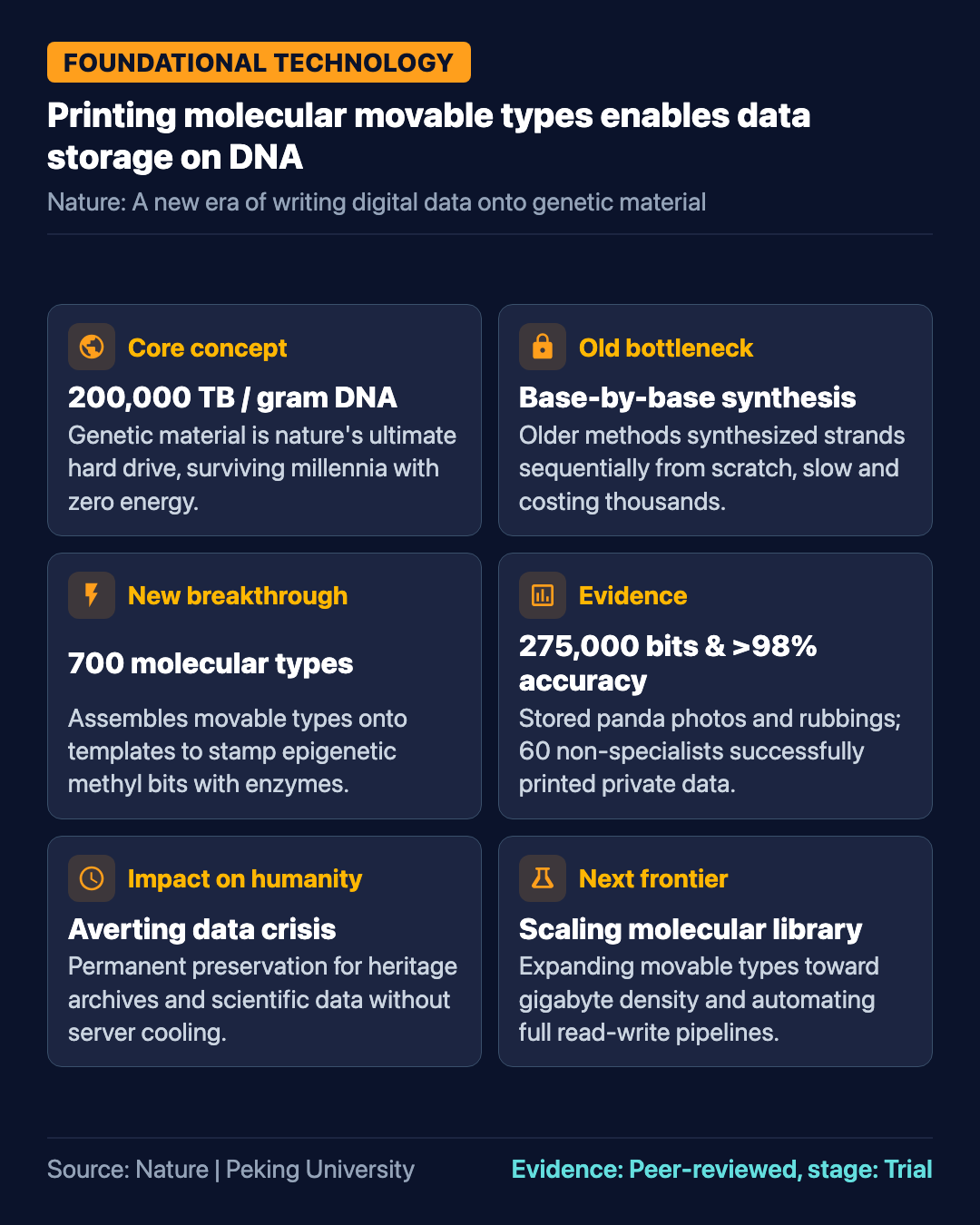
In theory, a single gram of biological genetic material can store over two hundred thousand terabytes of data, equivalent to the capacity of hundreds of thousands of modern computers combined. Furthermore, this biological thread can survive intact for thousands of years under ambient conditions without drawing a single watt of electricity. Yet, the bottleneck separating this vision from reality for decades has been de novo DNA synthesis.
Note – De novo DNA synthesis: A chemical technique that links individual microscopic building blocks in a laboratory to construct a new biological data strand from scratch, much like picking up individual grains of sand to build a sandcastle.
THE MOLECULAR PRINTING BREAKTHROUGH
Historically, writing data into genetic material forced specialists to chemically assemble each nucleotide letter sequentially. This process mirrored a medieval scribe painstakingly copying manuscripts letter by letter onto parchment. It required hazardous, highly purified chemicals, demanded days of processing for a tiny file, and drove recording costs up to thousands of dollars per megabyte.
The breakthrough paper in Nature overturned this traditional mindset. Rather than synthesizing entirely new molecular chains from zero, researchers created universal, reusable information templates. Next, they synthesized a library of seven hundred short molecular fragments acting like movable type pieces in a classical printing press.
Note – Epigenetic bits: Chemical markers stamped onto the surface of an existing data strand to represent binary information without altering the molecular backbone, similar to highlighting lines in a pre-printed book with a colored marker.
When introduced into solution, these movable type fragments exploit molecular self-assembly to attach accurately to designated positions on the larger template. A specialized enzyme then functions as an inking roller, transferring methyl groups across the molecule to record binary bits. A tagged position registers as a bit one, while an untouched position represents a bit zero.
Note – Molecular self-assembly: The natural phenomenon where microscopic structures spontaneously bind together according to physical attraction without human manual manipulation, much like magnetic toy tiles snapping into a pre-designed shape.
Note – Methyl group: A tiny molecular cluster comprising one carbon atom bonded to three hydrogen atoms, serving as a chemical ink droplet to mark data states on the surface of a molecular strand.
HOW SCIENTISTS VERIFIED THE TECHNIQUE
To validate this molecular printing framework, the researchers operated a fully automated laboratory setup. They successfully recorded approximately two hundred and seventy-five thousand bits of digital data, including a high-resolution color photograph of a giant panda measuring sixteen point eight kilobytes and an ancient Han Dynasty stone rubbing.
Each printing reaction operates in parallel, allowing up to three hundred and fifty bits of information to be stamped onto a template in a single simultaneous step. This represents an enormous leap forward compared to older approaches that moved one nucleotide letter at a time. Once printed, researchers recovered the data using nanopore sequencing.
Note – Nanopore sequencing: A data readout method that threads a molecular strand through a microscopic artificial opening and measures tiny electrical current fluctuations, akin to how a magnetic tape head reads magnetized tracks on a cassette.
Cross-verification confirmed that the readout and decoding accuracy exceeded ninety-eight percent, keeping the overall error rate below two percent. Most notably, the authors proved the technology's real-world usability. They assembled portable experimental kits and invited sixty non-specialist students with no background in biology to test the platform. Using ordinary pipettes, these volunteers successfully printed their own private text messages onto molecules without operating any expensive chemical synthesizers.
MEANING FOR HUMANITY AND NEXT STEPS
This achievement provides humanity with a transformative foundation to address the looming global data storage crisis. For the first time in history, recording data on genetic material has transitioned from the painstaking manuscript copying era into the movable-type printing press era, drastically accelerating writing speeds while eliminating large volumes of toxic chemical waste.
The primary immediate beneficiaries will be national archives, historical libraries, museums, and large scientific research institutions. These entities manage vast reserves of cultural heritage records, astronomical observations, and organismal genomes that must be preserved for centuries without degradation or massive server cooling expenses.
Nevertheless, this technology remains in an exploratory experimental trial stage and requires many years before reaching commercial scale. The current demonstration remains at hundreds of kilobits, which is still far below the gigabyte and terabyte capacities required by industrial data centers. Scientists must also improve template durability, refine automated error-correction software, and develop more portable, affordable reading devices. The team's next phase aims to expand the movable-type library to increase storage density dozens of times over and automate the complete pipeline from printing to reading.
SOURCES
Nature – Parallel molecular data storage by printing epigenetic bits on DNA – https://doi.org/10.1038/s41586-024-08040-5
Peking University – Molecular Movable-Type Printing for DNA Data Storage – https://newsen.pku.edu.cn/news_events/news/focus/14188.htm
EurekAlert – Printing epigenetic bits turns DNA into rewritable storage – https://www.eurekalert.org/news-releases/1062388
0 comments
Ads
Related Posts
Ads