Ads
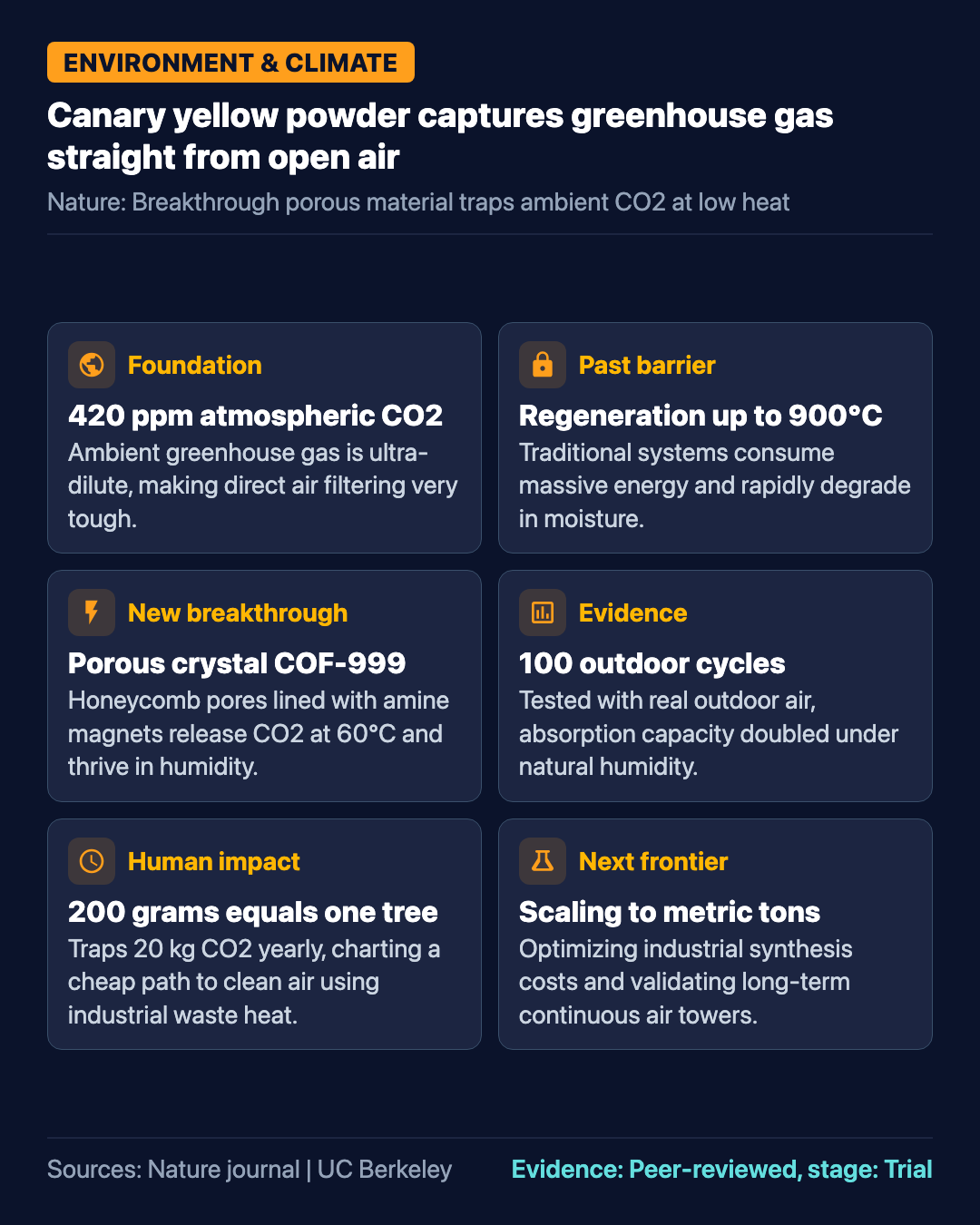
Canary yellow powder captures greenhouse gas straight from open air
khoảng 2 giờ trước
00THE HANDHELD CARBON TRAP
If you have ever rested under the generous shade of an ancient tree on a sweltering summer day, you have likely felt nature's quiet marvel. A mature tree stands for a century, silently drinking in invisible carbon dioxide day after day and exhaling clean air back to the sky. But what if a compact device the size of a small kettle, holding a pinch of canary yellow powder that fits inside your palm, could match the air-cleaning power of that majestic tree?
What sounds like science fiction just emerged from a laboratory at the University of California, Berkeley. In a landmark study published in the journal Nature in late October 2024, a team led by Professor Omar Yaghi introduced an extraordinary porous crystalline material named COF-999. The researchers demonstrated that this fine yellow powder can capture carbon dioxide directly from open ambient air with unprecedented efficiency, unlocking a promising new chapter in humanity's fight against global climate change.
WHY IS SNATCHING CO2 FROM BREEZE SO HARD?
To understand why this discovery made international headlines, we must look at the direct air capture challenge that researchers have wrestled with for decades. Carbon dioxide, or CO2, is the primary greenhouse gas driving global warming. Many industrial plants attach large scrubbers to their smokestacks to catch emissions before they billow into the sky. At the mouth of an exhaust pipe, CO2 makes up a dense 10% to 15% of the gas mixture, akin to plucking large oranges out of a concentrated fruit basket.
Note – Direct air capture: An engineering approach that pulls ambient air straight from our surroundings to filter out carbon dioxide, acting like a giant vacuum cleaner cleansing outdoor atmosphere.
Note – Greenhouse gas: Atmospheric gases that trap solar heat rather than letting it radiate into space, functioning like panes of a greenhouse that warm the planet.
Once CO2 disperses into the boundless sky, however, filtering becomes mercilessly difficult. In the free air that we breathe every day, CO2 sits at roughly 420 parts per million, which equals about 0.04% by volume. That proportion resembles hunting for exactly four black sesame seeds scattered among ten thousand white sesame seeds on a vast beach. To make matters worse, outdoor air carries moisture, dust, and competing pollutants, which rapidly poison or clog ordinary filtering materials before they can catch any CO2.
Note – Parts per million: A metric of extreme chemical dilution, abbreviated as ppm, where one part per million resembles a single drop of ink dissolved in a bathtub brimming with water.
WHAT MAKES THE YELLOW POWDER DIFFERENT?
Existing outdoor carbon-capturing systems rely on caustic liquid bases or bulky chemical filters. The primary flaw of these older technologies is their heavy appetite for energy. To force the filter to release its trapped CO2 for underground storage and reset the material for the next cycle, engineers must heat the whole system between 100 degrees Celsius and 900 degrees Celsius. In many setups, generating that scorching heat consumes so much energy that power plants end up emitting substantial amounts of greenhouse gases just to run the scrubbers.
COF-999 breaks through this long-standing bottleneck with an exquisite molecular architecture. It belongs to an advanced class of substances known as covalent organic frameworks. Imagine COF-999 as a microscopic honeycomb sponge built from strong carbon bonds that create billions of uniform hollow channels. Inside these microscopic pores, the Berkeley team grew dense carpets of basic polyamines. Carbon dioxide molecules are naturally weak acids, while polyamines are basic. As ambient wind drifts through the pores, these polyamine strands act like molecular tweezers, clamping firmly onto CO2 molecules while letting nitrogen and oxygen sail past undisturbed.
Note – Covalent organic framework: A porous crystal network built from linked organic molecules, resembling microscopic scaffolding packed with millions of uniform interior voids.
Note – Polyamines: Organic compounds containing nitrogen and hydrogen that carry slight alkalinity, serving as molecular magnets grabbing mildly acidic substances like carbon dioxide.
Most surprisingly, COF-999 loves moisture. Water vapor has long been the sworn enemy of carbon capture, clogging reactive sites and ruining synthetic sorbents. For COF-999, humidity acts as a powerful catalyst. Laboratory measurements revealed that when ambient relative humidity reaches 50%, the material's capture capacity surges from 0.96 millimoles to 2.05 millimoles of CO2 per gram, more than doubling its performance. Water molecules form delicate bridges that help the polyamine tweezers cradle and lock CO2 molecules into place with greater ease.
HOW DID SCIENTISTS PUT IT TO THE TEST?
Rather than confining their experiments to computer simulations or idealized bottled gases, the Berkeley researchers challenged COF-999 against the messy outdoor atmosphere. They packed a modest amount of the yellow powder into a slender cylindrical column and pumped raw outdoor air directly from the UC Berkeley campus through the device, carrying all the moisture, smog, and airborne particles of daily life.
Sensitive spectrometers monitoring the exhaust line showed that the breeze emerging from the yellow powder was completely scrubbed clean of CO2, leaving zero trace behind. The reaction kinetics proved equally remarkable, with the material reaching half of its maximum capacity in just 18.8 minutes of exposure to outdoor air.
Even more crucial was the material's stamina under thermal regeneration. Once saturated, COF-999 only needs gentle warming to 60 degrees Celsius to release its stored gas. That temperature feels like warm domestic bathwater, vastly milder than the boiling or kiln-like temperatures required by earlier technologies. At 60 degrees Celsius, the polyamine tweezers softly relax, releasing a stream of pure CO2 into collection vessels while keeping the honeycomb skeleton intact. The team ran this capture-and-release cycle more than 100 consecutive times using real outdoor air. Spectroscopic audits confirmed that after 100 complete rounds, the crystal framework suffered zero structural damage and retained full capture capacity without dropping a single percentage point.
Note – Thermal regeneration: The process of gently warming a capture material to release trapped molecules, similar to wringing out a saturated sponge so it is ready for another round.
THE CLIMATE EQUATION AND ROAD AHEAD
The potential impact of this breakthrough on humanity is immense. According to international climate assessments, avoiding dangerous warming requires not just slashing future emissions, but actively removing billions of tons of historical CO2 lingering in the atmosphere. The synthesis of COF-999 proves that durable outdoor atmospheric scrubbers can operate without exorbitant energy inputs. Because it releases carbon at a modest 60 degrees Celsius, future filtration hubs could run on low-grade industrial waste heat, data center exhaust cooling loops, or simple rooftop solar thermal collectors, driving operational costs down drastically.
Calculations by the research team indicate that roughly 200 grams of COF-999 powder, an amount that easily fits in a standard coffee mug, can capture about 20 kilograms of carbon dioxide each year. That matches the annual carbon uptake of a healthy, mature tree. If successfully deployed at scale, this technology would benefit communities worldwide by accelerating the transition toward a truly carbon-neutral economy.
Despite these promising early milestones, moving from laboratory glassware to global industrial deployment will require steady, deliberate steps. The discovery remains in early-stage laboratory trial at the gram scale. Scientists have yet to see how the framework behaves over thousands of cycles across several continuous years under extreme outdoor weather such as freezing blizzards, desert sandstorms, or dense urban soot. Furthermore, synthesizing covalent organic frameworks currently requires intricate chemistry and specialized starting compounds. The Berkeley group is actively investigating cheaper mass-production techniques and designing aerodynamic filtration towers to test multi-year durability before commercial rollout can be realized.
SOURCES
Nature – Carbon dioxide capture from open air using covalent organic frameworks – https://doi.org/10.1038/s41586-024-08080-x
Berkeley News – New material captures carbon dioxide directly from ambient air – https://news.berkeley.edu/2024/10/23/new-material-captures-carbon-dioxide-directly-from-ambient-air/
ScienceDaily – Capturing carbon from the air just got easier – https://www.sciencedaily.com/releases/2024/10/241023111719.htm
VnExpress Khoa học – Bột màu vàng hút CO2 từ không khí hiệu quả ngang cây xanh – https://vnexpress.net/bot-mau-vang-hut-co2-tu-khong-khi-hieu-qua-ngang-cay-xanh-4808064.html
0 comments
Ads
Related Posts
Ads