Ads
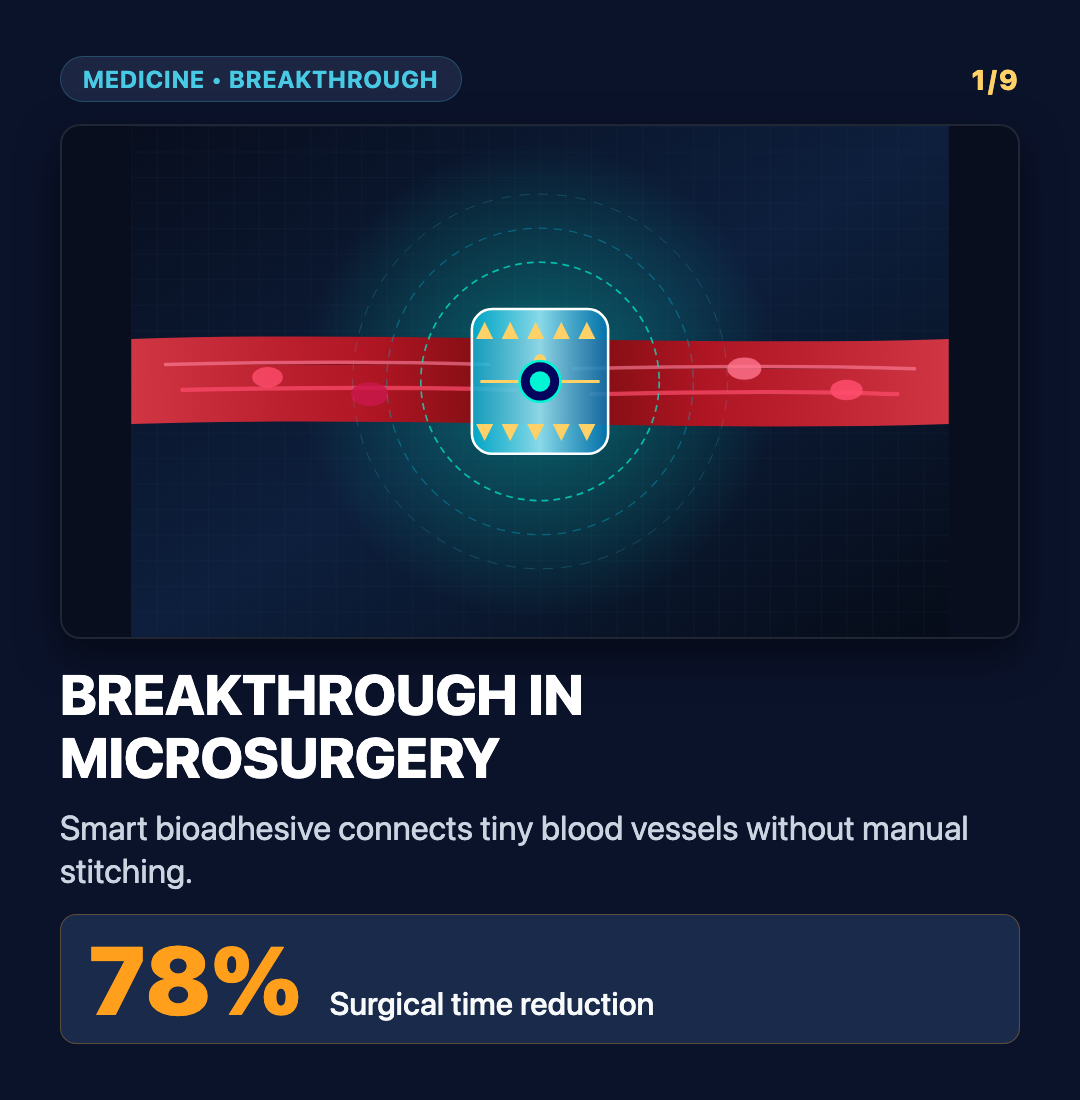
Smart bioadhesive connects tiny blood vessels without surgical stitches
2 ngày trước
00Smart bioadhesive connects tiny blood vessels without surgical stitches
Imagine having to stitch a flexible rubber tube thinner than a millimeter with thread far finer than a spider silk, all while liquid rushes through it under pressure. That is the daily ordeal faced by surgeons attempting to connect tiny blood vessels during severed digit reattachments or complex organ transplants.
On November twelfth, twenty twenty-six, in the renowned international journal Science, a research team led by Professor Wen Zeng from the Army Medical University in China and Professor Malcolm Xing from the University of Manitoba in Canada unveiled a transformative breakthrough: an integrated microneedle-interlocking bioadhesive system fitted with artificial intelligence wireless sensing, enabling small-caliber blood vessels to seal firmly without a single stitch.
WHAT MAKES JOINING TINY BLOOD VESSELS SO CHALLENGING
In modern medicine, reconnecting blood vessels with diameters under three millimeters is known as microsurgery. It is an indispensable technique in organ transplants, tissue reconstruction following tumor removals, and emergency replantations of severed fingers or limbs. For decades, surgeons have relied solely on ultra-fine needles and microscopes to place manual sutures around vessel rims.
Note – Microsurgery: High-precision surgical techniques performed on extremely small body structures under high magnification microscopes. It resembles a master watchmaker using magnifying lenses to repair miniature gears inside a watch.
This demanding work requires exceptional hand-eye coordination and can stretch across exhausting hours. Each needle piercing necessarily damages the delicate inner lining of the blood vessel. These micro-tears act like rough scratches on a smooth slide, causing blood cells to snag and trigger clots that choke off circulation. Worse still, injured vessel walls often respond by growing thick scar tissue, gradually strangling the lumen and causing the transplanted tissue to die.
Note – Vascular anastomosis: The surgical connection of two severed blood vessel ends to restore normal blood circulation. It functions like a plumber joining two sections of pipe to ensure seamless, leak-free water flow.
Note – Thrombosis: The formation of a blood clot inside a blood vessel, obstructing or halting the vital flow of blood. It is similar to a clump of debris lodging in a drainpipe and blocking the passage of water.
Note – Neointimal hyperplasia: The abnormal growth and accumulation of cells in the innermost layer of a blood vessel following injury, forming raised scar tissue. It mirrors mineral scale building up inside plumbing pipes over time, constricting the inner channel.
LEARNING FROM TREE ROOTS TO REINVENT SURGICAL ADHESIVES
In past years, scientists explored various liquid medical glues to avoid needle trauma. Yet conventional glues consistently failed. Surgical environments are constantly soaked in blood and bodily fluids, washing liquid adhesives away before they can bond, just like trying to stick standard tape onto a damp bathroom mirror. When ultra-powerful glues were tried, they risked leaking into the vessel lumen and cementing it shut, or releasing toxic chemicals.
To overcome this persistent hurdle, researchers drew inspiration from nature. They noticed that plant roots anchor securely into wet, shifting soil through multi-directional branch structures. From this insight, engineers developed the iMAS bioadhesive platform, combining two essential elements: a water-repellent polymer matrix and arrays of three-dimensional tetrahedral microneedles.
The hydrophobic matrix behaves like the surface of a lotus leaf or a rain jacket. Upon contact with the vessel, it sweeps away moisture and blood within seconds, establishing an instantly dry contact zone. Simultaneously, the microscopic tetrahedral teeth gently engage and mechanically interlock the outer vascular layers in three dimensions. Thanks to their pyramid-like geometry, these microneedles hold the vessel ends firmly without piercing the delicate inner endothelial lining, completely eliminating tissue tearing and bleeding.
Note – Tetrahedral microneedles: Microscopic four-sided pyramid-shaped teeth fabricated with high-resolution three-dimensional printing. They act like miniature interlocking hooks on velcro strips, locking tightly together without ripping the underlying fabric.
AN AI SENSOR LISTENING TO THE PULSE OF BLOOD FLOW
The innovation extends beyond a mechanical adhesive. In the days following reconstructive surgery, vessels remain vulnerable to sudden clotting. Today, clinical teams must rely on periodic visual inspections or bulky ultrasound scans, often catching blockages only after tissues have begun to starve and die.
The team resolved this critical limitation by embedding a paper-thin wireless sensor directly into the outer adhesive sleeve around the vessel. This sensor continuously captures minute mechanical pulsations generated with every heartbeat.
A specialized artificial intelligence algorithm analyzes the pulse waveforms in real time. If the blood vessel begins to narrow or a micro-clot forms, the pulse rhythm and shape change instantly. The AI flags these subtle shifts and immediately transmits a wireless alert to the physician's phone, giving medical teams a crucial window to intervene before permanent tissue necrosis takes hold.
Note – Vascular hemodynamics: The physical principles describing the pressure, velocity, and fluid motion of blood moving through the circulatory system. It resembles tracking the pressure and flow rate of water throughout a municipal pipe network.
ROBUST EVIDENCE FROM PRECLINICAL TRIALS
The investigators evaluated the platform in rat femoral arteries measuring roughly one millimeter across. The experimental results demonstrated decisive improvements over conventional hand-stitching.
Surgical duration was dramatically cut. While veteran surgeons typically required fifteen to twenty minutes of meticulous suturing per microvessel, applying the smart adhesive required less than four minutes. Procedural time plummeted by seventy-eight percent. This sharp reduction is critical for preserving graft viability by minimizing the time tissues spend deprived of oxygenated blood.
In mechanical and safety tests, the adhesive seal withstood pressures far exceeding normal blood pressure without any leakage. Over weeks of monitoring, all connected vessels maintained one hundred percent blood flow patency. Microscopic evaluations revealed that scar-forming inner wall thickening was heavily suppressed, while natural endothelial cells regenerated smoothly across the seam.
The embedded AI monitoring system also demonstrated exceptional diagnostic fidelity, detecting induced vascular occlusions hours earlier than conventional monitoring approaches.
SIGNIFICANCE FOR HUMANITY AND THE ROAD AHEAD
This intelligent bioadhesive represents a compelling leap for reconstructive and transplant surgery worldwide. If validated for human use, it could transform grueling, multi-hour microsurgeries into standardized, swift procedures. Patients with severed digits or limbs would experience higher reattachment success, and organ transplant recipients could face significantly lower risks of post-operative vascular failure. Simplified procedures could also empower emergency teams beyond specialized medical centers to perform vital vessel repairs.
Nonetheless, important milestones remain before this technology reaches human operating suites. The study represents early-stage preclinical research conducted in small rodent models. Human blood vessels are larger, operate under higher hemodynamic pressures, and possess distinct immune responses. Scientists must also confirm that all microneedle components and sensors either biodegrade harmlessly or can reside safely long-term without triggering chronic foreign-body inflammation.
The next development phase will test the system in large animal models like swine or sheep, whose circulatory systems closely match human physiology, while refining sterile medical-grade manufacturing pipelines. It stands as an inspiring scientific milestone, pointing toward safer surgical outcomes for millions in the years ahead.
SOURCES
Science – AI-monitored bioadhesive for sutureless microvascular anastomosis – https://doi.org/10.1126/science.aed8712
Third Military Medical University – Bioinspired sutureless vascular anastomosis platform – https://www.jflab.ac.cn
University of Manitoba – Smart bioadhesives for reconstructive surgery – https://umanitoba.ca/engineering
0 comments
Ads
Related Posts
Ads