Ads
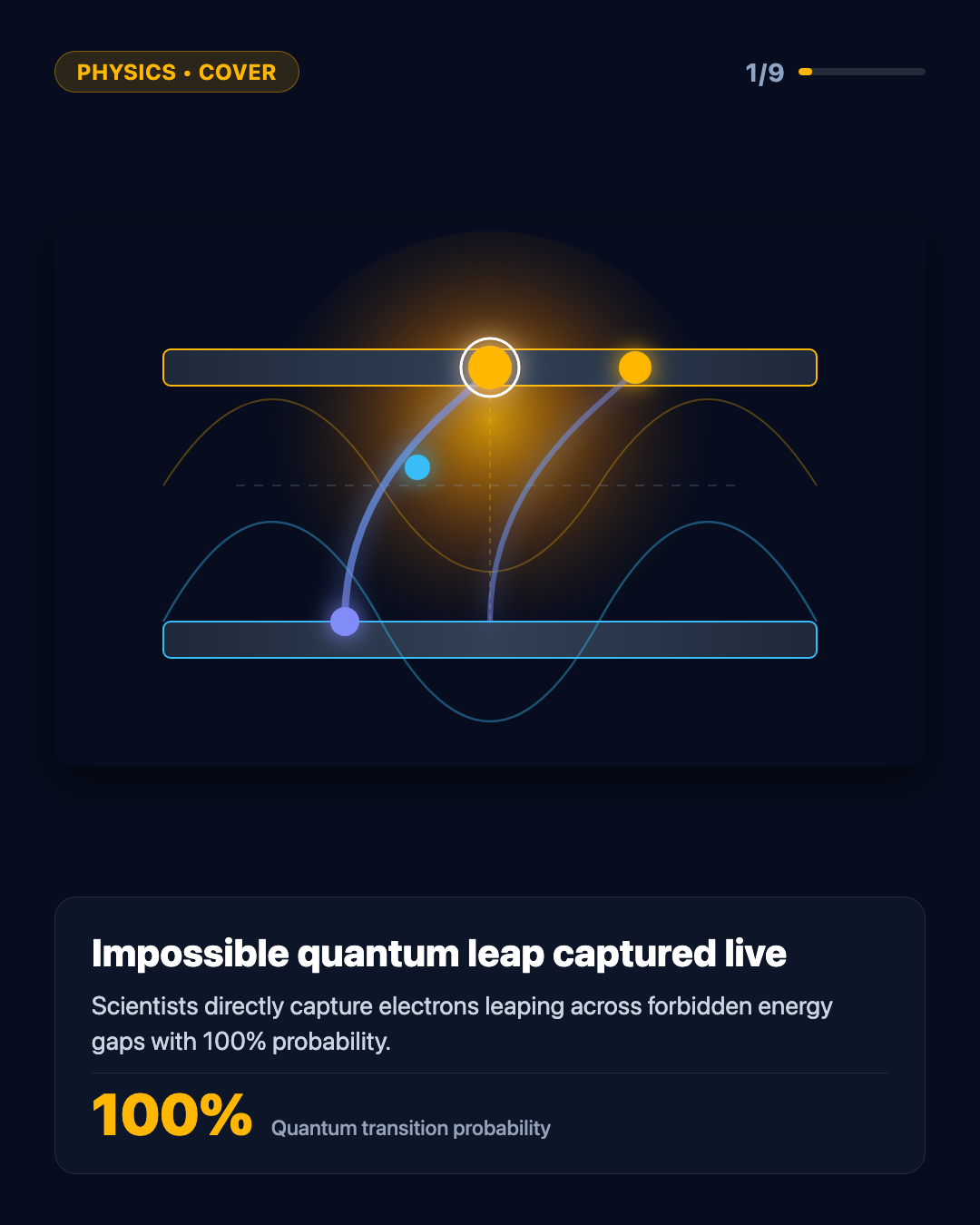
Scientists capture electrons making seemingly impossible quantum jumps
5 ngày trước
00SCIENTISTS CAPTURE ELECTRONS MAKING SEEMINGLY IMPOSSIBLE QUANTUM JUMPS
Imagine stepping into an elevator on the ground floor of a high-rise building. You press a button, and in the blink of an eye, the doors open directly on the twentieth floor without traveling through the nineteen levels in between. In everyday life, such a leap sounds impossible. Yet in the microscopic realm of subatomic particles, electrons have just been caught performing exactly that kind of extraordinary jump.
On November 13, 2026, in the scientific journal Nature, an international team of researchers from the University of Regensburg, Philipps-Universität Marburg, and Forschungszentrum Jülich in Germany announced that they directly recorded Landau–Zener–Majorana transitions in graphene in real time. By uniting ultrafast laser technology with momentum-resolved electron microscopy, the physicists tracked electrons leaping across a forbidden energy gap with a flawless 100 percent transition probability.
WHAT WAS THE ORIGINAL PROBLEM?
In solid materials like metals and semiconductors, the movement of electrons is governed by distinct energy bands. Think of these bands as floors in an apartment complex where electrons are allowed to live and travel. Between these permissible bands lies a vast empty space with no floor beneath it, known to physicists as a forbidden energy gap. Normally, an electron cannot linger or exist in this gap.
To move from a lower floor to an upper floor, an electron typically requires a sufficiently large boost of energy to climb the stairs, or it must rely on familiar quantum tunneling by burrowing a path through a physical spatial barrier. However, back in 1932, three pioneering physicists—Lev Landau, Clarence Zener, and Ettore Majorana—proposed a bold concept: if an intense electric field accelerates electrons with breathtaking speed, they can leap directly across the forbidden energy gap into the excited state without crossing intermediate physical space. For nearly a century, scientists understood this phenomenon only through equations on paper, never once witnessing it unfold directly inside a solid.
Note – Forbidden energy gap: The energetic divide between allowable energy states in a material, like an empty vertical void between building floors where particles cannot stably settle.
Note – Landau–Zener–Majorana transitions: A fundamental quantum process where particles switch energy states when rapidly driven past an avoided crossing, much like a speeding car hugging a banked turn without sliding off track.
WHAT HAS CHANGED COMPARED TO PREVIOUS UNDERSTANDING?
Previously, physicists believed that directly tracking electrons leaping across energy bands in a solid material was practically impossible because the entire process unfolds on femtosecond timescales (one quadrillionth of a second) and atomic spatial scales. Furthermore, theoretical models suggested that even under intense electric fields, only a modest fraction of electrons would make the leap, while most would suffer chaotic scattering or reflection.
The new study overturns those assumptions. The research team not only reconstructed the complete trajectory of the moving particles, but experimental data confirmed that when driven rapidly enough by the electric field of light, the transition probability reached an astonishing 100 percent. An entire swarm of electrons surged together from the lower valence band into the upper conduction band without leaving any particles behind.
HOW DID SCIENTISTS PROVE THIS?
To accomplish this feat, the researchers had to solve two formidable technical challenges: preparing a flawless material stage and constructing an ultra-slow-motion camera capable of recording at the universe's ultimate speed limits.
The chosen stage was graphene, an extraordinary sheet of carbon just one atom thick. Manufactured at Forschungszentrum Jülich with atomic-level perfection, the graphene layer was completely stripped of defects and contaminants that could knock electrons off course. In addition, the team used rotated graphene, orienting the carbon lattice so that the avoided energy gap emerged with pristine clarity.
Note – Graphene: An ultra-thin sheet of carbon atoms bonded in a honeycomb lattice just one atom thick, hundreds of thousands of times thinner than human hair yet exceptionally strong and conductive.
For the recording system, the physicists combined two cutting-edge tools: ultra-short infrared laser pulses and a photoemission momentum microscope. The laser pulses delivered an intense electric field that propelled the electrons into motion. Simultaneously, the momentum microscope acted like a panoramic camera: rather than snapping a conventional surface picture, it mapped the exact momentum and energy of all electrons at once. This allowed the team to capture motion snapshots within a fraction of a single optical wave cycle.
Note – Photoemission momentum microscope: An advanced instrument that uses light to eject electrons and measures their emission angles and velocities, creating comprehensive maps of electron energy and movement.
WHAT DOES THIS MEAN FOR HUMANITY?
This breakthrough expands foundational human knowledge by experimentally validating a core quantum mechanics prediction after 94 years of anticipation. It demonstrates that humanity can use the electromagnetic oscillations of light to steer subatomic particles with absolute quantum precision.
The field standing to benefit most profoundly is future semiconductor technology, specifically lightwave electronics. In today's computer microchips, data is switched using electric voltages at frequencies bounded by the gigahertz regime (billions of operations per second). If the high-frequency electric field of light waves can directly switch electrons across energy gaps, computational speeds could theoretically reach the petahertz scale—thousands to millions of times faster than modern silicon microprocessors.
Note – Lightwave electronics: An emerging computational paradigm that uses the ultra-rapid electric field oscillations of light instead of traditional voltages to direct electrons, potentially achieving petahertz processing speeds.
Nevertheless, the road from a physics laboratory to everyday consumer devices remains long, likely requiring many years or decades of sustained engineering. The experimental data also revealed an important physical constraint: shortly after the flawless 100 percent jump, the orderly flow of electrons is disrupted by lattice scattering. Electrons collide with thermal vibrations in the carbon lattice, gradually dissipating their synchronized motion.
Note – Lattice scattering: The process where moving electrons collide with vibrating atoms within a material's crystal lattice, akin to a vehicle hitting road bumps and gradually losing its smooth forward trajectory.
The next step for the research consortium is applying this subcycle videography technique to other complex quantum systems, including topological insulators and superconductors. By learning how to mitigate lattice scattering and sustain electron coherence, scientists are laying the essential groundwork for tomorrow's optoelectronic era.
SOURCES
Nature – Subcycle videography of Landau–Zener–Majorana transitions in graphene – https://doi.org/10.1038/s41586-026-11214-y
Forschungszentrum Jülich – Scientists capture electrons making seemingly impossible quantum jumps – https://www.fz-juelich.de/en/news/archive/press-releases/2026/quantum-jumps-graphene
ScienceDaily – Scientists capture electrons making seemingly impossible quantum jumps – https://www.sciencedaily.com/releases/2026/11/261112025523.htm
0 comments
Ads
Related Posts
Ads